

Replacing Diesel Gen with Solar-Battery Saves 49% in Energy Costs and Unlocks Immediate Shareholder Value
An Electron Intelligence Perspective on Energy Transition in Hospitality in Nigeria
Executive Summary:
- A 49% Collapse in Total Cost of Ownership (TCO): Transitioning a standard 100-key Lagos hotel from 24/7 diesel generation to a fully integrated Solar PV and Battery Energy Storage System (BESS) cuts 7-year lifetime energy costs from $3.17 million to $1.61 million. This drives a 25% reduction in the Levelised Cost of Energy (LCOE) from $0.28/kWh to $0.21/kWh.
- Defeating the “Diesel Penalty”: While energy consumes a tightly managed 5% to 8% of OPEX in advanced economies, off-grid diesel reliance pushes this to 15%–40% for Nigerian operators. Transitioning to a hybrid microgrid fundamentally restructures the P&L, trading hyper-volatile variable fuel costs for a predictable, fixed-cost asset.
- Rapid Cost Recovery & Risk Asymmetry: Despite a higher upfront capital requirement, the near-total elimination of daily diesel burn—saving over 2.9 million litres over 7 years—enables full project payback by Year 4. Sensitivity analysis proves the hybrid system remains economically superior even if diesel prices inexplicably plunge by 20% or solar equipment costs spike.
- Immediate EBITDA Expansion & Valuation Uplift: The $400,000+ reduction in Year 1 operating expenses flows directly to the bottom line. By structurally expanding Net Operating Income (NOI), asset owners capture immediate cap rate compression, driving a proportional multi-million-dollar increase in overarching property valuation.
- Zero-CAPEX Deployment Pathways: For hospitality groups unwilling to tie up $1.4M in non-core infrastructure, adopting Energy-as-a-Service (EaaS) or Power Purchase Agreements (PPA) shifts the upfront cost to third-party developers. This allows hotels to capture day-one margin expansion, guarantee 24/7 uptime, and achieve premium ESG certifications with zero initial capital outlay.
Key Model Assumptions
The underlying analysis is based on a robust, 24/7 Total Cost of Ownership (TCO) model for a 100-bed full-service hotel in Lagos, Nigeria, assuming 70% average occupancy.
- Current Diesel Price: $0.97/Litre (₦1,450/L)
- Hotel Daily Load: 4,410 kWh
- Peak Power Demand: 275.6 kW
- Diesel Generator LCOE: $0.28/kWh
- Solar+BESS LCOE: $0.21/kWh
- System Sizing: 1,600 kWp PV / 450 kW BESS (10-hour autonomy)
- Discount Rate (Real): 12%
Analyst Note: Sizing parameters assume an aggressive standalone design meant to completely offset a 450-kW diesel generator’s output without grid reliance. This stress-tests the maximum capital burden of a renewable microgrid against prevailing local diesel retail prices, capturing peak daytime loads and substantial overnight base loads (HVAC, refrigeration, common area lighting).
Explore the Data Behind the Insights
The underlying financial model driving this analysis is available for public use.
DOWNLOAD THE FREE EXCEL MODEL
The Energy Imperative: Powering the Lagos Hospitality Sector
The hospitality sector in West Africa operates in an infrastructure paradox: delivering world-class, uninterrupted guest experiences atop a deeply fragmented power grid. In Lagos, grid unreliability dictates that full-service and luxury hotels must act as their own independent utility providers. For decades, the default mechanism for ensuring 24/7 uptime has been the deployment of oversized diesel generator sets (gensets).
Because of this structural deficit, energy is universally the largest or second-largest operating cost for hotels in Nigera. In advanced countries, energy typically accounts for a tightly managed 5% to 8% of total operating expenses (OPEX). In Nigeria, however, that figure aggressively scales: it routinely hits 3x the advanced country average (15% to 24%) for the best-run, large-scale upscale hotels, and up to 5x (25% to 40%) for the vast majority of the country’s hotels.
To anchor this with a large-scale example, tracking Transcorp Hotels’ financial reports from 2013 through 2025 illustrates a relentless escalation in absolute energy spend. By 2024, the hospitality giant saw its annual energy costs surge by nearly 96% year-over-year to ₦4.76 billion, about 16.4% of its total operating expenses; and further breached the ₦5.0 billion mark in 2025 (accounting for 12.6% of a significantly expanded OPEX). If a highly optimised, flagship institutional property bears an energy burden mathematically triple the global standard, the unit economics for smaller operators are exceptionally fragile.
The model accounts for a calculated average load of 183.75 kW, scaling to a daily consumption of 4,410 kWh. A typical 100-key facility requires over 2.9 million litres of diesel across a 7-year timeframe.
The Diesel Trap: Volatility, Margin Erosion, and Hidden Costs
The economic viability of running a commercial property primarily on diesel has definitively fractured. Historically subsidized, diesel retail prices in Nigeria have undergone severe corrections. The 2025 base average anchors at ₦1,450/L ($0.97/L), largely driven by subsidy removals and currency adjustments.
However, the pump price is only the visible edge of the cost structure. The true “diesel trap” is compounded by a matrix of operational and structural inefficiencies:
- Macro-Escalation Risk: Fuel prices are hyper-sensitive to foreign exchange (FX) rates and policy signals. Recent federal policy adjustments signal a long-term real escalation rate of 3% annually above inflation.
- Opex Hemorrhaging: At a specific fuel consumption (SFC) rate of 0.26 L/kWh, a 100-key hotel burns over $404,000 in fuel in Year 1 alone.
- Routine Maintenance: Gensets require rigorous, continuous maintenance. Routine servicing, oil changes, and filter replacements cost approximately 7% of the equipment CAPEX annually.
- The Grid Intermittency Constraint: While grid integration is theoretically cheaper, the frequency of voltage sags, brownouts, and total collapses prevents grid power from serving as a primary, reliable baseline.
Solar-Battery Hybrids Slash Levelised Cost of Energy by 24%
The CAPEX vs. OPEX Trade-off
Deploying a robust hybrid system, featuring 1,600 kWp of solar capacity and a 450 kW battery inverter with 10 hours of storage autonomy, requires a substantial upfront equity injection of $1.46 million. Conversely, a new 450 kW diesel generator costs merely $48,000 upfront.
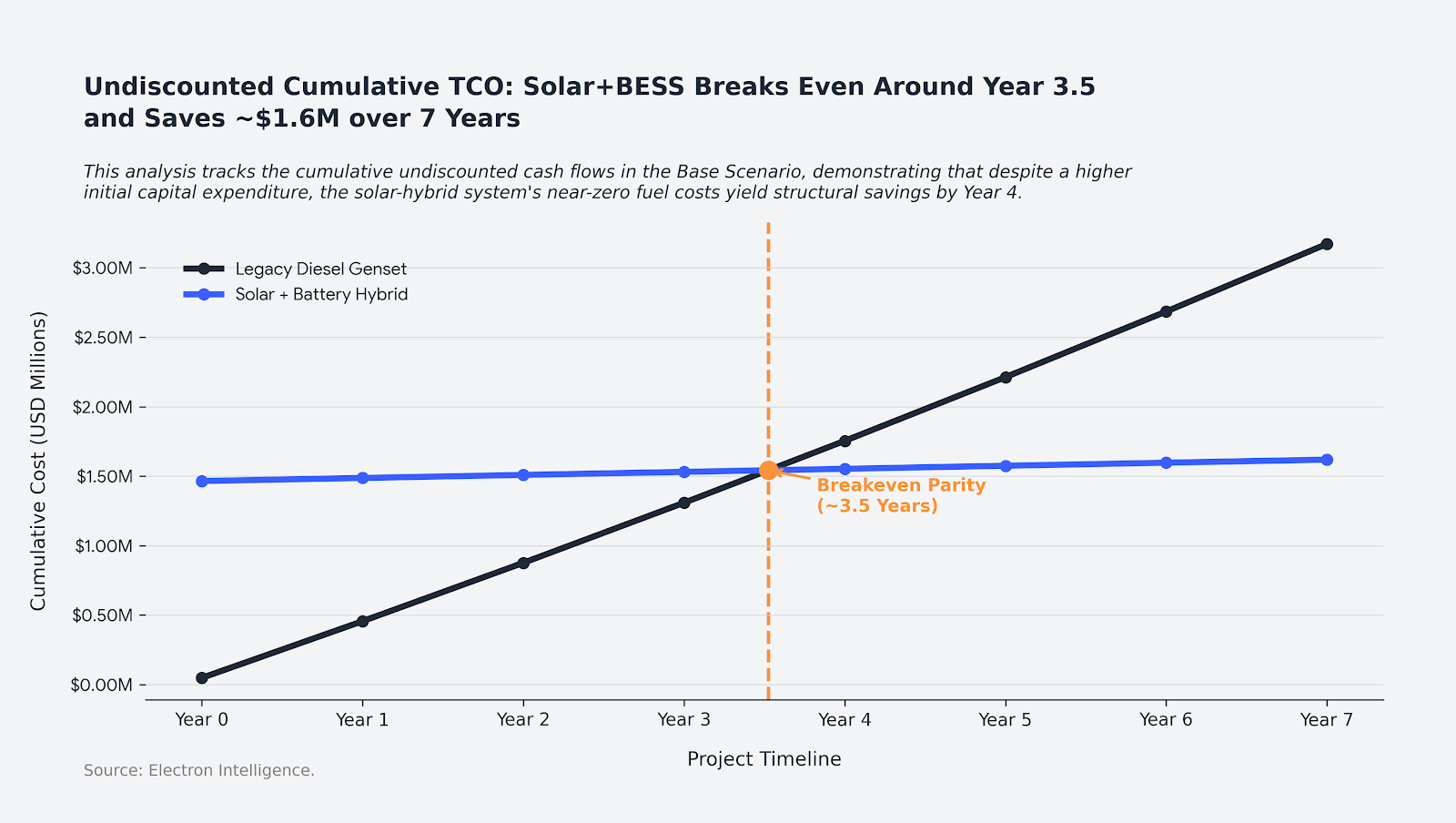
However, the cost curves intersect violently in the near term. The Solar+BESS model limits annual OPEX to minimal operations and maintenance (O&M) and lifecycle replacements, totaling roughly $22,000 annually. Diesel OPEX starts above $407,000 and escalates every year. Over a 7-year project life, the undiscounted cumulative cost of the diesel system reaches $3.17 million, whereas the solar and battery system caps out at $1.61 million.
Levelised Cost of Energy (LCOE) Parity
Normalising these cash flows utilising a 12% real discount rate demonstrates the unit-cost efficiency of the hybrid model. The NPV of total lifetime costs for diesel is $2.05 million, compared to $1.56 million for the Solar+BESS configuration.
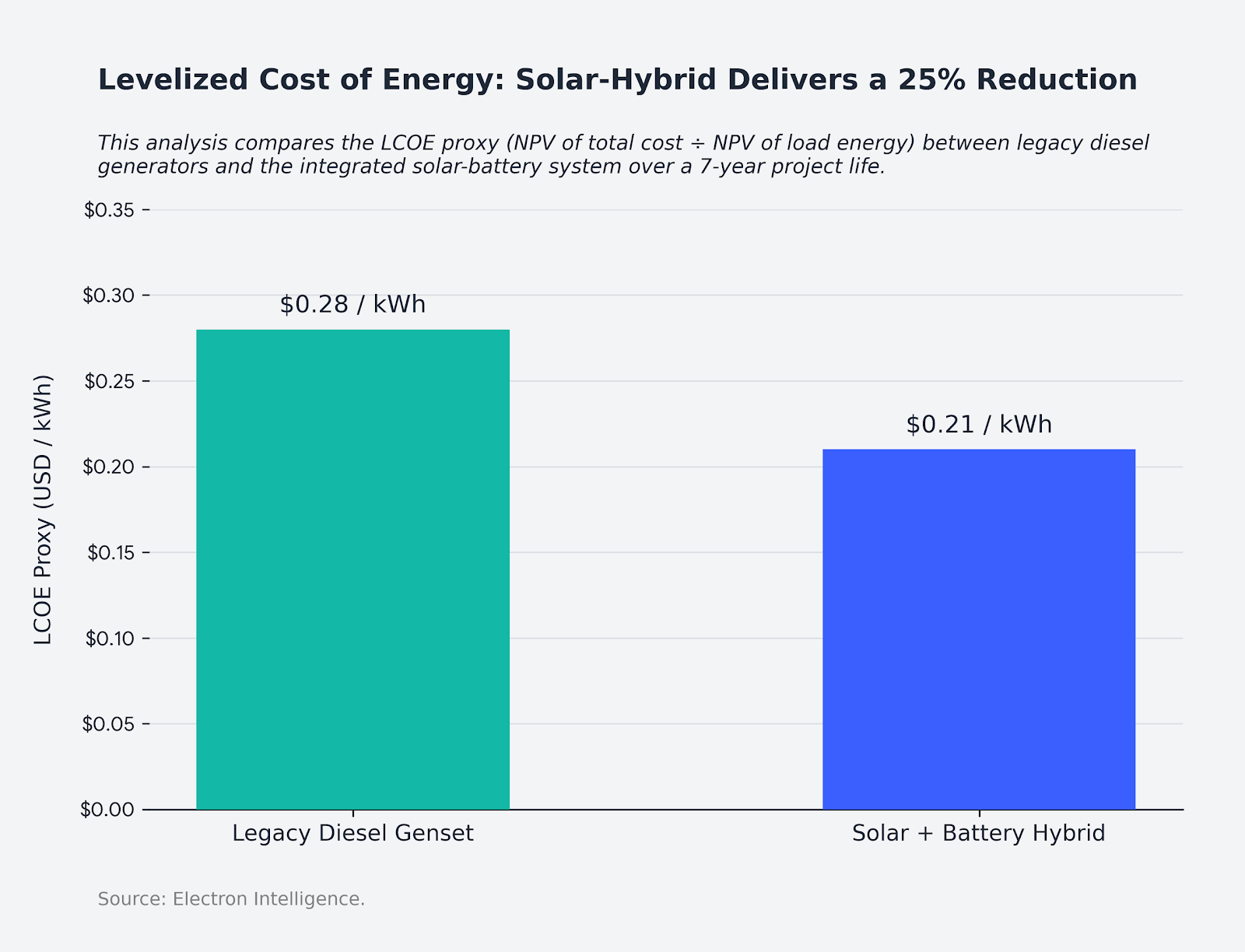
When divided by the net present value of the load energy delivered, the resulting LCOE tells the definitive story: Diesel LCOE is $0.280 / kWh, whereas Solar+BESS LCOE is $0.213 / kWh.
Reliability and Resilience
A 10-hour battery autonomy buffer, scaling to roughly 2,300 kWh of usable capacity, fundamentally changes the property’s operational risk profile. Sized against peak output, the BESS covers evening and overnight demand seamlessly. It eliminates the transient voltage dips associated with genset start-ups, protecting sensitive hospitality equipment (HVAC compressors, elevators, IT infrastructure) and guaranteeing silent, vibration-free night operations, which are premium tangible benefits for guest experience.
Benchmarking the Hybrid Advantage Across African Markets
The calculated reduction in LCOE and absolute cost is completely aligned with broader macroeconomic and energy transition literature across Sub-Saharan Africa. Studies assessing commercial and industrial (C&I) energy transitions indicate that substituting diesel baselines with high-yield solar PV configurations in Nigeria generates typical operational savings of 65% to 80% over a 10- to 20-year horizon. Our model’s 7-year analysis, returning roughly 50% savings, represents an aggressively conservative, highly compressed timeframe that still validates the underlying thesis.
The model assumes 35 kWh/room-night for occupied rooms (with an 80% non-room common area multiplier). This precisely tracks with empirical evaluations of 3-to-4-star full-service hotels in West Africa running heavy split-unit or centralized chilled-water HVAC systems. At 4,410 kWh daily, the scale of consumption makes the unit-cost reduction of $0.067/kWh massive in absolute dollar terms.
The financial logic modeled for Lagos mirrors the exact “green premium” transition currently accelerating in hubs like Nairobi and Cape Town. In South Africa, mitigating load-shedding via extensive commercial BESS deployment has already proven that self-generation stabilizes property yields, allowing “green hotels” to command premium valuations and higher Average Daily Rates (ADR).
Stress-Testing the Economics: Resilience Against Macro Shocks
The validity of a corporate transition strategy lies in its resilience to downside scenarios. Sensitivity analysis confirms that the Solar+BESS solution maintains its economic superiority even against aggressive market shocks.
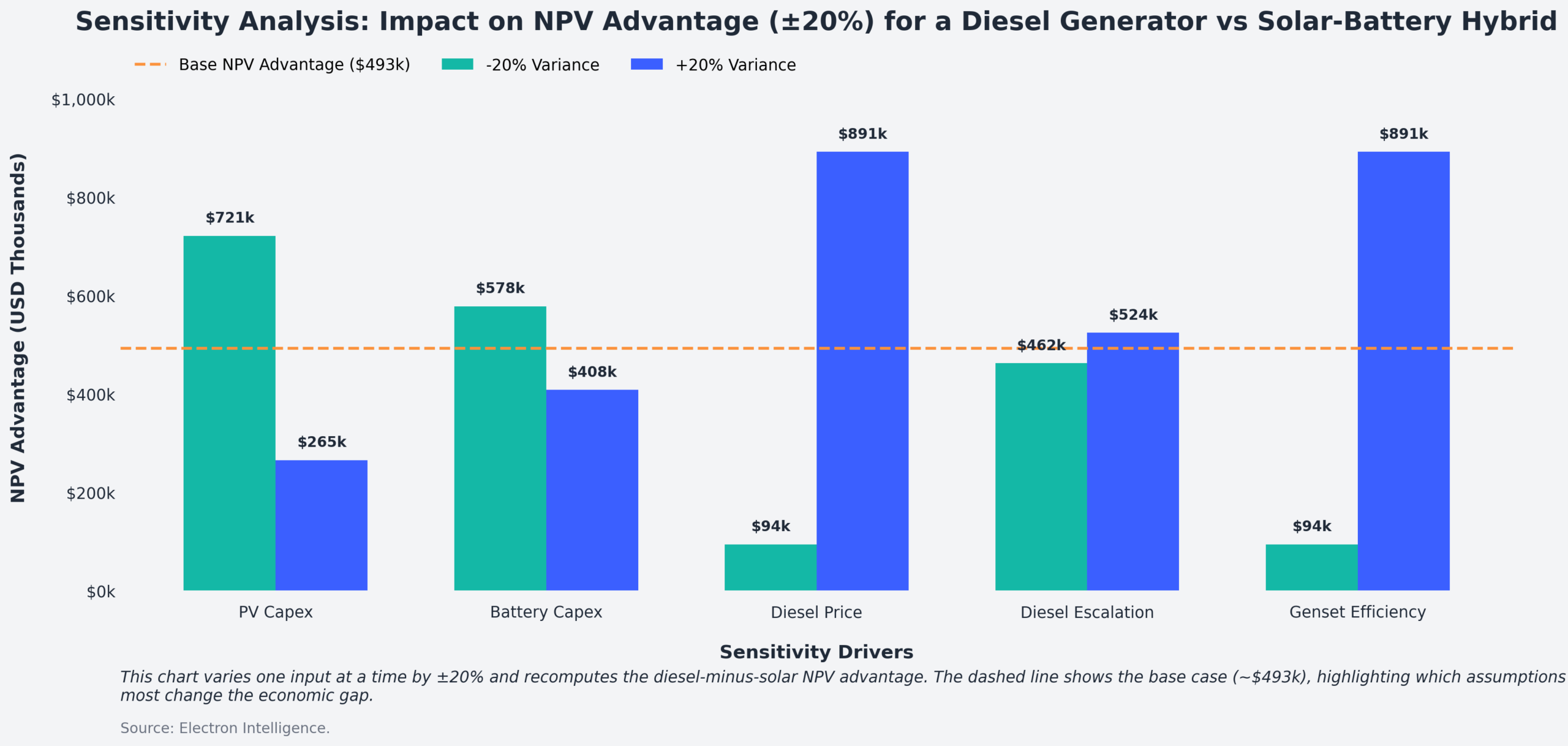
Even if structural reforms fail and diesel prices crash by 20% to roughly $0.77/L, the hybrid system still outperforms diesel. The NPV advantage shrinks, but Solar remains $93,730 cheaper over the 7-year lifespan. Conversely, if supply chain bottlenecks or FX depreciation spike diesel costs by an additional 20%, the solar advantage hyper-accelerates, driving the NPV difference to $891,462.
Should supply chain friction push the upfront cost of PV panels or battery packs up by 20%, the project does not break. A 20% PV CAPEX spike still yields a $264,659 net positive advantage for the hybrid system over diesel. A 20% BESS cost increase yields a $407,520 advantage. In every modeled permutation, the hybrid system mathematically defeats continuous diesel generation.
Beyond Energy: Valuation, ESG, and Operational Alpha
The implications of this data extend far beyond the facility management office; they are central to boardroom strategy, asset valuation, and brand equity.
Financial Realities and Asset Valuation: The $400,000+ reduction in annual Year 1 OPEX flows directly to the property’s bottom line. In commercial real estate, net operating income (NOI) directly dictates asset valuation. Applying a standard capitalization rate (cap rate) to this expanded EBITDA means that deploying a $1.46M solar asset disproportionately inflates the overarching value of the hotel property by millions of dollars upon project commissioning.
Brand Equity and Corporate Mandates: International leisure travellers and corporate accounts are increasingly enforcing stringent ESG requirements. By eradicating the carbon intensity of a 450 kW diesel engine burning 1,146 litres daily, the property instantly qualifies for premier green building certifications (e.g., EDGE, LEED), expanding its Total Addressable Market (TAM).
Implementation Mitigation – Overcoming the CAPEX Hurdle: The primary friction point is the Year 0 capital requirement. While the ROI is definitive, tying up $1.4M in non-core infrastructure is challenging for hospitality groups focused on geographic expansion. The strategic mitigation is the adoption of Energy-as-a-Service (EaaS) or Power Purchase Agreements (PPA). Under these models, third-party developers finance, install, and maintain the solar-battery infrastructure. The hotel commits only to purchasing the generated power at a fixed, discounted rate compared to diesel.
Conclusion
The arithmetic of energy generation in African hospitality has fundamentally inverted. Operating a commercial hotel in Lagos strictly on diesel generation is a strategy of capital destruction. The data conclusively demonstrates that transitioning to a fully scaled Solar PV and Battery Energy Storage System delivers an unlevered 12% real return, slashes levelized energy costs by 25%, and insulates the asset from volatile fossil fuel markets.
For major hospitality groups, energy transition is no longer a question of technological feasibility; it is a straightforward capital allocation decision. Those who move rapidly to hybrid architectures will capture significant operational alpha, permanently expanding their margins while their localised competitors continue to burn their profits at the pump.
Explore the Data Behind the Insights
The underlying financial model driving this analysis is available for public use.
DOWNLOAD THE FREE EXCEL MODEL