

Africa is in the middle of a battery storage boom. Egypt’s Kom Ombo plant is pairing 500 megawatts of solar with 300 MWh of storage. Rwanda’s Bugesera airport project is structuring commercial power contracts around battery-backed supply. ESMAP has catalysed over $725 million in storage investments across five African markets in the last two years alone. The money is flowing, but the assumptions behind it may not hold.
Most of this capital is being deployed on the back of Lithium Iron Phosphate (LFP) cost curves and manufacturer datasheets designed for temperate climates. The battery gets treated as a static capital asset: a box purchased, installed, and expected to perform for a decade. But in Lagos, Accra, Nairobi, and Casablanca, that box is fighting a different war. Ambient temperatures that never relent. Cycling regimes driven by unreliable grids. Field service realities that can leave a failed component unreplaced for weeks. Under persistent African operating stress, the same chemistry becomes a fundamentally different asset.
This article, the first of a two-part series, traces that reality through our Battery Degradation Model. It shows how temperature, cycling intensity, operating depth, and field reliability combine to eat away at active electrochemical capacity over time, and why the gap between nameplate energy and dependable delivered energy is the number that should be keeping project developers up at night.
Executive Summary
- Degradation runs nearly double in African conditions. LFP batteries in a West African operating context face approximately 3.3% annual capacity fade, split equally between calendar and cycle degradation, compared to roughly 1.5–2% in temperate environments. Heat, aggressive cycling, and deeper operating windows all compound the loss.
- Service shortfalls begin as early as Year 2. Our model shows that a Lagos C&I system already falls below its required service level in the second year of operation without augmentation, requiring over 8 MWh of cumulative capacity additions across a 15-year project life to maintain dependable output.
- Warranties are legal documents, not performance guarantees. A 10-year manufacturer warranty can be voided when systems operate outside strict temperature limits or when O&M delays leave batteries sitting in high-heat, high-state-of-charge conditions without active cooling. Remote sites face significant availability gaps where a simple component failure leads to weeks of downtime.
- The “African Premium” is physics, not markup. African operating environments (27–35°C ambient, 330 cycles per year, constrained field support) accelerate side reactions, thicken the solid electrolyte interphase, and steadily reduce the active lithium available for useful work. The same chemistry becomes a fundamentally different asset under persistent stress.
- Chemistry selection is a tactical decision, not just a cost one. LFP’s superior thermal stability materially outperforms NMC in hotter environments (3.3% vs. 5.1% annual fade), but no chemistry is immune. Site-specific electrochemical modelling, not generic datasheets, is essential for closing the gap between nameplate capacity and dependable delivered energy.
The “African Premium” and the Warranty Mirage
Batteries in Africa do not age the way global benchmarks predict. Heat and heavy use combine to accelerate degradation well beyond what temperate-climate models assume. Global battery performance benchmarks are almost universally calculated at a “temperate” reference point of 25°C, making them insufficient as a standalone guide for a utility-scale project in the Northern Cape or a C&I installation in Lagos.
The issue is not that temperate benchmarks are wrong; it is that they are incomplete once batteries are deployed into hotter, more variable, and often less forgiving operating environments.
Tropical Reality vs. Temperate Benchmarks
In Africa, assets are deployed into environments where ambient temperatures frequently sit between 27°C and 35°C. While LFP has emerged as the dominant choice for its thermal stability, a “one-size-fits-all” approach to chemistry selection does not hold up.
The model separates degradation into two channels. Calendar fade is the irreversible loss that accumulates with time and heat exposure, even when the battery is idle. Cycle fade is the wear imposed by active use: charging, discharging, and repeated depth-of-discharge stress. Together, they determine how quickly a specific chemistry loses capacity in a specific environment.
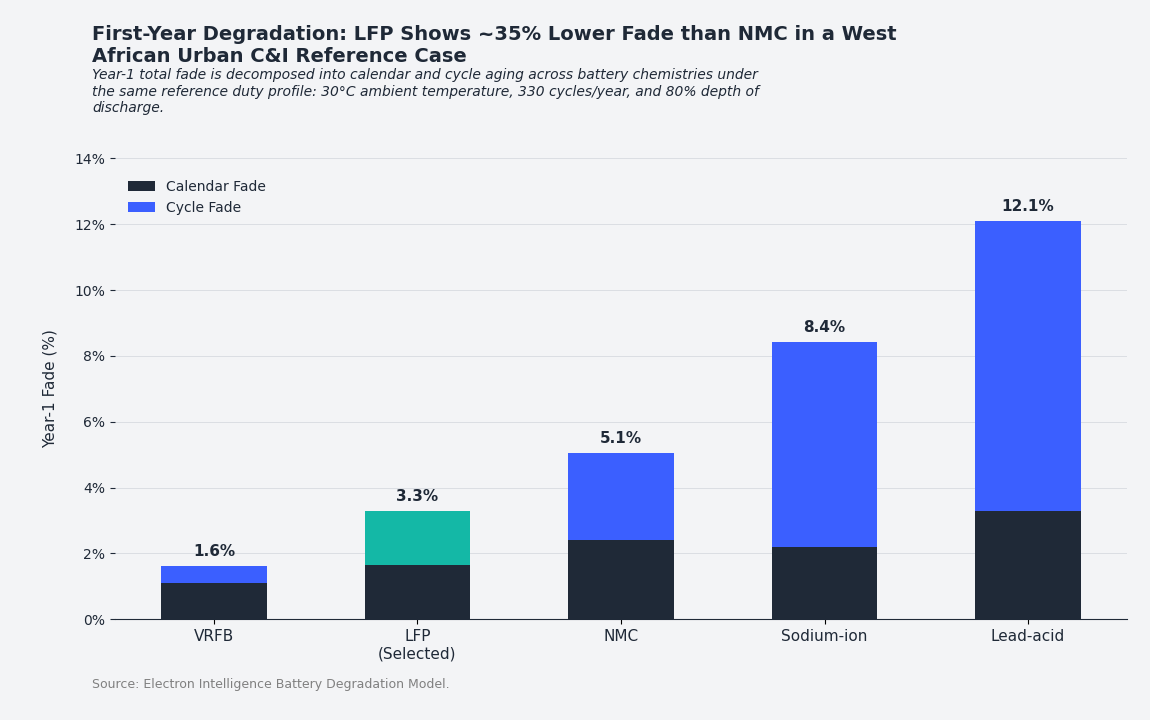
As illustrated above, the model splits aging into calendar fade and cycle fade. Even with LFP’s resilience, a West African context faces a total annual fade of approximately 3.3%, nearly double the rate of temperate environments. Generic datasheets are not enough. Site-specific modelling is what separates a project that performs from one that quietly underdelivers.
The Mechanics of Physical Failure
Battery storage in Africa costs more than the global benchmark suggests. Not because African developers are paying a premium for the same product, but because African operating conditions impose a higher degradation rate on the same chemistry. The heat accelerates calendar aging. The grid instability in many markets forces more frequent cycling. The O&M access constraints reduce availability.
The “African Premium” is not an abstract surcharge. It is the physical consequence of how the cell ages under combined stress. Elevated temperatures accelerate side reactions and thicken the solid electrolyte interphase (a protective film inside the cell that gradually chokes performance). Repeated cycling, especially at deeper operating windows, compounds that wear by steadily reducing the amount of active lithium available for useful work. Over time, the cell’s internal resistance rises, usable capacity falls, and the battery drifts further from its day-one condition.
Contextual Realities and the “O&M Catch-22”
Because operating conditions vary wildly across the continent, the model accounts for four specific archetypes: Urban C&I, Utility-scale, Remote Mini-grid, and Harsh Off-grid. This matters because degradation is not only about what happens inside the cell. It is also about whether the system can be kept within safe operating limits once real-world maintenance and logistics enter the picture.
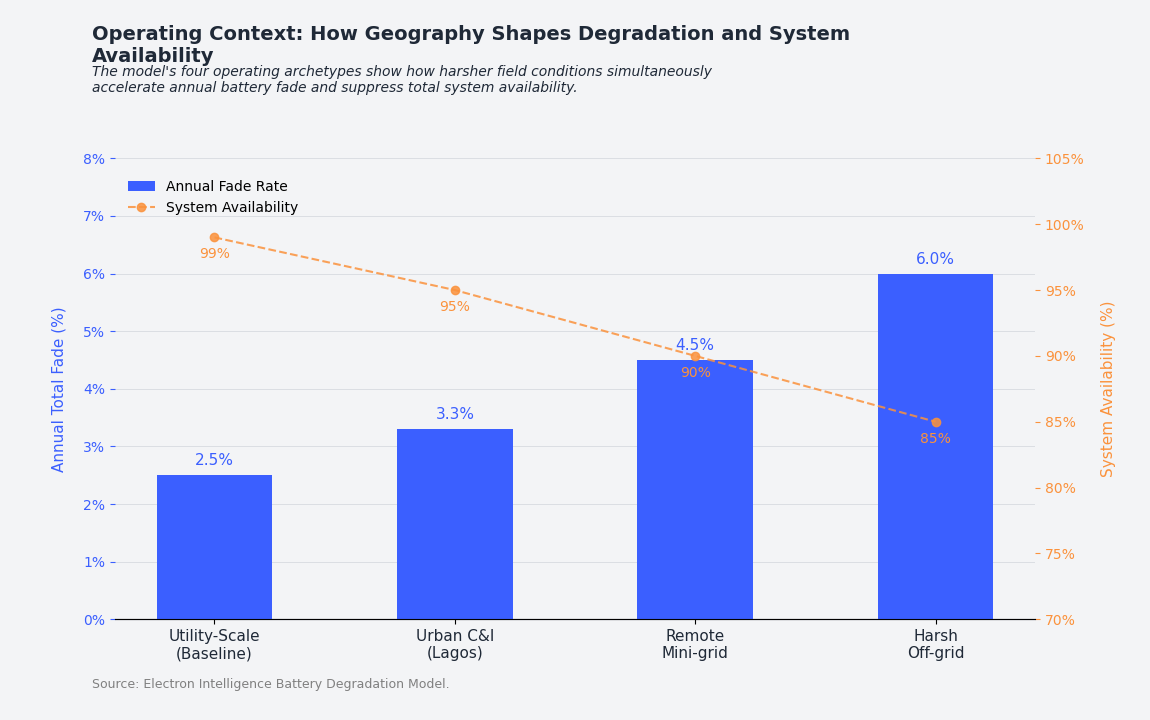
Physical decay alone does not determine field performance. System availability determines how much of the battery’s remaining capacity can actually be counted on when it matters. Remote sites often face a significant availability gap due to mobilization constraints; a simple component failure can lead to weeks of downtime. This creates a “Warranty Mirage”: a 10-year warranty is a defensive legal document, not a performance guarantee.
An LFP battery in a Lagos C&I context ages at a noticeably faster rate than the same chemistry on a well-managed utility site in the Western Cape, not because the cells are different, but because the conditions they operate in are.
Manufacturers often void warranties if systems operate outside strict temperature limits or if O&M delays lead to the battery sitting in a high-heat, high-state-of-charge (SOC) state without active cooling.
Predictive Modelling and Strategic Management
So far, this article has described how batteries degrade faster in African conditions. The next question is practical: when does that degradation start to hurt, and what can a project do about it? The model answers this by projecting year-by-year state of health and flagging the point where usable energy falls below the service level the project was designed to deliver.
The Model’s Predictive Logic
The heart of the model lies in a 15-year state-of-health projection (SOH) that identifies when physical decline begins to constrain dependable system performance.
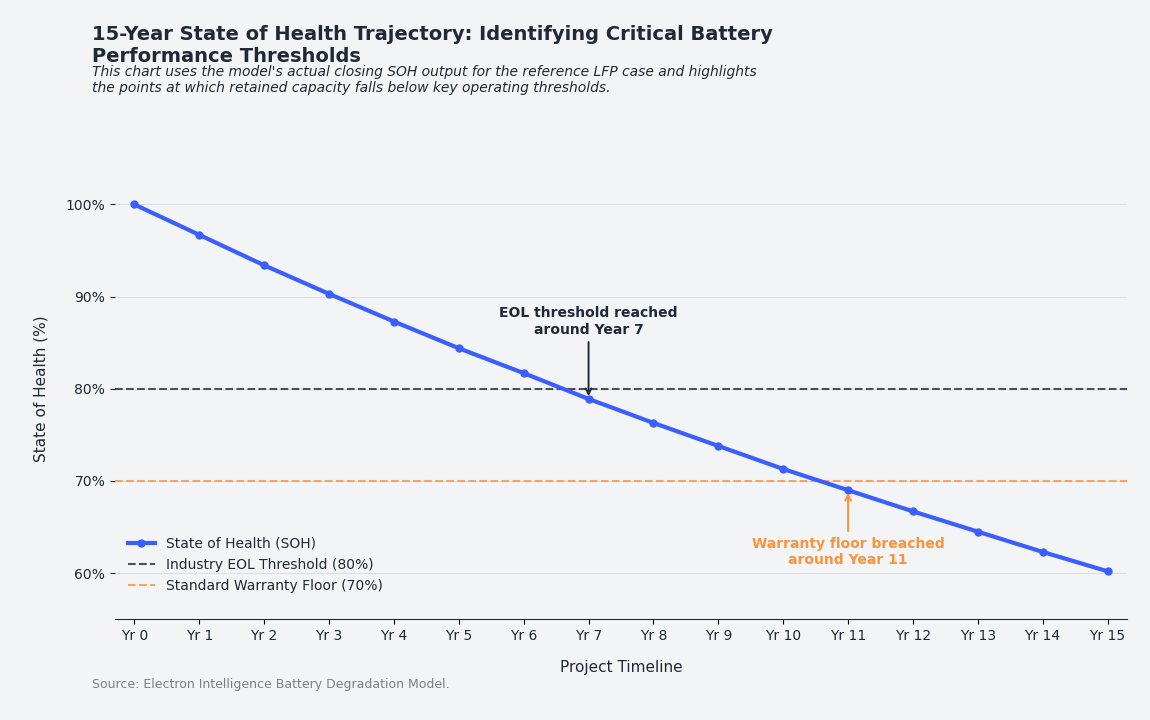
This timeline reveals a critical reality: in a high-heat context such as Lagos, the system can begin its second year already below its original full-service condition. The initial gap is modest, but the direction matters. A battery that starts life as a precisely sized asset does not remain precisely sized for long when ambient heat, cycling intensity, and operating context continuously erode usable capacity. By Year 10, the system in the reference case is already approaching the lower end of its dependable operating range, with the 80% and 70% markers serving as practical thresholds for intervention and reassessment.
Strategic Trade-offs: Augmentation vs. Shortfall
Once the model detects that dependable usable energy has fallen below the service threshold, the battery ceases to be a static installed asset and becomes a managed physical problem.
At that point, the developer or operator faces two options:
- Continuous Augmentation: restoring lost capability by adding new battery modules.
- Accepting the Shortfall: operating with declining service performance as usable capacity erodes.
The second part of the article will explore the economic implications of either choice. For this first article, the important point is simpler: physical degradation does not remain confined to the cell. It eventually forces an operational choice.
Tactical Mitigation through Chemistry
Chemistry selection matters more than most project models assume. The industry’s shift from nickel-rich chemistries toward LFP is not simply a cost story; it is a response to operating reality. In hotter environments with imperfect field conditions, LFP’s superior thermal stability and lower degradation sensitivity make it materially better suited to preserving dependable performance over time. That does not make it immune to stress. It does, however, make it more physically resilient in the contexts that define many African and emerging-market deployments.
The Bottom Line: Reliability as a Geographic Variable
The same battery chemistry can age very differently depending on where it sits: how hot the air is, how hard the grid works it, and how quickly someone shows up when something breaks. Storage performance is not defined by nameplate capacity or warranty language. It is defined by how much usable energy remains available and dependable under actual operating conditions. The real unit of analysis is not the battery at installation, but the battery as it survives the field.