Africa's Power Letter
AFRICA’S POWER MARKET IS EXPANDING
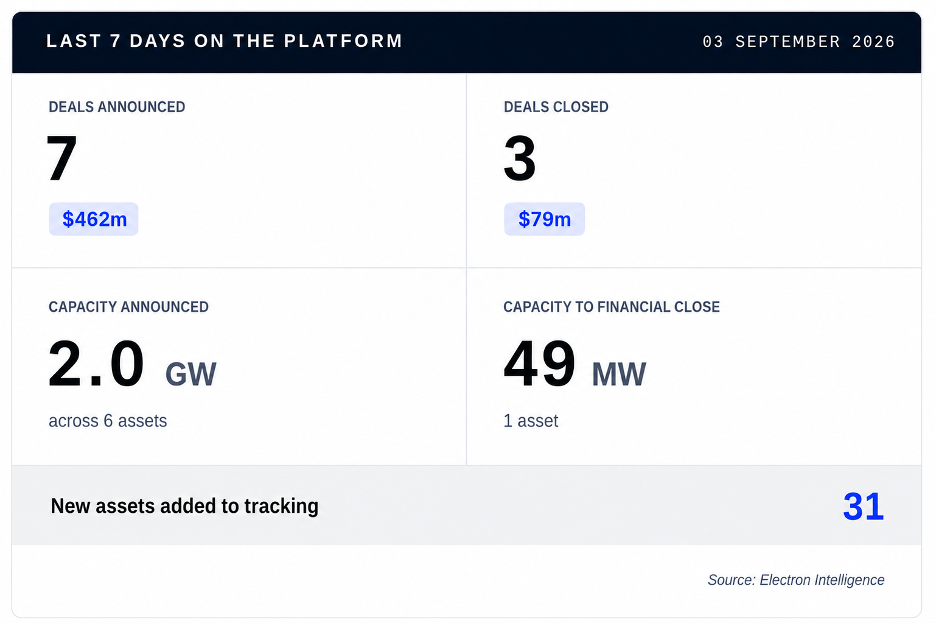
This week gives a useful sense of the market Electron Intelligence was designed to follow. We logged 7 announced deals worth $462 million and 3 transactions at close reaching $79 million. 6 assets totalling 2.0 GW entered the announced pipeline; one 49 MW asset reached financial close. We also added 31 assets to the platform. We’re constantly following the people, projects and capital that turn a growing pipeline into operating electricity systems.
THIS WEEK'S DEEPDIVE
A regional market needs rules that match its ambition
West Africa is pushing an important door open through the WAPP’s (west Africa Power Pool) Day-Ahead Market. A functioning regional market can give generators more buyers and power systems more options. Payment discipline will decide how far the model travels. Nigeria’s international customers remitted about 96% of invoices in 2022. That figure fell to 75% in 2024 before recovering to 85% in 2025. Unpaid bills have also constrained Côte d’Ivoire’s exports and the projects behind them.
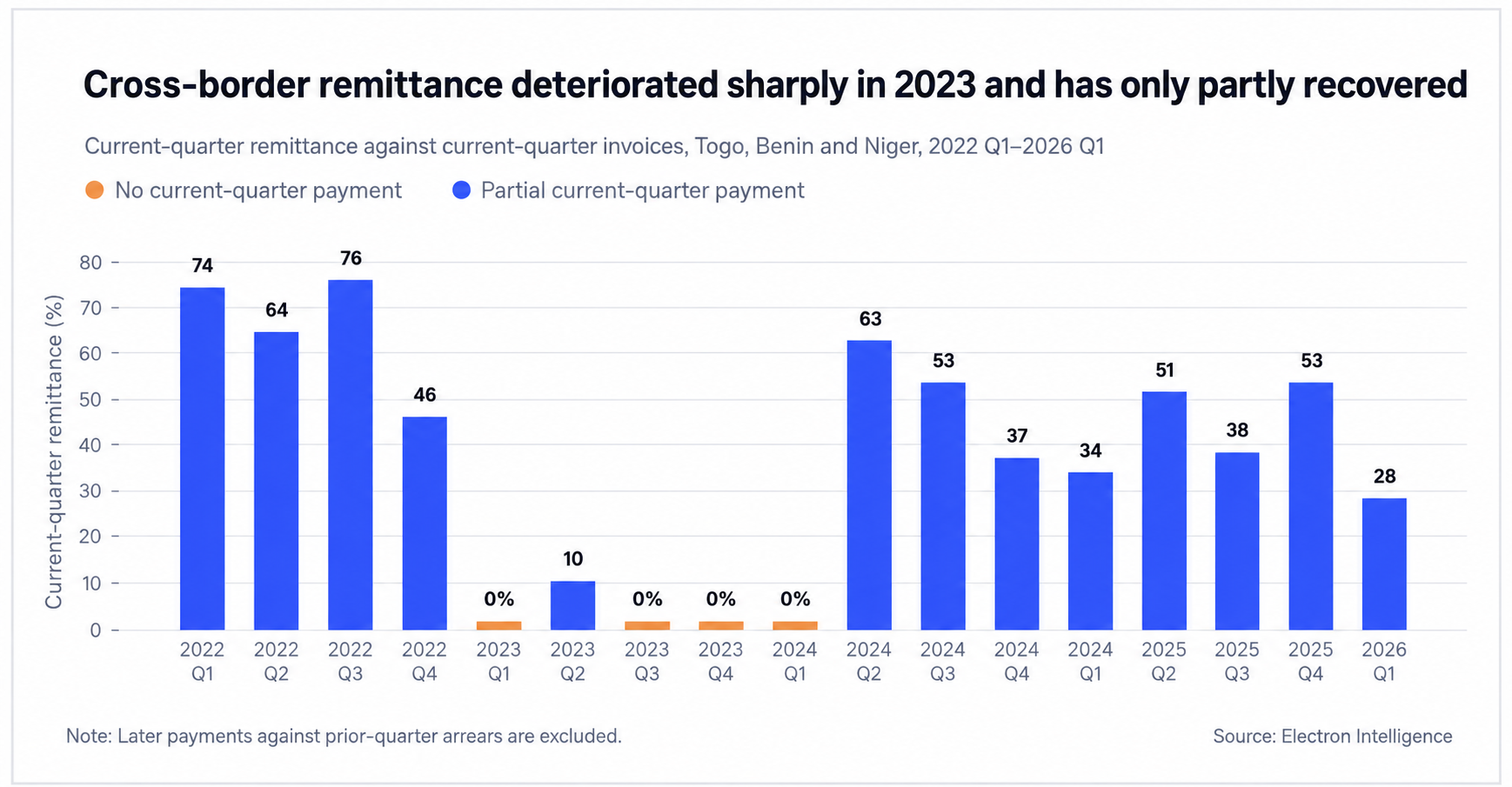
WAPP has named the tools: collateral, credit limits, default controls and a proposed regional revolving fund. Investors now need to see those tools work at market speed. We see an investable market taking shape, one that needs transparent rules and durable payment mechanisms. EI will keep tracking the route from market design to traded power, because that is where regional ambition becomes an operating asset class.
CHART OF THE WEEK: CAPITAL AT SCALE
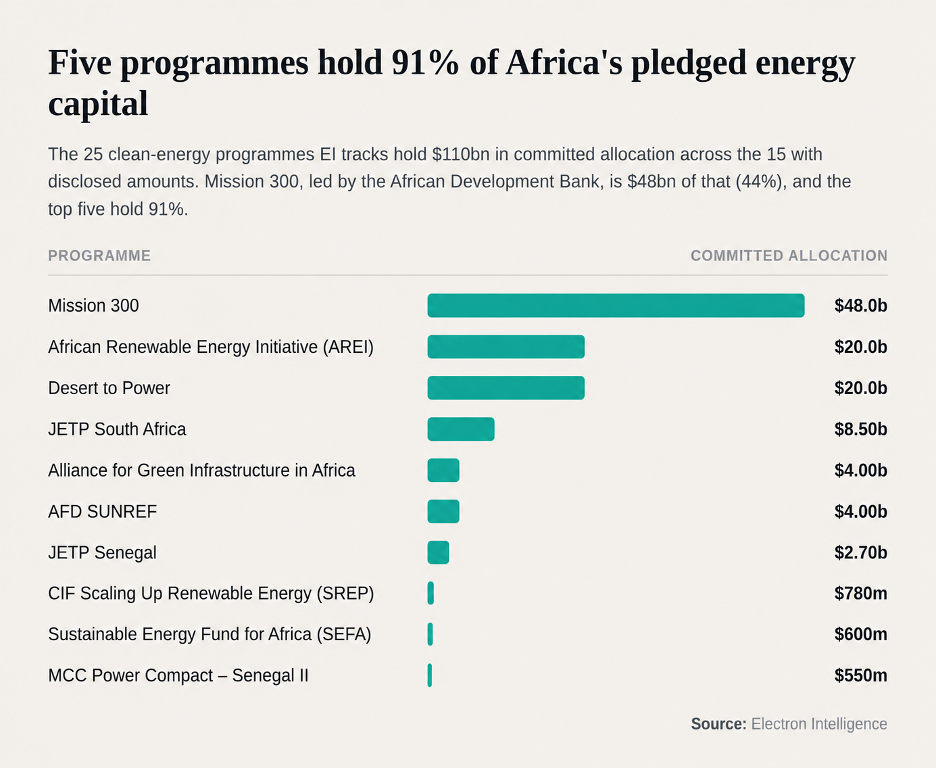
Africa’s clean energy funding is heavily concentrated among a small number of major programmes. Mission 300 leads with $48 billion, or 44% of the $110 billion in committed allocations we track. A few vehicles now carry enough capital to change the pace of project development across the continent.
The five largest programmes account for 91% of the total. AREI and Desert to Power each stand at $20 billion after Mission 300. The work now sits inside those commitments: which markets attract the capital, which projects secure it, and which assets get built. That is the order of magnitude EI is committed to making legible.
AFRICAN ENERGY WEEK 2026
Africa’s power market grows through projects, capital and the people who bring them together. African Energy Week returns to Cape Town from 12–16 October, convening governments, utilities, financiers and developers from across the continent. Secure your African Energy Week 2026 delegate pass
EI RESEARCH DESK
Gulf capital is taking a bigger position in Africa’s power sector.
Masdar’s 1 GW wind commitment on the Gulf of Suez shows the appetite for large greenfield projects. Abu Dhabi’s ePointZero is moving further along the same curve: it has agreed to acquire 90% of Azura Power, an operating platform with 752 MW across Nigeria, Senegal and Mozambique, plus more than 1.5 GW of development across gas, renewables and battery storage.
These are different transactions, but they point in the same direction. Gulf investors are pairing large new-build commitments with ownership of operating power platforms that have contracted revenues, local teams and room to expand. That gives them a longer role in the market, from construction through to operations and the next development cycle. EI will watch whether other Gulf investors follow ePointZero into platform acquisitions, especially in markets where established PPAs sit alongside credible expansion pipelines.
RESEARCH RADAR
Projects and policy choices that will shape the next phase of growth.
Central African Republic: Sakai puts meaningful capacity on the grid. UAE-based Global South Utilities completed the 50 MW Sakai solar plant, with 15 MWh of storage, in ten months. The asset could serve more than 300,000 households and lift national capacity by about 60%. Sakai shows how a single well-executed project can widen access at speed. Read here
Ghana: Bui is building a stronger hydro-solar system. The Bui Power Authority is building 300 MWp of solar alongside batteries, with 100 MWp targeted this year. Solar generation can conserve water in the Bui dam for evening demand and dry periods. The programme points to a practical response to drought risk: use the grid assets already in place more intelligently. Read here
Nigeria: tariff reform would change the market’s economics. NERC’s 2025 report places the cost of Nigeria’s electricity subsidy at $1.45 billion (₦1.93 trillion). Tariffs recover about 39% of supply costs. End-user tariffs sit at roughly $0.08 per kWh against an African average of $0.19. The government has signalled subsidy removal by 2027. A credible reform path would create a healthier base for generation, distribution and investment. EI will track the policy signals, tariff changes and investment response as that path develops. Read here
ACCESS THE FULL PLATFORM
Coverage of Africa power and renewables markets. Live deal tracking, asset profiles, electricity pricing index, PPA tracker and contracted energy pricing, and the import tariff & VAT data for African markets.
Request Access