Cross-Subsidy in Nigeria's Electricity Market: Where It Works, and Where Government Pays Instead
On August 10 2026, NERC (the Nigerian Electricity Regulatory Commission) dissolved KAEDC’s board. The regulator two reasons: insufficient assets relative to liabilities, meaning KAEDC owed more than it had available to pay, and an inability to present a credible pathway to sustainable recovery, meaning the company could not show regulators a realistic plan to close that gap on its own.
Nigeria's electricity tariff system relies on premium-paying Band A customers to subsidize cheaper power for Bands B through E. Across the country's Distribution Companies (DisCos), that premium rarely covers the gap. Government subsidy fills most of it instead because premium customers cover far less than the tariff design assumes. Kaduna Electricity Distribution Company (KAEDC) sat at the weak end of that trend. It paid just 41.93% of its adjusted market invoices in 2025. KAEDC's cumulative market obligations stood at $335.2 million (₦456.5 billion) as of May 2026, made up of $305.1 million (₦415.5 billion) owed to the Nigerian Bulk Electricity Trading company (NBET), and $30.1 million (₦41 billion) owed to the Nigerian Independent System Operator (NISO) for transmission and system operation charges.
We carried out this analysis to test whether Nigeria's tariff bands fund themselves the way the cross-subsidy design assumes, or whether government is absorbing more of the gap. We used NBET and NERC market obligation data, DisCo-level billing and collection figures, and the Band A through E tariff schedule to calculate subsidy dependence and cash-realized tariff per kWh for each of Nigeria's eleven DisCos. Kaduna's board dissolution gave us a real-world case to check the pattern against.
Executive Summary
- Only two of Nigeria's eleven electricity DisCos keep their government subsidy dependence below 53%: Eko and Ikeja, both based in Lagos, sit at 51.5% and 52.3%. The other nine range from 53.6% in Abuja to 82.6% in Yola.
- The premium rate that customers pay depends on how many hours of power they receive each day, not on how much they earn. A business with a reliable connection pays the Band A rate regardless of its size or income. A household with a poor connection pays a much lower rate regardless of what it can afford. The tariff system sorts by service quality, not by wealth.
- No DisCo runs on customer-funded cross-subsidy alone. Even in Eko and Ikeja, where subsidy dependence is lowest, government still covers roughly half of the wholesale power bill.
- Weak collection and heavy subsidy dependence compound each other. The DisCos furthest behind on both measures carry the most exposure to the kind of regulatory intervention Nigeria's power sector is now willing to use.
Nigeria's Premium Tariff Exists, but No DisCos’ Revenue Depends on It
Nigeria's premium electricity customers pay $0.154/kWh (₦209.50/kWh). Customers on the cheapest tariff pay $0.024/kWh (₦32.26/kWh), roughly a sixth of that rate. The gap between those two prices is supposed to be covered by the premium customers themselves: businesses and households with reliable power paying enough extra to keep the tariff low for everyone else.
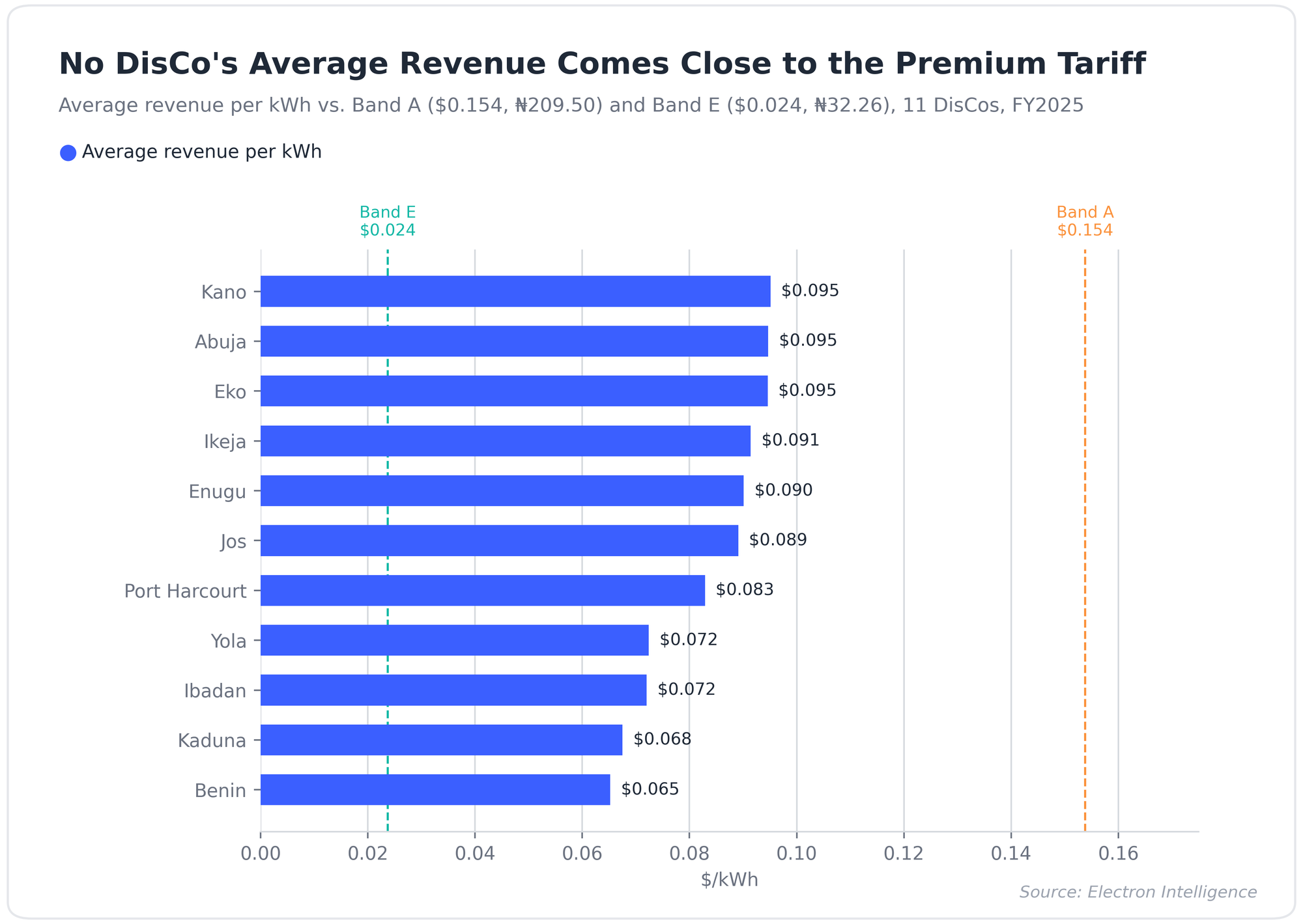
Fig 1: No DisCo's blended tariff reaches even 55% of the way from Band E to Band A.
That gap shows up in what DisCos actually collect. Kano, Abuja, and Eko collect close to $0.095/kWh (₦129/kWh) on average across their full customer base, the highest in the country. Benin, Kaduna, and Ibadan collect under $0.072/kWh (₦98/kWh), the lowest. The difference between the two groups is real, and it tracks a company's mix of well-served, premium-paying customers against poorly-served ones.
But none of it gets close to the premium rate itself. Even Kano, the strongest performer, collects just over half the distance between the cheapest tariff and the premium one. Nigeria's electricity market has a premium tier that pulls revenue upward, but no part of the country runs on that premium tier. Every DisCo still depends overwhelmingly on customers paying well below the cost-reflective rate.
Why almost every DisCo depends more on government than on its own premium customers
Government subsidy dependence across Nigeria's electricity market stood at 18.7 % in 2022. By 2024 it had reached 62.6%. It eased slightly to 57.4% in 2025, but that is still more than three times its 2022 level.
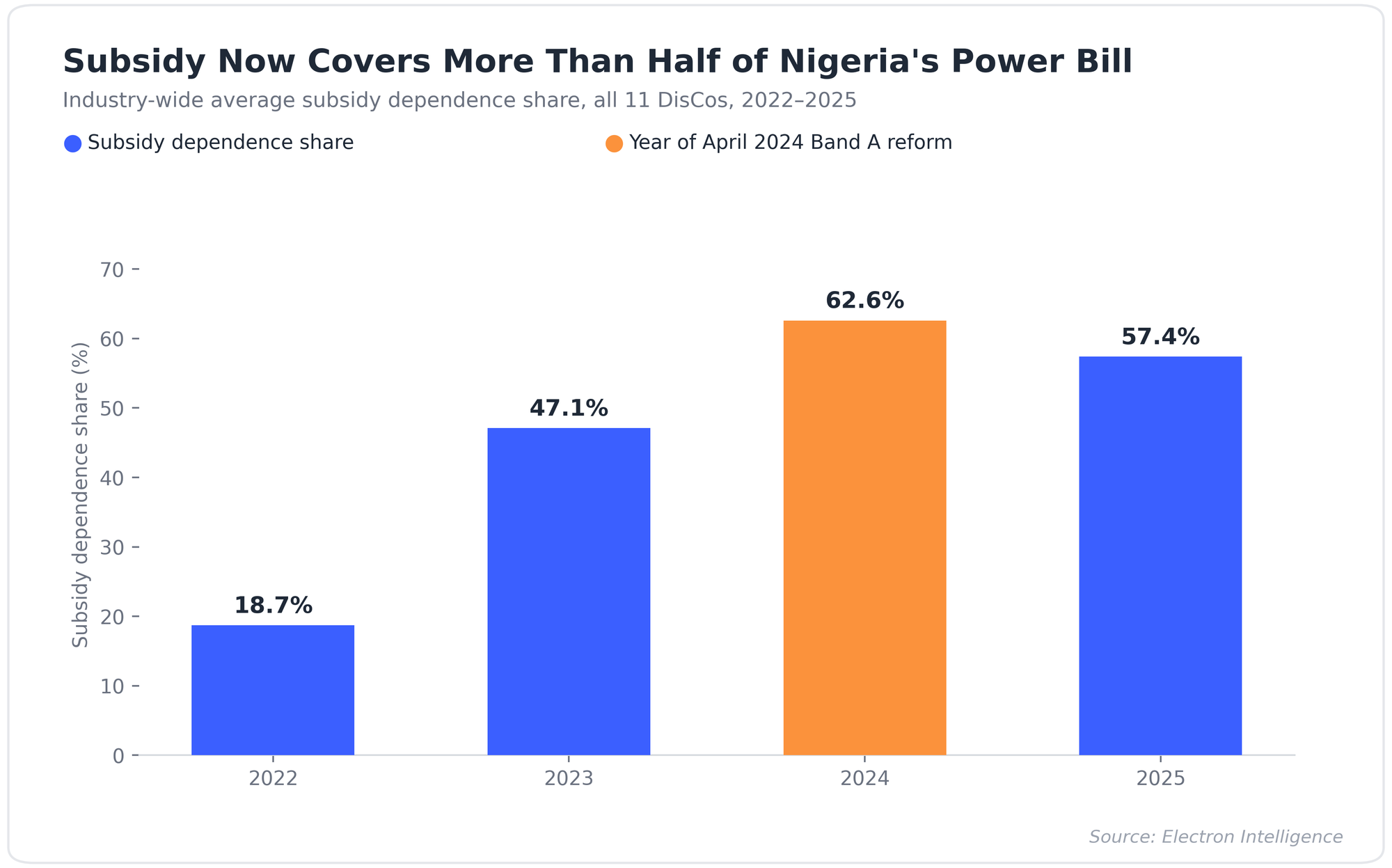
Fig 2: Subsidy dependence rose from 18.7% in 2022 to 62.6% in 2024, then eased to 57.4% in 2025.
That increase tracks a weakening naira, not a decision by government to expand support. The Federal Government's role is to cover the difference between what NBET invoices a DisCo for wholesale power and what that company is actually required to remit. NBET's invoices are tied to dollar-denominated generation and gas costs. When the naira weakens, those invoices rise in naira terms even if nothing changes on the ground, and the Federal Government absorbs the difference rather than letting DisCos pass it on to customers. The market-wide average revenue per kWh rose from $0.040/kWh in 2022 to $0.085/kWh in 2025 (₦54.45/kWh to ₦115.58/kWh), but subsidy dependence rose faster over the same period, which means the tariff increases have not kept pace with what government is absorbing on DisCos' behalf.
If premium customers were funding this system the way the tariff design implies, subsidy dependence would sit low and hold steady, moving only with how many premium customers each DisCo serves. Instead, it moved with the exchange rate, and government absorbed the difference. Government is not supplementing a subsidy that customers mostly fund, rather, it is funding most of it directly, and how much it funds shifts with currency conditions the tariff system was not built to price in.
Collection efficiency explains why some DisCos need more government help than others
Eko and Ikeja, the two lowest on subsidy dependence, also collect more of their billed revenue than any other DisCo in the country, at 87.9% each. Jos and Kaduna, at the other end of collection, recover less than half of what they bill, 46.1% and 45.7%. Their subsidy dependence sits at 61.0% and 66.4%, among the highest in the country.
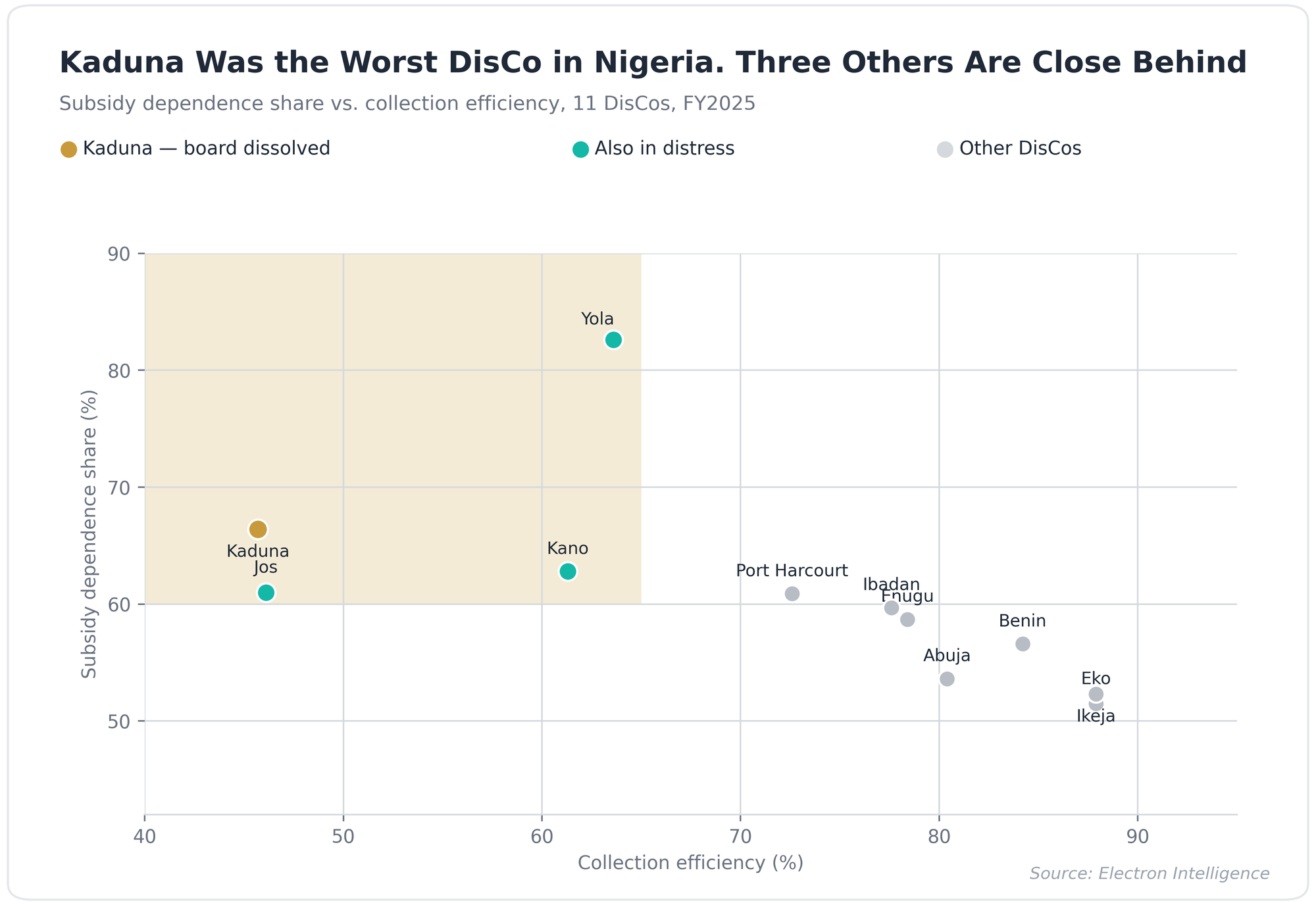
Fig 3: Kaduna, Jos, Kano and Yola combine weak collection with heavy subsidy dependence, the pattern behind Kaduna's dissolution.
Billing a customer and collecting from that customer are two different steps, and government's obligation is set by the first one. A DisCo that bills $170 million and collects $75 million still owes NBET based on the full $170 million. The unrecovered $95 million does not reduce what NBET is owed. It falls to government to cover regardless of whether the shortfall came from a tariff structure priced below cost or from customers who were billed but never paid.
But in Yola’s case, its collection efficiency, 63.6%, sits in the middle of the country, better than Kaduna's or Jos's. But its subsidy dependence, 82.6%, is still the highest in the country. The reason isn't collection. It's revenue base: Yola bills only $42.3 million, versus Kaduna's $90.1 million, and its distribution losses run so high that little of what it does bill comes from premium-rate customers. Weak collection explains most of Nigeria's subsidy bill, but not this part. Some DisCos, like Yola, simply don't have enough customers who can pay a cost-reflective rate to begin with.
Even after accounting for what DisCos actually collect, the picture does not improve much
A DisCo's real cash position depends on two things at once: how much of its billing comes from higher-paying customers, and how much of what it bills it actually collects. A strong number on one side does not make up for a weak number on the other. If a DisCo bills well but collects only half of it, its real cash position is cut in half too, no matter how strong its customer mix looked on paper. A weak customer mix can still leave a DisCo with a real cash margin if it collects well. The same weak mix, paired with poor collection, leaves close to no margin at all.
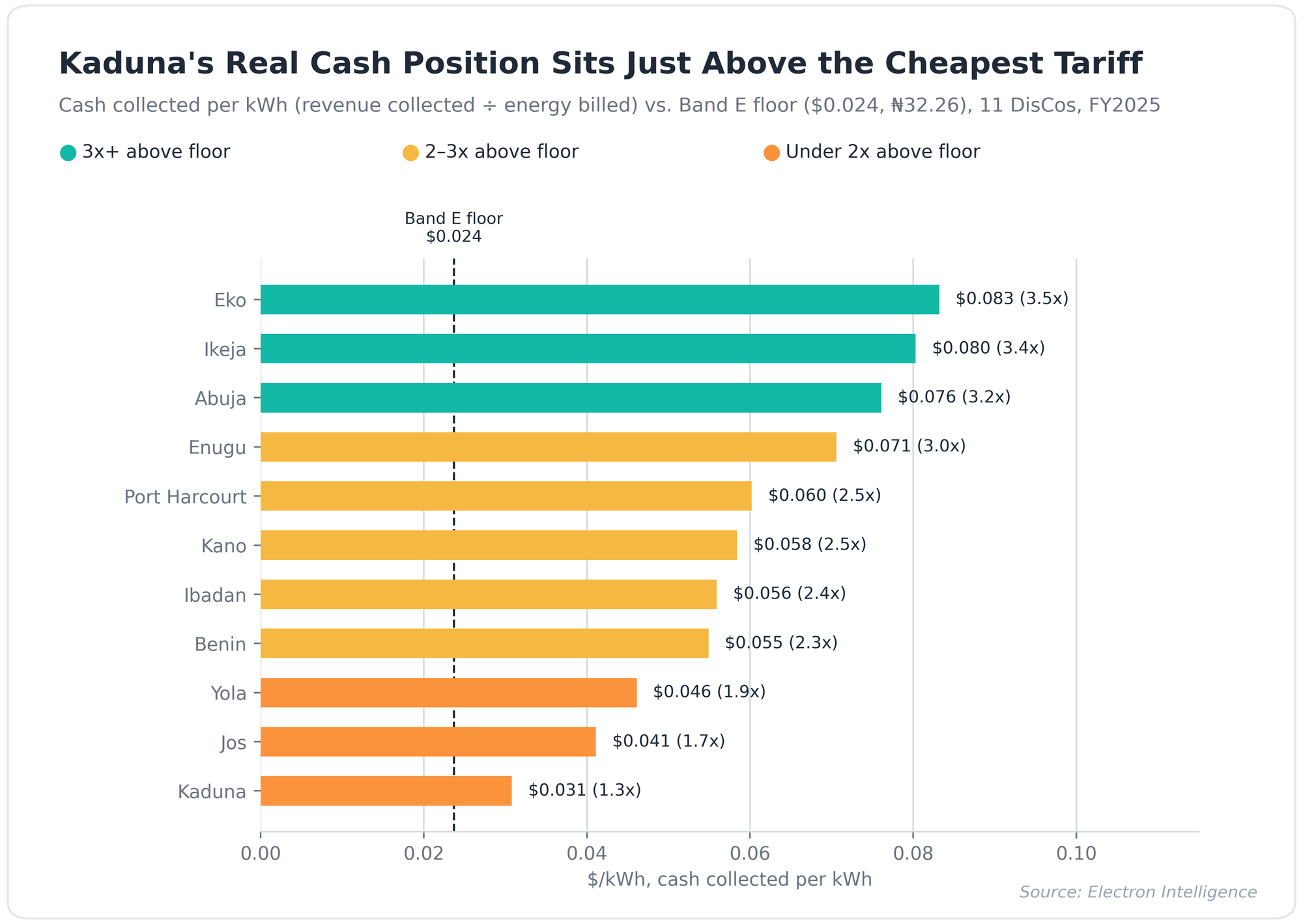
Fig 4: Kaduna's cash collected per kWh sits just 1.3 times the Band E floor, the thinnest margin in the country.
Kaduna's weak customer mix limited what it could bill. Weak collection then cut further into what it had already billed. Neither problem cancelled the other out, each one reduced the same shrinking base. Benin only had the first problem. Its collection stayed strong enough to recover most of what it billed, which is why it still ended up with cash collected per kWh of $0.055 (₦74.73), 2.3 times the Band E floor. Kaduna had both problems, and each one took a share of what was left after the other.
The result for Kaduna was cash collected per kWh of $0.031 (₦41.99), only $0.007/kWh above the $0.024/kWh Band E floor, the rate charged to the least reliable, lowest-paying customers in the country. In practical terms, Kaduna's real cash income per unit of electricity sold was only marginally more than it would have earned if every one of its customers had been billed at the cheapest tariff on the ladder. A DisCo in that position has almost no cash buffer left to absorb a bad quarter, a currency shift, or a slow-paying customer segment, which is the same position NERC's order pointed to when it dissolved Kaduna's board.
What We're Watching
Nigeria's Minister of Power announced in July 2026 that electricity subsidy payments will phase out from 2027. The announcement ruled out raising tariffs in the near term. It also cited a $2.20 billion (₦3 trillion) subsidy burden and $4.77 billion (₦6.5 trillion) owed to power generating companies. The GenCos dispute that second figure. They put the real amount above $5.14 billion (₦7 trillion) and are calling for an independent audit.
Three things will show whether the phase-out closes the gap or just moves it. First, whether that audit happens, and whether it resolves the dispute over how much is actually owed to GenCos. Second, whether the 2027 phase-out gets paired with a tariff increase, since removing subsidy without raising tariffs does not close the underlying gap between what DisCos charge and what power costs. Third, whether the regulator applies to other DisCos the same treatment it gave Kaduna. Jos and Yola carry the weakest collection efficiency and the highest subsidy dependence in the country after Kaduna, making both candidates for the kind of intervention that just hit Kaduna's board.
Not all of that exposure is commercial, though. Jos and Yola sit in the same low-allocation corridor as Kaduna: the three of them, plus Kano, together receive only about 4% of national grid capacity, and transmission repairs across the region have stalled over insecurity a board dissolution cannot fix. A new board can chase collections harder. It cannot add megawatts to the line or secure a transmission tower under threat. Whether NERC's next move distinguishes between the two will say more about what the regulator can actually fix than the intervention itself.
Bottom Line
Nigeria's tariff system is described as cross-subsidy, but it only functions that way in 2 of 11 DisCos: Eko and Ikeja, where subsidy dependence sits near 51 to 52%. Everywhere else government covers the bulk of the wholesale bill, and how much it covers moves with the exchange rate rather than with what premium customers pay. Weak collection widens that gap further, because a DisCo that bills but never collects still owes NBET in full and government still closes the difference. Kaduna carried both weaknesses at once: a customer mix generating little premium revenue and collection efficiency below 46%, until its cash position sat barely above the tariff charged to the least reliable service in the country.
The $2.94 billion (₦4 trillion) bond programme clears debt already accumulated, but neither it nor a 2027 subsidy phase-out without a tariff increase touches what keeps generating new debt: the gap between what DisCos charge and what power actually costs. Absent that, the policy choice only decides which DisCo runs out of room first.