EI Brief
In this issue we cover: the last 30 days of African power activity; this week’s deepdive; the chart of the week and what we’re watching on our radar.
Market Activity: the last month on the platform
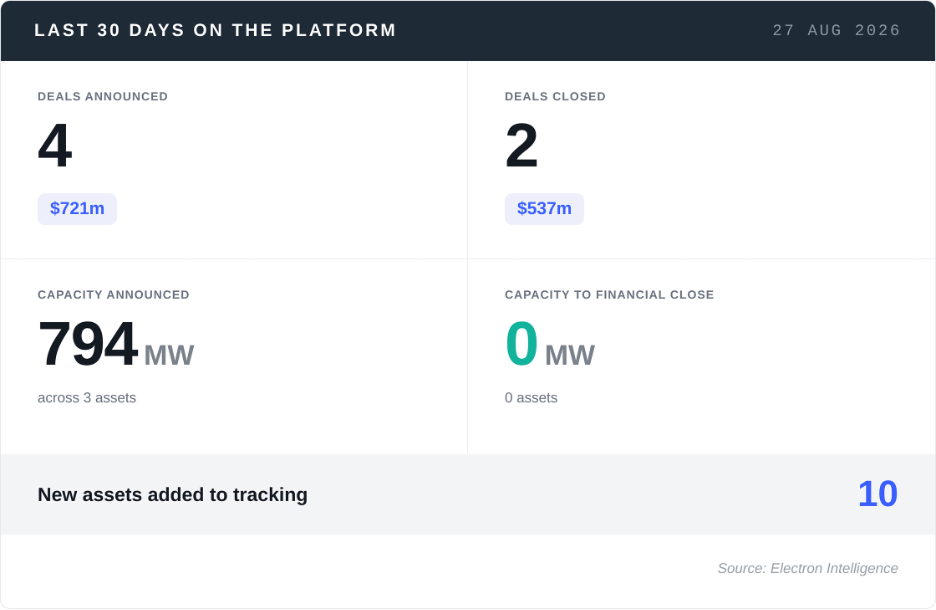
August was rather quiet. Four announced transactions worth $721 million; two reached financial close, for a combined $537 million. 10 new assets entered platform tracking, and 794 MW of new generation was announced across three assets.
None of that 794 MW reached financial close.
This Week’s Deep Dive
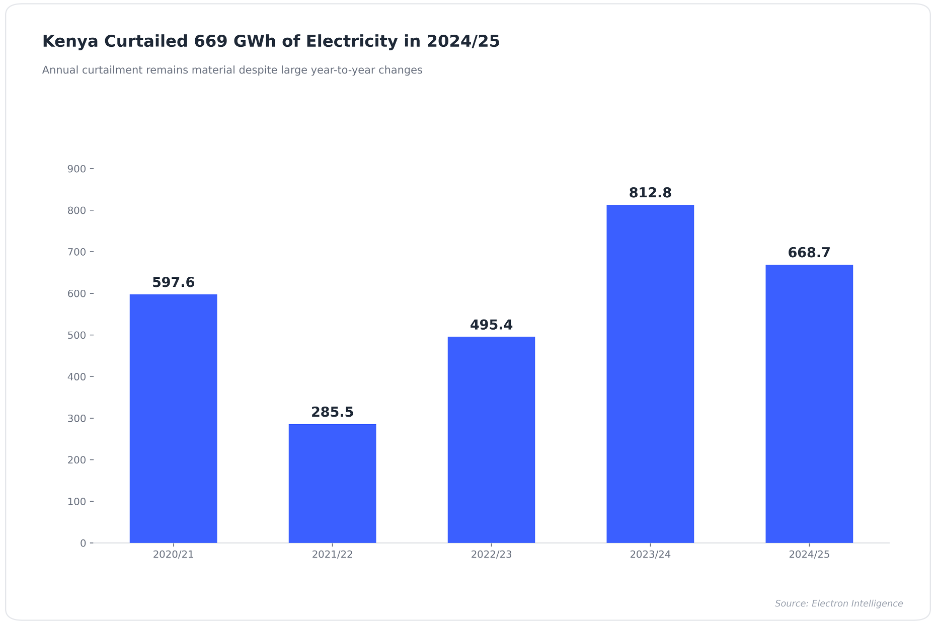
Kenya's grid already curtails hundreds of gigawatt-hours a year, almost all of it is geothermal, while wind has stayed largely insulated, and this week’s deepdive explains why: whether a plant gets turned down and whether it still gets paid are two separate decisions. The system operator decides which plants get turned down, but each plant's power purchase agreement decides who still gets paid for it, and large wind projects like Lake Turkana and Kipeto carry deemed-generation thresholds that let them absorb curtailment before Kenya Power owes any payment, which is the mechanism the EPRA (Energy and Petroleum Regulatory Authority) credits for wind's clean record so far.
Kenya is now adding 539 MW of new baseload, geothermal, hydro, and Ethiopian imports, without having published the same terms for any of it. The open question is whether that new capacity gets the same protection wind has had, or none at all.
Read the Analysis here
Chart of the Week
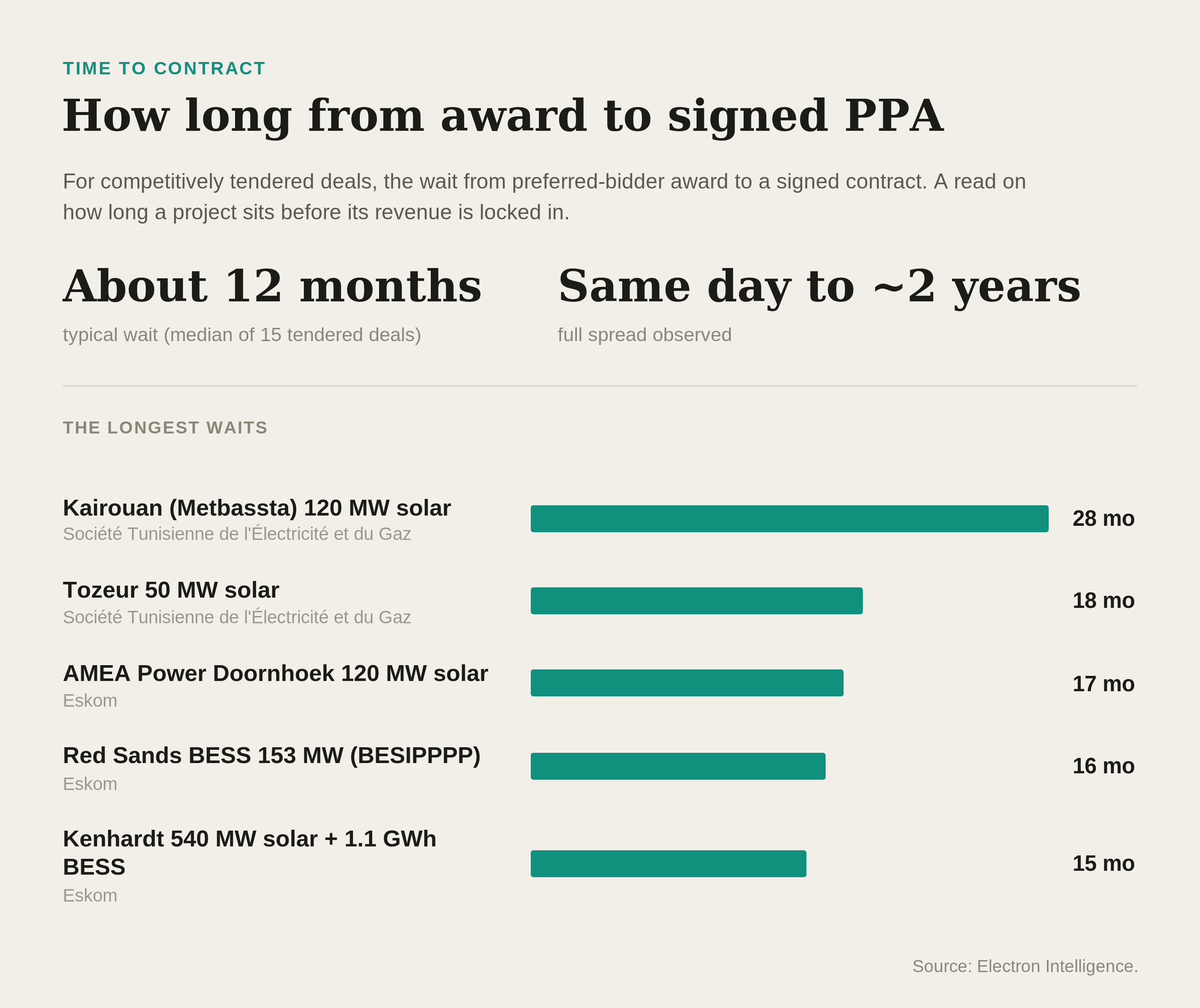
We timed the gap between winning a tender and signing the contract on 15 African power deals, to show how long revenue stays unlocked after a project has been effectively won. Winning the tender is the easy part.
The typical deal waits about 12 months from award to signature. A project can win and still spend a full year before any of its revenue is contracted. The spread runs from the same day to about 28 months, wide enough that two projects can clear identical tenders and one signs a year and a half after the other. The award date tells a lender almost nothing about when a project becomes bankable.
The longest waits sit with two state utilities. All five of the longest waits run through Tunisia’s STEG or South Africa’s Eskom. The developer is ready, but the counterparty is not. When the offtaker is a stressed national utility, the signature is the bottleneck.
EI Research Desk: one thing that stood out this week
Nigeria's Rural Electrification Agency has launched the Renewable Asset Management Company (RAMCO). RAMCO is a as a special purpose vehicle to professionally manage, maintain, and optimize publicly funded renewable energy infrastructure nationwide, targeting about ₦3 trillion in sector investments. Most publicly funded mini-grids get installed, get a ribbon-cutting, then sit with no one responsible for maintaining or refinancing them. RAMCO's job is to aggregate mature mini-grids and solar home systems, keep them running, and refinance them so so private capital can recycle into the next batch.
RESEARCH RADAR
New reports, market moves, deals, and policy shifts we're tracking across Africa’s 54 markets.
Kenya put $150m into 120 new solar mini-grids. Under the Kenya Off-Grid Solar Access Project, the government and development partners are funding 120 mini-grids to reach communities the national grid does not, part of a dual push to both modernise the grid and widen off-grid access. We are watching whether publicly-backed mini-grids can close the access gap faster than grid extension has.
Zambia lined up another 220 MW of solar. Suncore Solar signed a memorandum with local partners MUZ and Monasa to develop a 220 MW plant, adding to a fast-growing pipeline as the country races to replace drought-hit hydro. We are watching whether these early-stage agreements convert into financed, built capacity rather than stalling as paperwork.
Sudan scrapped import duties on solar equipment. With its grid shattered by war, the government removed tariffs on solar imports so households and businesses can power themselves, treating distributed solar as emergency infrastructure. We are watching whether cheaper hardware turns into real installations in a market with little financing and high risk.
Also Published
Cross-Subsidy in Nigeria's Electricity Market: Where It Works, and Where Government Pays Instead Aug 13
The Real Cost of Cheap Grid Across Selected African Power Markets Aug 6
What Drove Financial Performance Across Africa's Utility-Scale Operators Jul 30
A Landed Cost Breakdown of Solar in South Africa and Kenya, and What Sets Them Apart Jul 23
Access the full platform
Coverage of Africa power and renewables markets. Live deal tracking, asset profiles, electricity pricing index, PPA tracker and contracted energy pricing, and the import tariff & VAT data for African markets.
Request Access