EI Research Brief
In this issue: Our maiden financial benchmark Webinar for African Power Operators; African power market activities in the last 30 days; this week's deep dive; Chart of the week; Research Radar and other published research
In this issue: Our maiden financial benchmark Webinar for African Power Operators; African power market activities in the last 30 days; this week's deepdive; Chart of the week; Research Radar and other published research
LIVE WEBINAR: AFRICAN POWER FINANCIAL PERFORMANCE BENCHMARK
Last week, we presented our new benchmark of 26 utility-scale power operators across 13 African countries, covering FY2021 to FY2025 and around $28 billion in combined annual revenue. Joseph and I walked through the economics of operating power in Africa and one pattern was prevalent: more than size, ownership, or grid exposure, the customer behind the cash flow is what separates the operators that can finance themselves from those that cannot.
If you missed the webinar or want to watch it again, you can access it on our YouTube channel: https://youtu.be/FYVUEfxOTz8
MARKET ACTIVITY
The last week on the platform
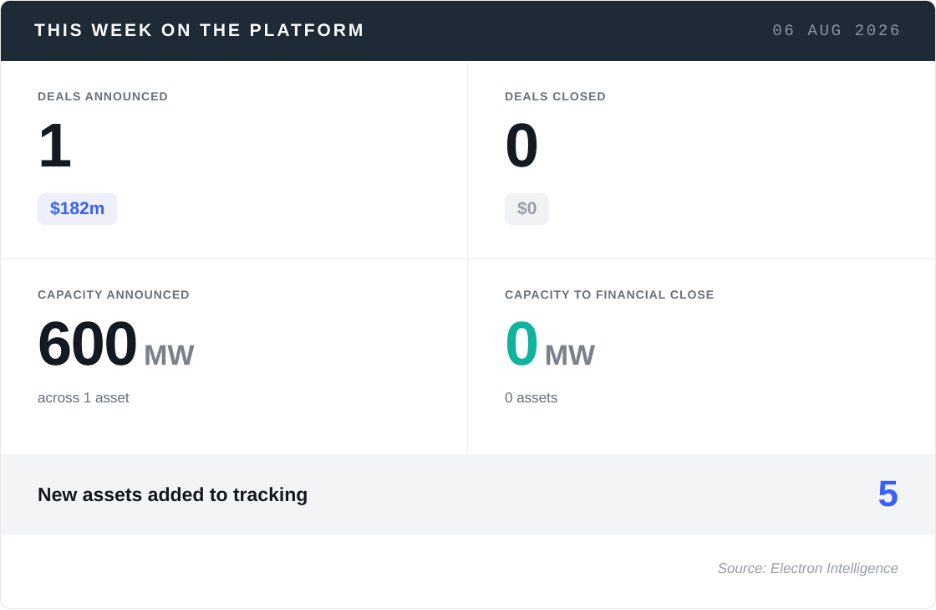
Activity was subdued over the past week, with 1 announced transaction valued at $182 million, while no deals reached financial close. During the period, 5 new assets were added to platform tracking, and 600 megawatts of generation capacity were announced across one asset. None of that capacity progressed to financial close.
THIS WEEK'S DEEP DIVE
The Real Cost of Cheap Grid Across Selected African Power Markets
Published electricity tariffs did not consistently reflect the true cost of electricity across African power markets. Once the cost of maintaining dependable electricity was incorporated, the relative affordability of several markets changed significantly, with unreliable electricity increasing operating costs for commercial and industrial users despite comparatively low published tariffs.
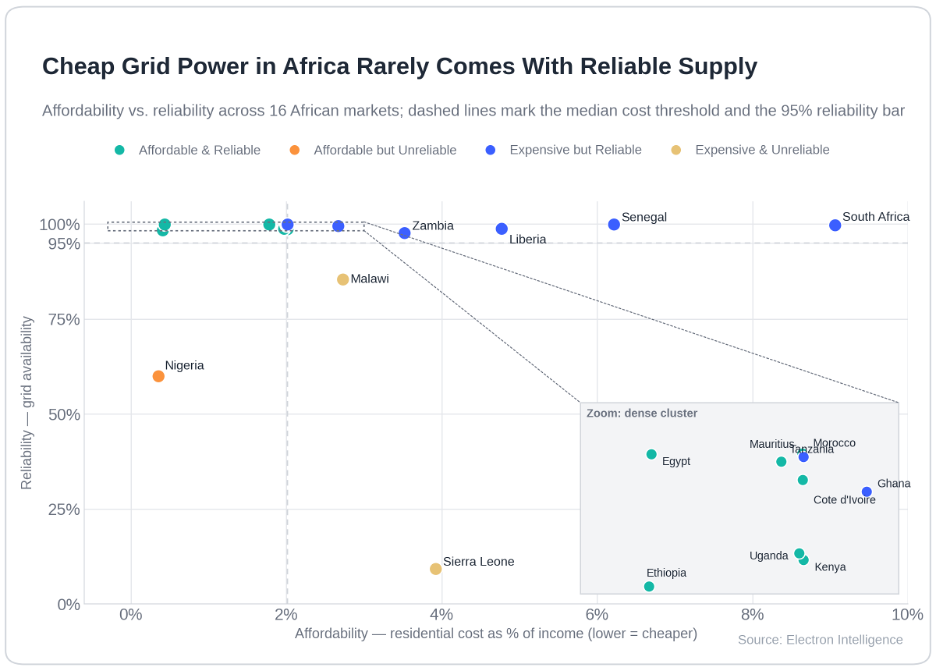
Our analysis of selected African electricity markets shows that electricity system performance explains affordability more effectively than tariff levels alone. Markets combining dependable electricity with competitive pricing generally delivered lower total electricity costs, while those with persistent supply disruptions transferred a substantial share of electricity costs to businesses through self-generation and operational disruptions. These findings suggest that evaluating electricity markets requires equal consideration of both electricity pricing and system reliability, particularly for commercial and industrial users whose competitiveness depends on continuous power supply.
Read it here.
CHART OF THE WEEK
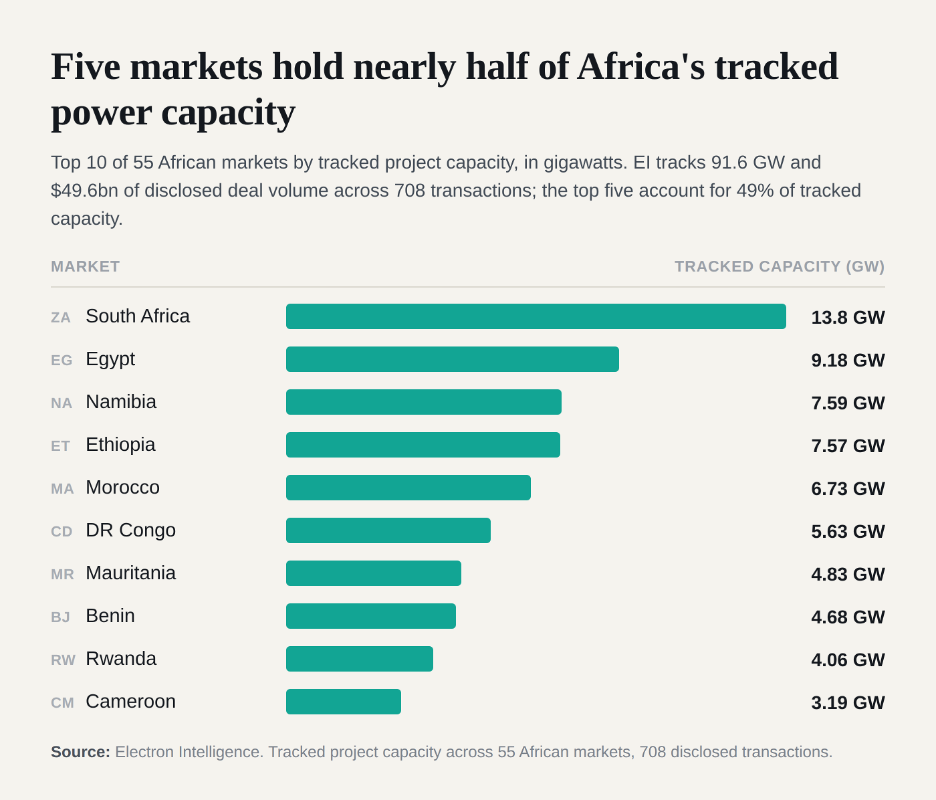
We mapped 91.6 GW of tracked power capacity across 55 African markets to show where it concentrates.
Three patterns stood out
- Capacity is highly concentrated. Five of 55 markets hold 49% of the 91.6 GW EI tracks, and South Africa alone holds about 15% of it at 13.8 GW, half as much again as second-placed Egypt. The remaining 45 markets share barely half the pipeline between them.
- The ranking rewards pipelines, not economies. Small, sparsely populated states like Namibia (7.59 GW) and Mauritania (4.83 GW) sit near the top, lifted by export-scale solar, wind and green-hydrogen projects that dwarf their own domestic demand. Nigeria, the continent's largest power market, does not appear in the top ten the largely small-scale, behind-the-meter solar leaves it out of a grid-scale ranking.
- Where the gigawatts are is not where the money is. The top five by capacity span North, Southern and East Africa, but disclosed deal volume tells a narrower story: Southern and East Africa alone concentrate 46% of the $49.6bn tracked.
EI RESEARCH DESK
One thing that stood out to us this week.
Geregu Power, a listed Nigerian generator, put out its half-year results this week, and they were rough. Revenue fell from ₦87.6bn to ₦18.7bn in a year. Profit fell from ₦20.3bn to ₦2.5bn. This is a privately owned, dividend-paying generator, not a struggling state utility. The plant kept running, but the income did not. For a generator, the risk was never whether the turbines work. It is whether it gets paid.
Gross profit fell from ₦35.8bn to ₦6.9bn, and almost all of the ₦2.5bn came in the first quarter, so the second quarter barely broke even. Investors have cut the share price by about a fifth this year, one of the worst runs on the exchange. It fits a bigger problem: Nigerian generators are owed trillions of naira and are not paid on time for the power they send out. When the cash upstream dries up, the generators are the ones left holding the gap.
Full financials (Geregu Power interim results, filed on the NGX): africanfinancials.com/company/ng-geregu
RESEARCH RADAR
New reports, market moves, deals, and policy shifts we're tracking across the 54 markets.
Nigeria says it will end its power subsidy in 2027 without raising tariffs. Power minister Joseph Tegbe told reporters on 1 August the subsidy will be gone next year, while promising consumers will be no worse off. But the subsidy only exists because most customers pay less than power actually costs. Take it away and either bills rise or someone absorbs the gap, and the government already owes generators about ₦6.5trn. We are watching whether "no tariff hike" holds once the bills come due.
Morocco is building Africa's first battery gigafactory. The African Development Bank approved a €100m loan toward the continent's first large-scale lithium iron phosphate plant, positioning Morocco as a storage-manufacturing hub rather than only a project market. It is a bet on making batteries in Africa, not just importing and installing them. We are watching whether local production can reach the scale and cost that imported Chinese packs now set.
Egypt signed a 407 MW wind PPA with Alcazar Energy. The state transmission company, EETC, took the offtake for a wind farm at Zafarana, enough for roughly 775,000 homes, with power due from 2028. It adds to Egypt's fast-growing pipeline of grid-scale renewables on long public contracts. We are watching how much of that pipeline reaches financial close rather than stalling at signature.
Also Published
What Drove Financial Performance Across Africa's Utility-Scale Operators
A Landed Cost Breakdown of Solar in South Africa and Kenya, and What Sets Them Apart Jul 23
A Landed Cost Breakdown of Solar in Nigeria and What Sets the Price Jul 16
South Africa's Curtailment Surge Is Rewriting Which Renewables a Bank Will Fund Jul 09
Access the full platform
Coverage of Africa power and renewables markets. Live deal tracking, asset profiles, electricity pricing index, PPA tracker and contracted energy pricing, and the import tariff & VAT data for African markets. Request institutional access →