EI Research Brief
This week's stories test what happens when a market's numbers finally have to match what's actually happening on the ground. Nigeria found out again, when its regulator dissolved a distribution company's board for the second time in three years, after the debt it was meant to fix nearly quadrupled instead. Kenya is finding out from the opposite direction, with a grid asking for less of the very power everyone else on the continent is racing to build.
MARKET ACTIVITY
The last month on the platform
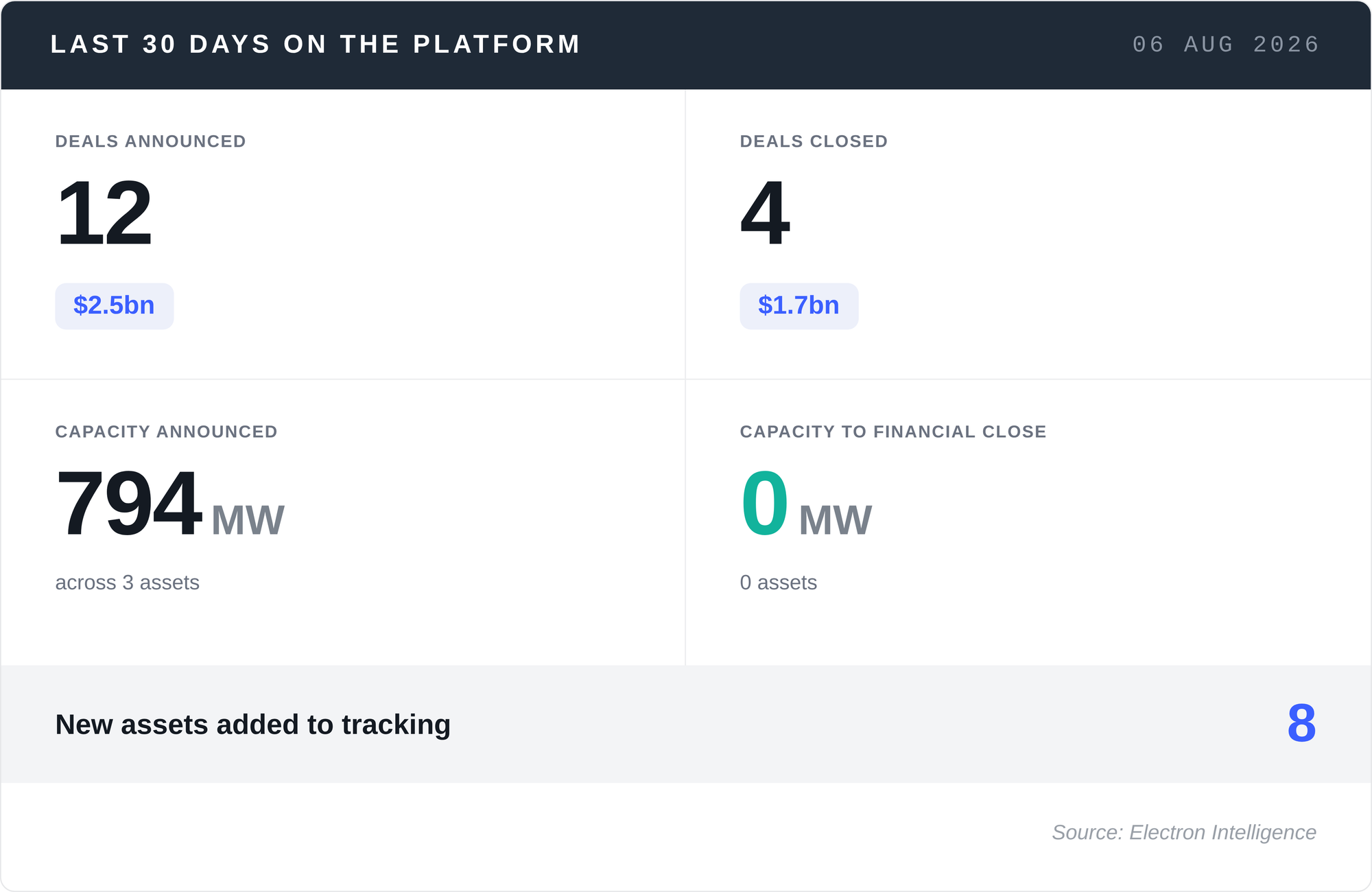
The last 30 days moved $2.5 billion across 12 newly announced deals and closed $1.7 billion more. But not one of those closes carried a megawatt of generation capacity with it. Zero MW, zero assets, reached financial close in the period, even as 794 MW of new capacity got announced across three separate assets elsewhere in the pipeline. Platform coverage kept widening too, eight new assets added to tracking.
THIS WEEK'S DEEP DIVE
Cross-Subsidy in Nigeria's Electricity Market: Where It Works, and Where Government Pays Instead.
Nigeria's electricity system is sold as cross-subsidy: premium customers pay more so everyone else pays less. Using NERC's (the Nigerian Electricity Regulatory Commission) own billing and collection data across all eleven DisCos, we found that story holds up in exactly two of them. The other nine, including Kaduna, whose board NERC dissolved this week, are financed by government instead, and not for one reason.
A weak customer mix limits what a DisCo can bill at the premium rate. Weak collection cuts into what gets billed anyway. Distribution losses eat into what never reaches a paying meter. And whatever's left still owes NBET (Nigerian Bulk Electricity Trading PLC) in dollar terms, whatever the naira did that month. Kaduna carried all four at once. A new board can chase collections harder. It can't rewrite who's on its network, patch a leaking grid, or hold the exchange rate still, so how many of the other nine are just one of those four problems away from the same fate?
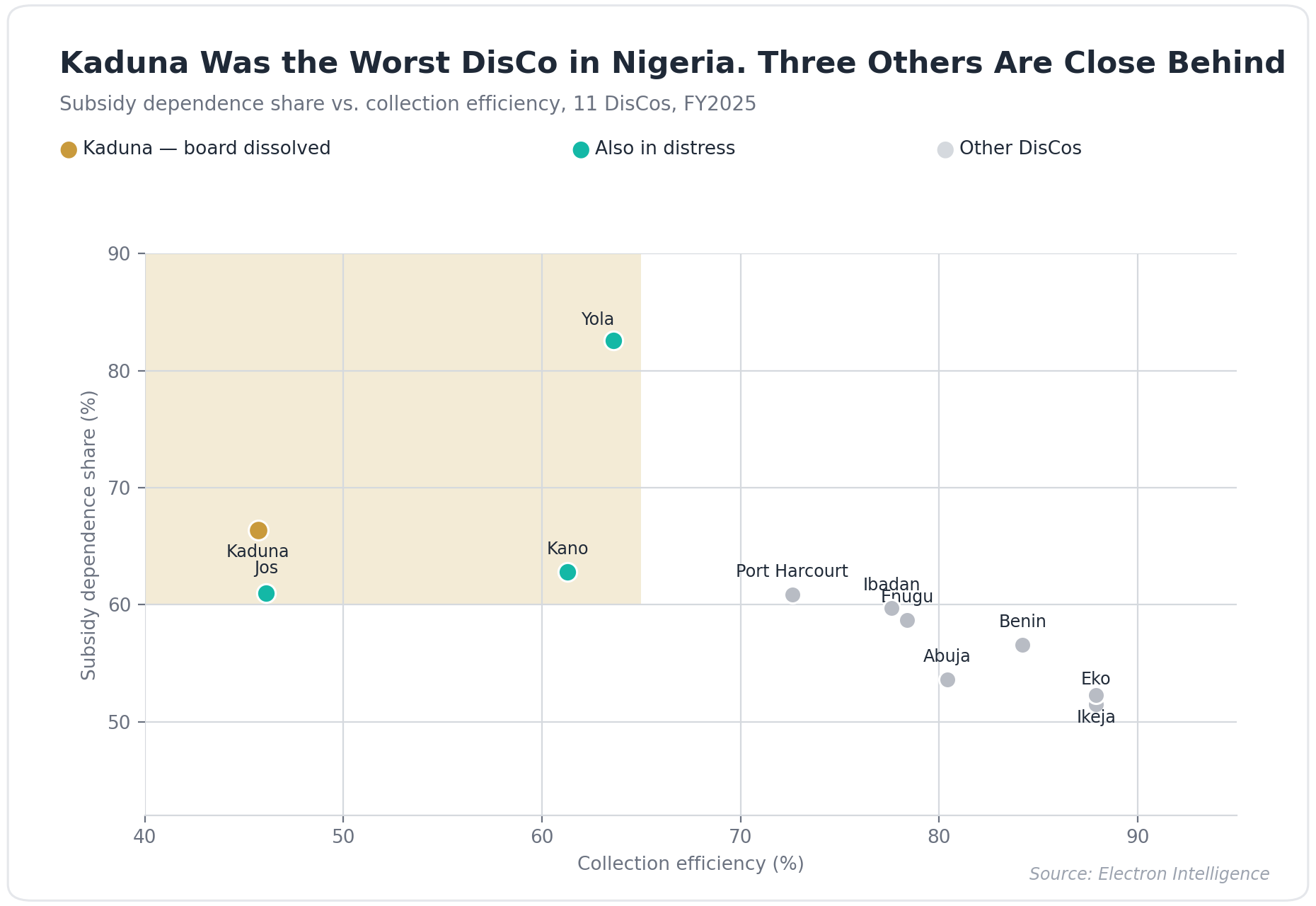
CHART OF THE WEEK
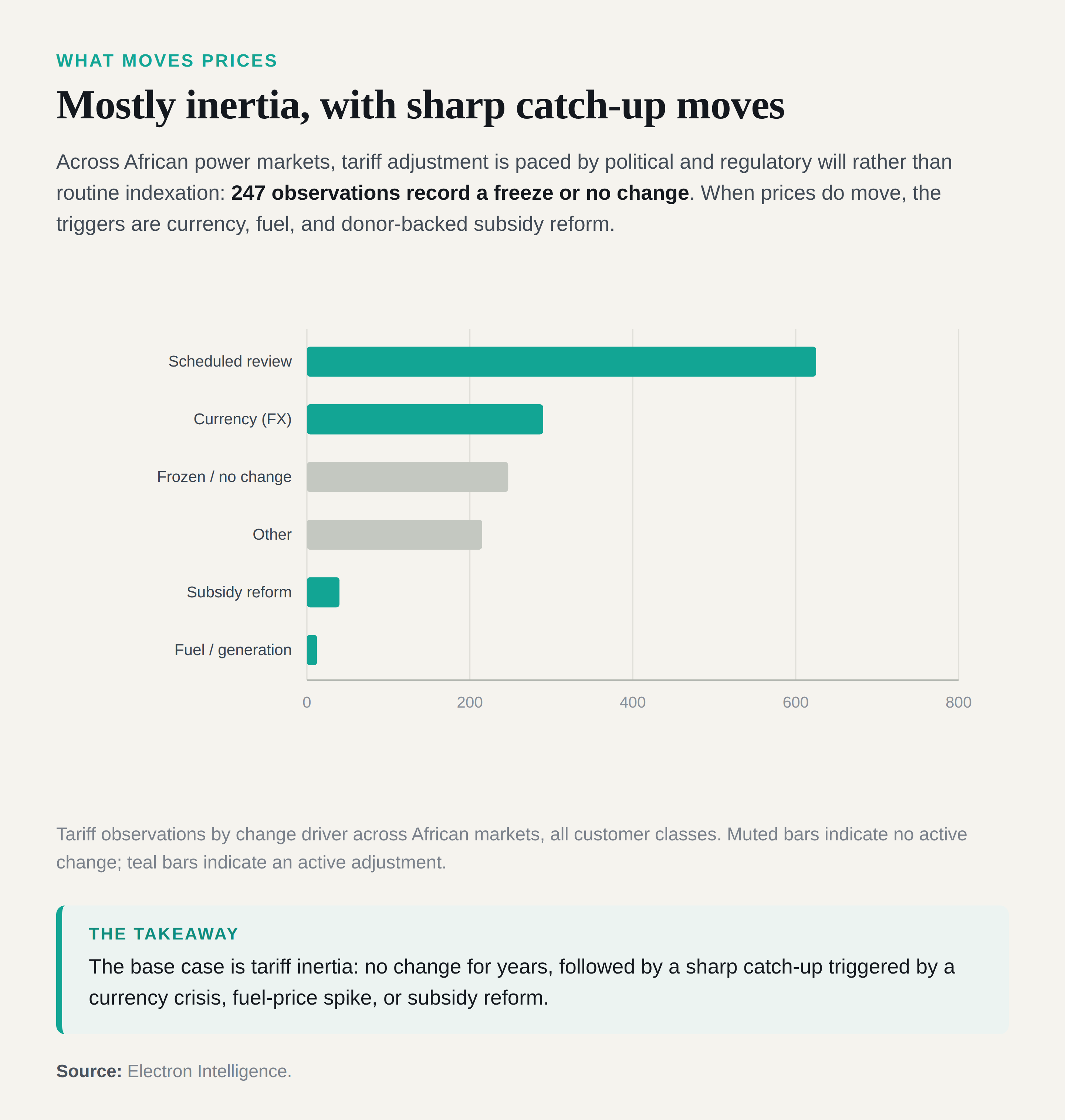
Kaduna's math did not drift for years by accident. Across the continent, electricity tariffs move the same way: not on a schedule, but only when something finally forces the issue. We grouped every African tariff observation we have by what actually triggered it, to see how rare that forcing moment really is, and what usually causes it.
Three patterns stood out
- The default setting is "no change." A freeze is one of the larger buckets on the chart, with 247 observations recording no movement at all. Regulatory and political will, not a pricing formula, decides when a tariff is touched, so long stretches pass with prices held flat.
- When tariffs do move, currency is the main external trigger. After scheduled reviews, the currency (FX) bar is the biggest driver of an actual change, well ahead of fuel costs or donor-backed subsidy reform. Devaluations, not routine indexation, are what force most resets.
- Prices stay flat, then jump. Because a change waits on a shock instead of a schedule, tariffs tend to sit still for years and then move all at once. The usual pattern is a long freeze followed by a sharp rise when a currency crisis, fuel-price spike, or subsidy reform finally forces it.
EI RESEARCH DESK
One thing that stood out to us this week.
Kenya, one of the greenest grids on Earth, spent the week asking for less green power. Wind and solar now cover more than a third of demand at peak, past the point most grids handle comfortably, and Kenya Power says the intermittency is getting expensive: it has to pay backup plants just to stand ready for the moments the wind drops and the sun clouds over. So, it’s asking to slow down wind and solar and lean harder on geothermal and hydro instead.
Almost everywhere else in Africa, the fight is to add renewables, not manage them. Kenya got there first, and what it's asking for says as much about the limits of an old grid as it does about the success of a new one.
Read it here
RESEARCH RADAR
New reports, market moves, deals, and policy shifts we're tracking across Africa’s 54 markets.
Egypt signed a 407 MW wind PPA with Alcazar Energy. The state transmission company, EETC, took the offtake for a wind farm at Zafarana, enough for roughly 775,000 homes, with power due from 2028. It extends Egypt's fast-growing pipeline of grid-scale renewables on long public contracts. We are watching whether the grid can absorb wind and solar at this pace without the curtailment now emerging elsewhere on the continent.
Zambia cleared a 500 MW solar project through regulatory approval. Hungary-based EnerSynk secured the key permits for one of the country's largest solar plants yet, part of Zambia's drive to add gigawatts of solar after drought crippled its hydro. It signals foreign developers moving into a market racing to diversify away from water. We are watching whether Zambia's copper mines, its largest power users, step up as the buyers that make plants like this bankable.
South Africa's private power market keeps scaling. SolarAfrica and MPower are building a 184 MW solar plant with 300 MWh of storage in Mpumalanga, wheeled across the grid to corporate buyers rather than sold to Eskom. Private, storage-backed generation for industry is fast becoming the country's default new build. We are watching whether wheeling volumes keep climbing as the new trading rules are finalised.
A Nigerian regulator, a Kenyan grid operator, and three deal teams elsewhere on the continent are all running some version of the same test, in different rooms: whether the story a market has been telling about itself still matches the numbers underneath it. Kaduna is where it didn't. Kenya is where it's starting to strain. The rest of this week is everyone else finding out which room they're standing in.
The Real Cost of Cheap Grid Across Selected African Power Markets Aug 6
What Drove Financial Performance Across Africa's Utility-Scale Operators Jul 30
A Landed Cost Breakdown of Solar in South Africa and Kenya, and What Sets Them Apart Jul 23
A Landed Cost Breakdown of Solar in Nigeria and What Sets the Price Jul 16
Access the full platform
Coverage of Africa power and renewables markets. Live deal tracking, asset profiles, electricity pricing index, PPA tracker and contracted energy pricing, and the import tariff & VAT data for African markets. Request institutional access →