EI Research Desk: 17 transactions added to the platform, solar financing concentrated in two markets, South Africa’s flexible power procurement, AXIAN’s regional solar PPA, and Gridworks’ Zambia–DRC interconnector investment plans.
A MORE DETAILED VIEW OF AFRICA’S POWER MARKET
This week, Electron Intelligence added 17 transactions and six assets, alongside 148 power purchase and related agreements. We also published 26 electricity-price records, expanding the detail available on financing activity and commercial terms.
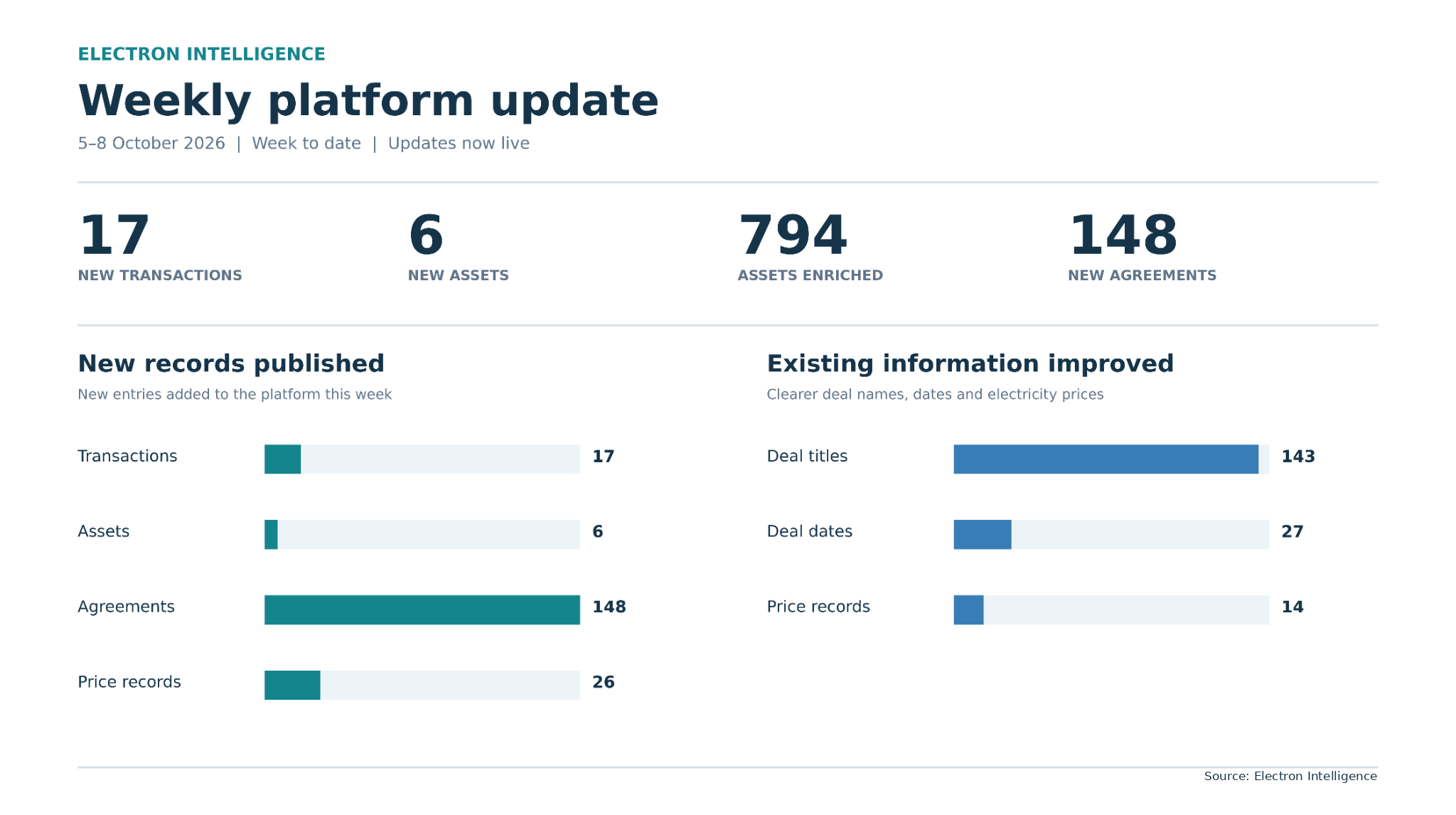
The update also enriched 794 existing asset profiles with project specifications, company roles and development milestones. We clarified 143 transaction titles, improved dates for 27 transactions and updated 14 existing price records.
For platform users, these additions make it easier to compare projects, identify the companies involved and follow their progress. The expanded agreement and pricing coverage also provides more evidence for assessing how electricity is bought and sold across African markets.
CHART OF THE WEEK: SOLAR FINANCING IS CONCENTRATED IN TWO MARKETS
South Africa and Nigeria account for 15 of the 24 solar project and portfolio financial-close announcements recorded by Electron Intelligence in 2026 through 7 October. The remaining nine are spread across nine countries, with one recorded in each. Financing activity within EI’s tracked coverage is geographically broad, but repeated closes remain concentrated in two markets.
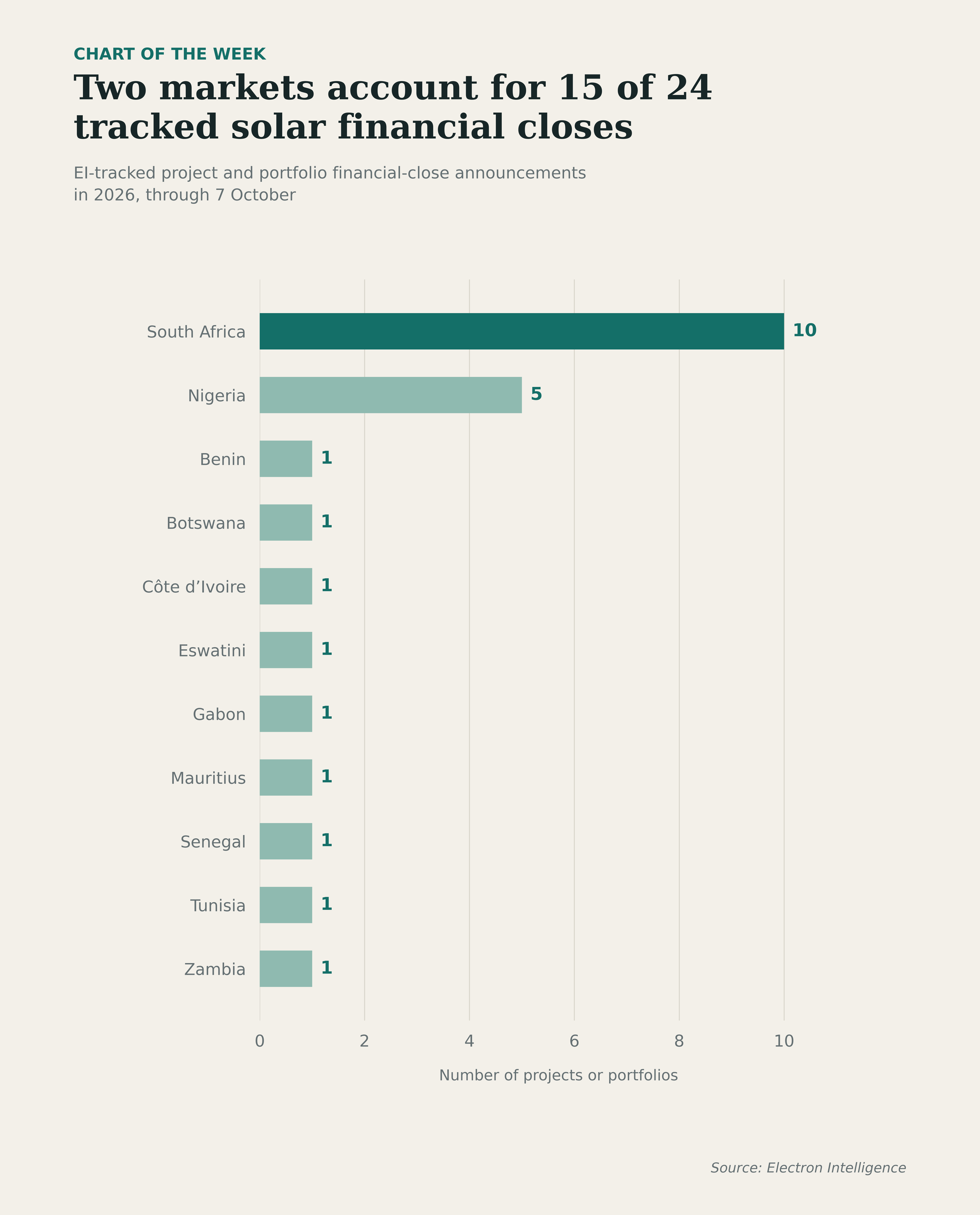
The two leading markets also show different financing structures. South Africa’s ten closes relate to individual projects, while Nigeria’s five cover portfolios comprising 315 mini-grid sites. Counting each portfolio as a single transaction understates the number of individual sites covered by financing activity in Nigeria. The concentration matters, but so does the structure beneath it: financing can support a single large plant or aggregate many smaller systems into one transaction.
This comparison measures tracked projects and portfolios reaching financial close, rather than their share of capacity or capital deployed.
THIS WEEK’S DEEP DIVE
Industrial demand could support complementary investment around Lagos–Ogun’s public transmission expansion
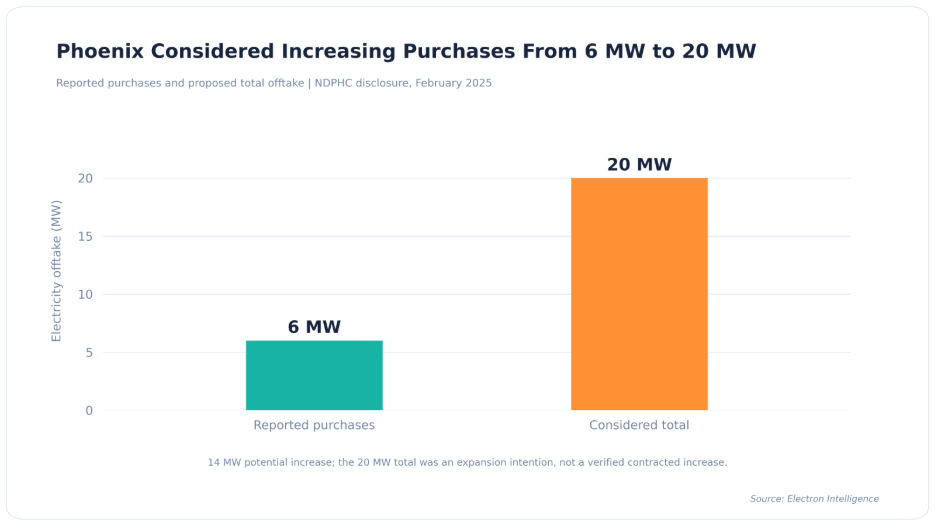
Public investment is expanding the transmission network around Agbara and Ogijo, supported by JICA’s US$189.82 million loan programme. Industrial customers provide an existing market around these assets. Phoenix Steel was considering increasing electricity purchases from 6 MW to 20 MW to accommodate expansion, while Strongpack reaffirmed its intention to connect to the grid. These developments point to two potential sources of additional grid demand: factory expansion and existing production shifting towards grid supply.
This week’s analysis examines where customer connections and local reinforcement could complement publicly funded works. Agbara has the clearest delivery activity and a disclosed financing partnership, while Ogijo offers specific historical engineering recommendations. Their investment potential depends on identifying where private capital could complement public funding and establishing payment structures that support capital recovery . EI will track customer commitments, delivery milestones and asset-level financing agreements that could turn these leads into financeable projects.
ONE THING THAT STOOD OUT THIS WEEK
South Africa prioritises flexible supply before procuring more wind and solar
South Africa’s latest procurement plans prioritise battery storage and gas-fired generation before another round of wind and solar projects. On 7 October, the government outlined a proposed allocation of 4.6 GW of battery storage and 5 GW of gas-to-power under its first Section 34 determination implementing IRP 2025. New wind and solar capacity would follow in a subsequent determination.
Increasing curtailment means additional generation does not automatically translate into more usable electricity. Batteries are intended to shift surplus output into periods of demand, while flexible gas plants would supply electricity when renewable production falls. The proposed allocation establishes a procurement direction, rather than confirming project awards or financing.
For project development, location and operating requirements become central to value. Storage needs access to surplus electricity and an unconstrained route to discharge it. Gas projects need fuel infrastructure and operating flexibility suited to intermittent demand. The announcement makes those system requirements more explicit in how South Africa intends to procure its next capacity additions.
RESEARCH RADAR
Zambia: Kafue Solar secures financing alongside grid upgrades
Globeleq announced financial close on its 40 MWac Kafue Solar project on 1 October. FMO and British International Investment committed US$52.1 million in long-term project financing, with electricity contracted to ZESCO under a 25-year PPA. A separate Norwegian grant will support connection works and upgrades at ZESCO’s Kafue Town substation.
The financing structure addresses generation and its connection infrastructure together. Kafue provides evidence that utility-contracted solar can secure financing in Zambia, while also showing the role development finance and grant-funded network works play in bringing projects forward.
South Africa: Private transmission procurement moves to 2027
South Africa now targets the final request for proposals for its first Independent Transmission Projects programme in the second quarter of 2027, replacing the previous third-quarter 2026 timetable. The programme covers approximately 1,164 kilometres of transmission infrastructure. Seven prequalified bidders will receive a second draft package before year-end, alongside proposed credit-guarantee terms.
The revised timetable extends the period before binding bids can be submitted. It also makes clear that private transmission investment depends on resolving payment security, regulatory cost recovery and risk allocation together. The guarantee structure is still being developed, so the programme remains a procurement opportunity rather than committed construction.
Zambia: AXIAN signs a solar PPA to supply regional electricity customers
AXIAN Energy and Africa GreenCo have signed a power purchase agreement for the Kudu solar project in Zambia, covering 200 MWac of capacity from a 240 MWdc facility. GreenCo will buy the electricity and resell it to utilities, mines, agricultural businesses and commercial customers across the Southern African Power Pool. The project is progressing towards financial close and construction.
The agreement gives AXIAN a route to customers beyond a single national utility. GreenCo takes responsibility for purchasing the plant’s output and finding buyers across the region, making its creditworthiness and trading capability central to the project’s financing. For Zambia, the structure connects new generation investment with both domestic and regional demand.
DRC–Zambia: Gridworks signs agreements for a privately financed power interconnector
Gridworks has signed agreements signalling its intention to become lead equity investor and majority shareholder in the Kalumbila–Kolwezi Interconnector Project. The proposed 200 km transmission line would carry up to 700 MW into the DRC’s Copperbelt mining region, with construction estimated to cost $300 million. Trafigura is arranging debt financing; the announcement does not confirm financial close.
Mining demand is providing a commercial basis for investment in cross-border transmission. The line would give Zambian producers additional access to Congolese customers while allowing mines to source electricity from across Southern Africa. Its significance extends beyond the proposed capacity: it offers a structure through which private investors can finance the network connecting regional supply with industrial demand.