EI Research Desk: 173 electricity tariff records added this week, mining-backed solar financing, Solarise Africa secures funding to expand in Uganda and Zambia.
EXPANDING ELECTRICITY TARIFF AND ASSET COVERAGE ACROSS AFRICA
This week, Electron Intelligence added 173 electricity tariff records across nine African countries, expanding the pricing data available on the platform. Namibia accounted for 47 new observations, followed by Togo with 38. The additions provide more detailed coverage for comparing electricity tariffs across African markets.
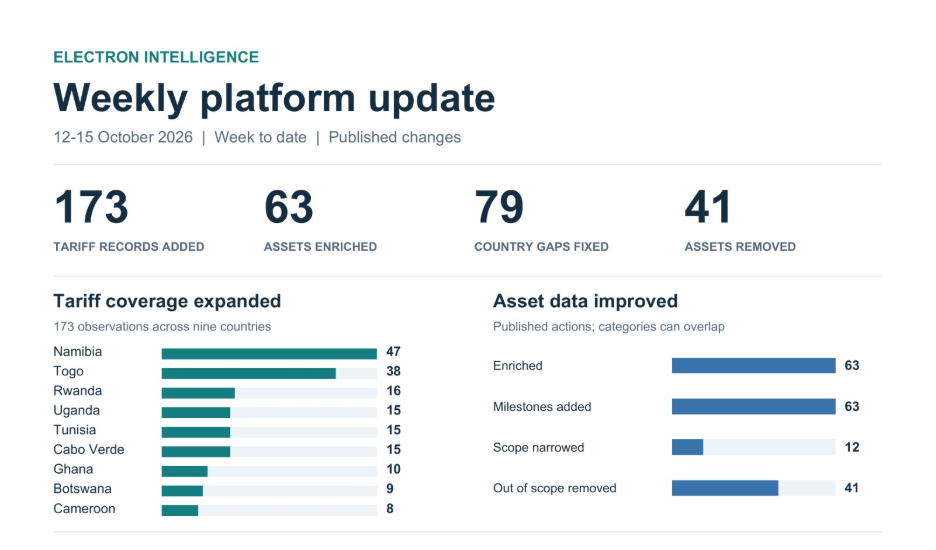
The update also enriched 63 existing asset profiles with additional project information and development milestones. Another 41 assets were removed following a review of their relevance to the platform's coverage, and the scope of 12 records was narrowed.
These updates improve the depth and consistency of EI's electricity pricing and asset data. The expanded tariff coverage supports comparisons across markets, while the asset revisions provide a more reliable basis for tracking projects and their development progress.
CHART OF THE WEEK: MINING DEMAND SUPPORTS POWER INVESTMENT WITHOUT MINE OWNERSHIP
Mines can support investment in renewable generation through electricity purchases without owning the plants. Independent suppliers own 15 of the 25 operating plants reviewed by Electron Intelligence across eight African countries. Mining companies own or co-own the remaining ten. The review draws on records from 2020–2026.
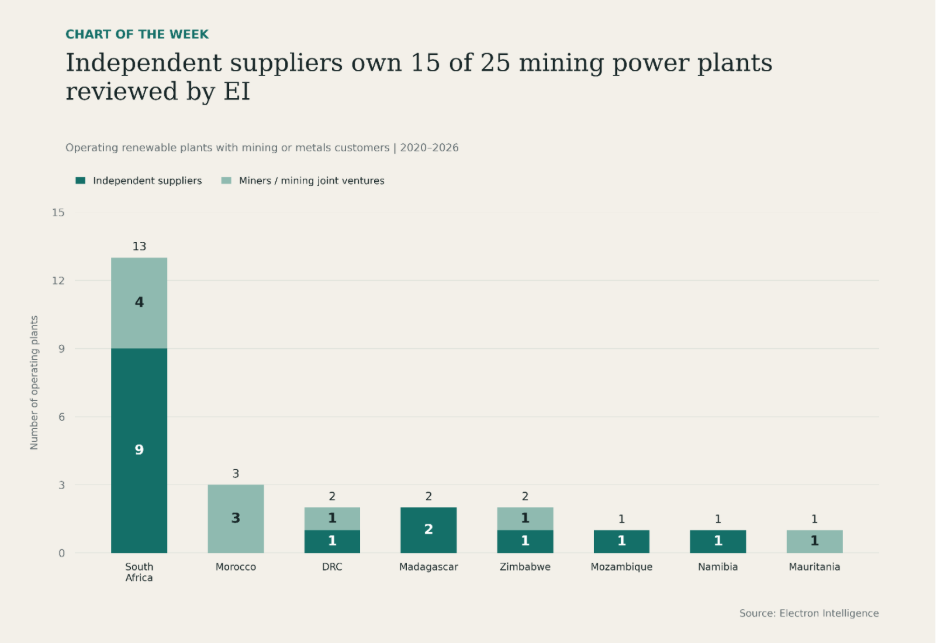
Nine of the supplier-owned plants are in South Africa, while six operate across five other countries. These arrangements allow power companies to invest against contracted mining demand. Mines secure electricity without funding the entire plant themselves, but remain dependent on the supplier to operate and maintain it. Miner-owned plants require a direct investment in generation alongside the mining business.
Ownership can also change after a plant starts operating. Caledonia developed the solar plant supplying Zimbabwe’s Blanket Mine, then sold the plant-owning subsidiary to CrossBoundary Energy for US$22.35 million in 2025. Blanket continues purchasing electricity under a 17-year PPA. The sale released capital for Caledonia while preserving the mine’s access to the plant’s output.
THIS WEEK’S DEEP DIVE
Morocco and Egypt show how private capital can finance grid infrastructure alongside public network operators
Morocco and Egypt are creating different commercial roles for private capital in electricity networks. Morocco’s proposed TAQA Morocco–Nareva partnership would develop and finance a 3,000 MW high-voltage direct current link, making the infrastructure available to ONEE. Egypt’s private electricity supply framework assigns certain connection works and costs to producers serving industrial customers. Approved projects involving Suez Steel, Ezz Steel and other users give that expenditure an identifiable purpose: connecting electricity production to industrial purchases.
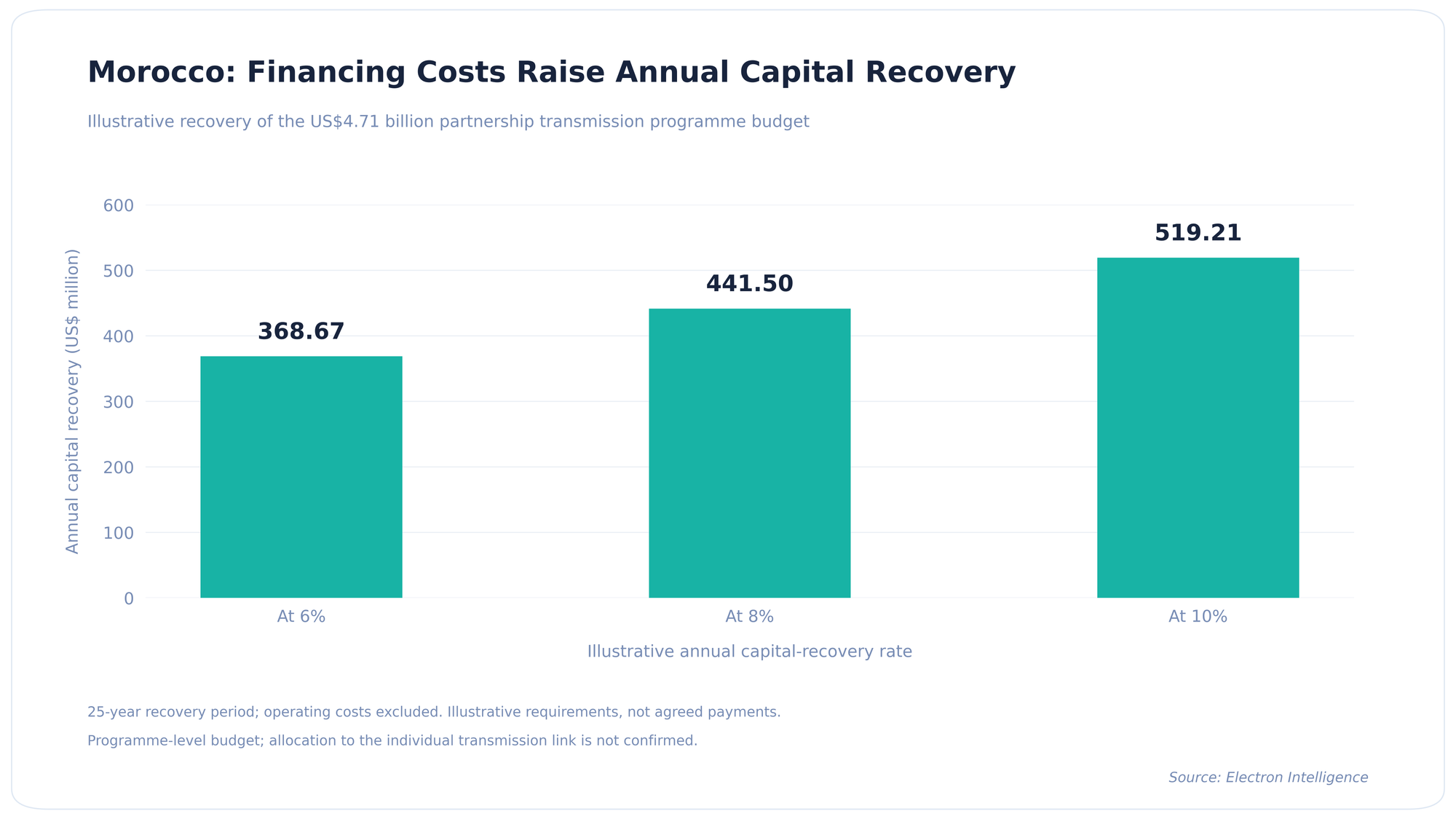
This week’s analysis examines how these arrangements could support investment recovery. Morocco’s dedicated development structure creates a potential transmission business whose income depends on the payment agreement with ONEE. Egypt’s connections support electricity sales, while eligible voltage arrangements could reduce network charges and improve the economics of supply. Illustrative calculations show how financing costs affect annual capital recovery and how delivered electricity volumes spread connection costs. The developments to watch include Morocco’s payment structure and procurement progress, alongside Egypt’s evolving market rules and the delivery of approved industrial supply projects.
ONE THING THAT STOOD OUT THIS WEEK
Solarise Africa secures funding to expand in Uganda and Zambia
Solarise Africa has secured approximately US$1.12 million (€1 million) from EEP Africa to expand its renewable energy leasing business in Uganda and Zambia. The company will match the grant, creating a 24-month programme targeting 3 MW of new capacity.
The funding addresses the cost of expanding a power business as well as installing equipment. It will support local operations, partnerships and project development. These activities help turn customer demand into projects that can be financed, installed and maintained.
The grant shares those expansion costs with Solarise Africa, while leasing allows customers to spread payments rather than fund installations upfront. The company aims to establish operations that can continue deploying projects after the grant ends. The announced funding therefore supports both an initial group of installations and the business needed to deliver further projects.
RESEARCH RADAR
South Africa: Eskom seeks an investment partner for 14-hour pumped storage
Eskom launched a partner-selection process on 13 October for the proposed 1.5 GW Tubatse pumped-storage project. Its approximately 21 GWh of storage would allow generation at full output for up to 14 hours.
That duration would allow the plant to supply electricity through longer periods of low wind and solar output. The financing proposal also leaves several revenue routes open, including a long-term agreement with the National Transmission Company South Africa and contracts with private buyers. How those payments are secured will shape the financing available to the project.
Africa: ZE-Gen funds deployment of alternatives to diesel generators
ZE-Gen announced funding on 7 October for ten clean-energy projects across eight African countries. The projects include solar-powered cold storage in Nigeria, battery-powered telecom infrastructure in Uganda and second-life battery systems in Rwanda.
The programme links electricity investment to specific uses, such as keeping food refrigerated and telecom towers operating. These deployments can provide evidence of operating costs, reliability and customer demand beyond small demonstrations. That evidence can help financiers assess whether the businesses can expand commercially.
Liberia: Mini-grid grants require developers to fund construction first
Liberia’s LESSAP II mini-grid programme scheduled developer prequalification to open on 8 October, backed by a US$3.95 million public funding allocation. It offers US$612 per verified customer connection, with grants capped at 80% of eligible project costs.
The payment structure matters: developers must finance construction before receiving grants. The subsidy reduces the cost they ultimately bear, but does not remove the need for construction finance. Access to that funding will therefore influence which developers can turn grant awards into operating mini-grids.
Mozambique: Gridworks begins contractor selection for transmission expansion
Gridworks invited contractors on 8 October to prequalify for Phases 2 and 3 of the Chimuara–Nacala transmission project. The construction package covers more than 400 km of lines and three substations. Gridworks is developing the project with Electricidade de Moçambique, supported by IFC.
The procurement gives the proposed investment a defined construction scope. The lines would strengthen electricity delivery to northern Mozambique and the Nacala corridor, allowing generation elsewhere on the network to serve those markets. Contractor prequalification advances preparation for delivery, although it does not establish financial close or construction commencement.