EI Research Desk: 438 Assets added to the EI platform, Chart of the Week, South Africa’s battery-storage contract, and Namibia’s Okatope solar project.
AFRICA’S POWER MARKET IS EXPANDING
The last 30 days show both the scale of activity entering Africa’s power pipeline and the smaller share reaching close. Electron Intelligence logged 25 announced deals worth $761 million and six closed deals worth $129 million. Twenty-four assets totalling 3.1 GW were announced, while one 49 MW asset reached financial close.
We also added 438 assets to the platform including historical projects dating back to 2020. These figures capture a market with a growing pipeline, but announcements and financial close mark different stages of progress. EI will continue following the projects, transactions and companies behind those numbers as new capacity moves towards operation.
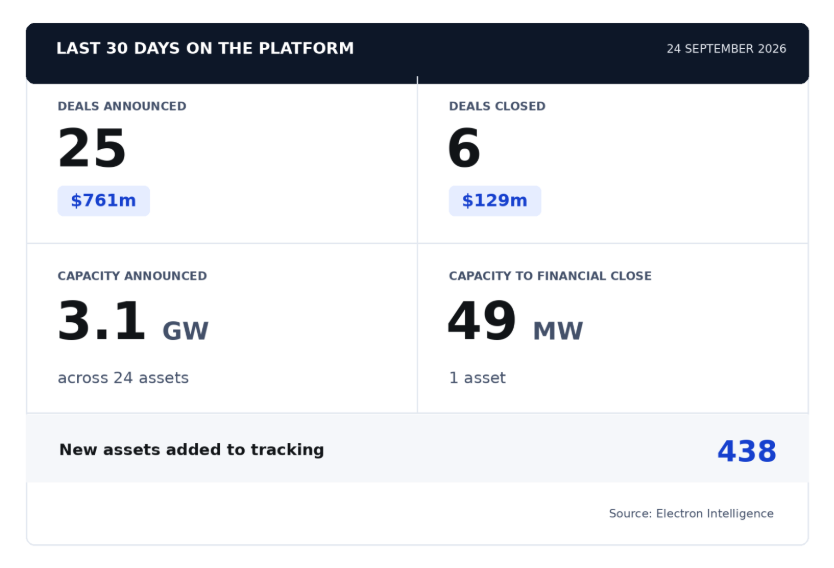
CHART OF THE WEEK: ENERGY TRADERS ARE AGGREGATING SOLAR DEMAND AT SCALE
Energy traders are creating a larger route to market for solar projects than the number of agreements alone would suggest. Electron Intelligence tracks 2.02 GW across 11 solar power purchase agreements signed with energy traders, slightly more than the 1.92 GW covered by 25 direct corporate contracts. The median contract involving an energy trader is 150 MW, three times the 50 MW median for corporate buyers.
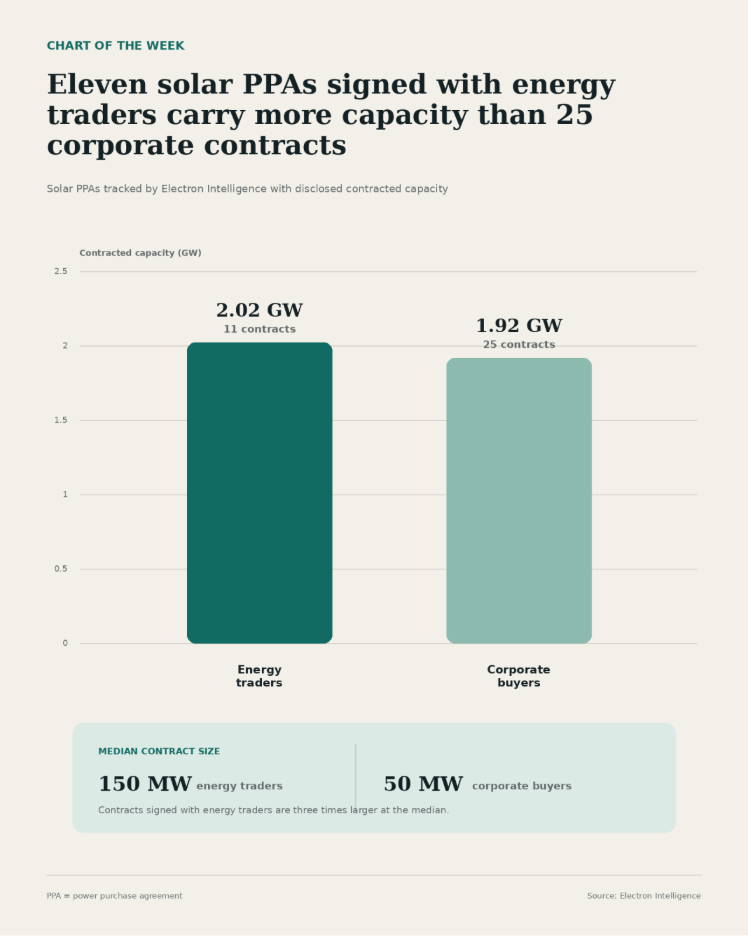
Direct corporate procurement remains important, but the capacity is distributed across a larger number of smaller agreements. Energy traders consolidate demand into bigger contracted blocks, allowing fewer contracts to support more generation capacity. The pattern shows how intermediaries can expand the market beyond companies able to procure large volumes of electricity independently and give generators a clearer route to multiple end users.
ONE THING THAT STOOD OUT THIS WEEK
Nigeria has commercially launched a $300 million Distributed Renewable Energy Fund to finance mini-grids, standalone solar systems and other decentralised power projects. Co-managed by the Nigeria Sovereign Investment Authority (NSIA)and Africa50, the fund has moved from structuring towards active capital deployment. The World Bank provided an initial $25 million contribution, while Sustainable Energy for All is supporting the platform.
The financing structure of this deal is what makes it stand out. Nigeria’s distributed-energy market has largely depended on individual facilities, grants and project-specific interventions. This fund creates a dedicated vehicle through which public and development capital can support a wider portfolio of projects and attract additional commercial funding. The $300 million represents the fund’s intended scale, rather than capital already deployed. Its significance will depend on how much additional capital is secured, which projects receive financing and how quickly that financing produces operating connections.
RESEARCH RADAR
South Africa: New construction contracts advance large-scale battery storage
Sterling and Wilson Renewable Energy has won a contract for two South African battery projects totalling 616 MWh. This puts a contractor behind a substantial amount of planned storage capacity, but the developer and delivery dates have not been disclosed. As South Africa adds more wind and solar generation, projects like these will help determine how much electricity can be shifted to hours when renewable output falls.
Namibia: Okatope selection advances competitive solar procurement
NamPower has selected an ANIREP-led consortium for the proposed 20 MW Okatope solar project, one of six projects in its competitive procurement programme. The selection brings the project closer to a contracted buyer, though the final award and power purchase agreement remains outstanding. It also shows a second route taking shape in Namibia alongside privately traded power: solar developed through NamPower’s procurement process.
AfDB grants target the development work behind green hydrogen in 4 countries
The African Development Bank has announced $20 million in grants for green-hydrogen projects in Egypt, Morocco, Namibia and South Africa. Green hydrogen requires large volumes of electricity, so the projects could create demand for new renewable generation. The grants address an earlier stage: preparing projects for investment. The scale of power capacity that follows will depend on which proposals secure customers, financing and delivery arrangements.