EI Research Desk: 475 transaction participant links added, This week's deepdive, and Burundi’s US$1.4 billion distribution partnership.
EXPANDING TRANSACTION COVERAGE AND IMPROVING ASSET DATA
This week, Electron Intelligence added 475 transaction participant links, strengthening the relationships between financing transactions and the companies involved. The update also introduced four new transactions and expanded manufacturing sector coverage to 33 records, improving how users can identify and compare investment activity across sectors.
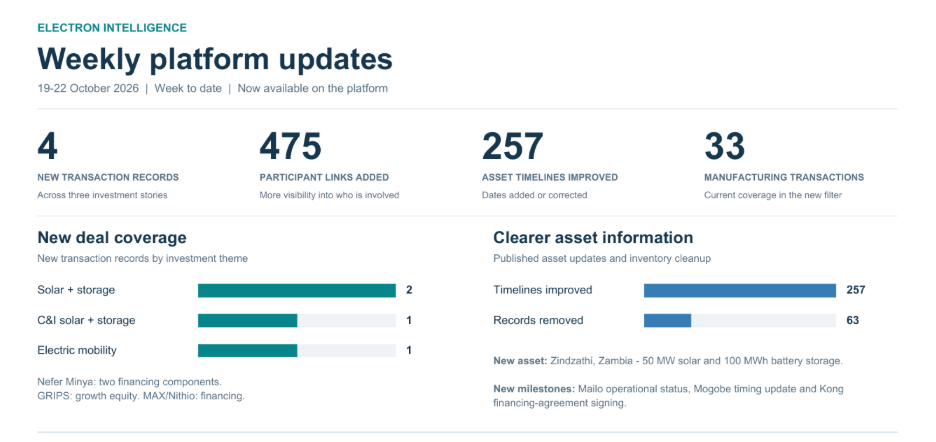
These updates improve the consistency and usability of EI's investment data. More complete participant information makes it easier to identify the organisations involved in transactions, while improved asset timelines and sector classifications provide a clearer basis for tracking project development and comparing financing activity across African energy markets.
CHART OF THE WEEK: HOW E-MOBILITY COMPANIES COMBINE EQUITY AND DEBT
Total fundraising figures mask significant variation in how electric-mobility companies fund their growth. In five financing packages tracked by Electron Intelligence from 2023 to 2026, debt accounted for 16% to 53% of overall disclosed capital. While Ampersand, Roam, and Dodai used a mix of approximately 60% equity and 40% debt, Kofa relied more heavily on debt than equity, supplemented by grant funding.
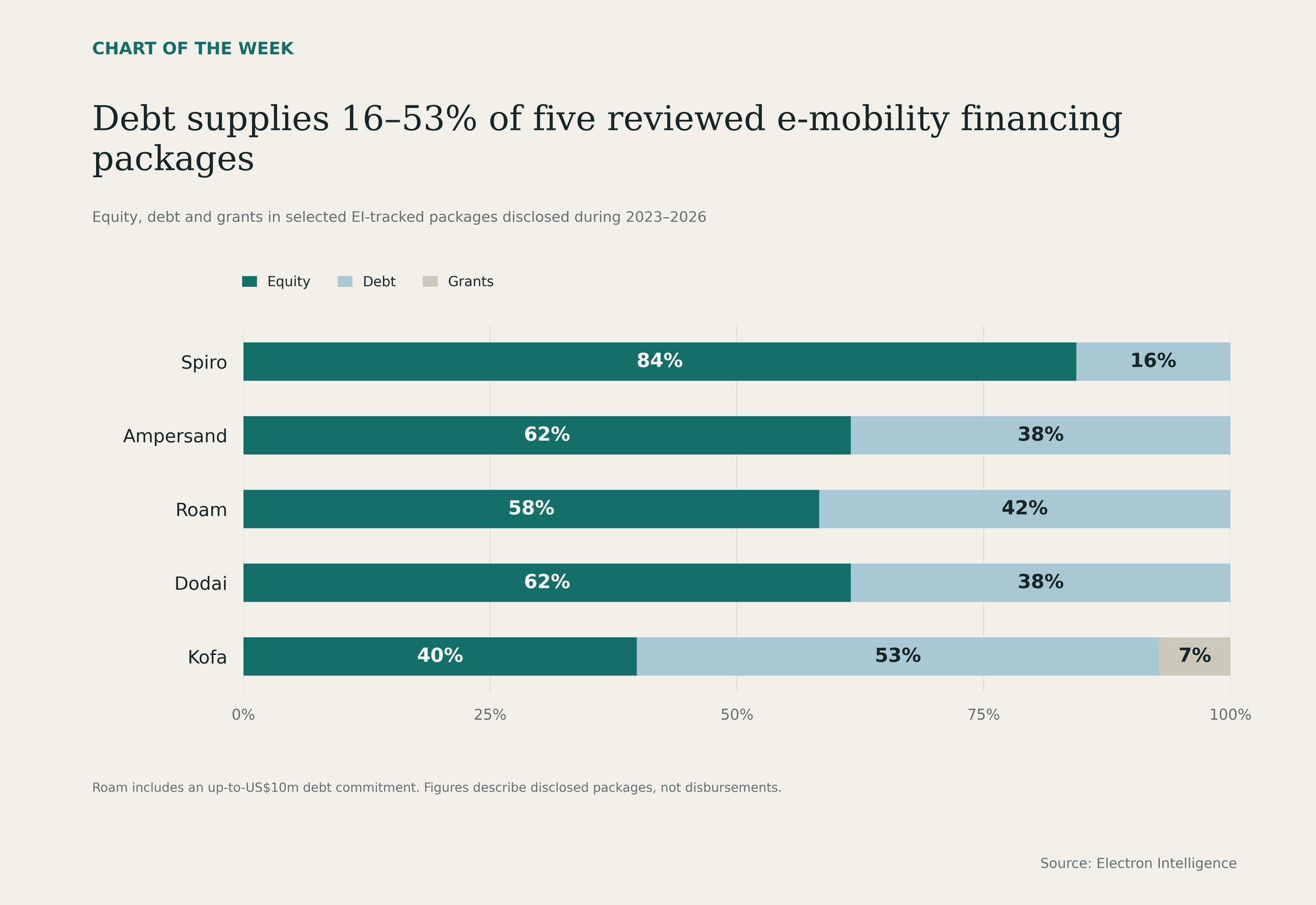
Spiro’s financing leans heavily toward equity, which makes up 84% of its reviewed capital package. This distinction is critical because identical fundraising totals can carry drastically different financial burdens. Unlike equity, which supplies capital without scheduled debt service, borrowing requires ongoing cash flow to cover repayment obligations. Evaluating a company’s financing therefore requires looking beyond the total figure to analyze its balance of equity, debt, and grants; as well as the specific assets and operations each funds.
The comparison covers selected disclosed packages, including Roam’s up-to-US$10 million debt commitment. It does not measure disbursements or the financing mix of the entire market.
THIS WEEK’S DEEP DIVE
Southern Africa’s interconnector pipeline could widen electricity trade and create new roles for private capital.
Southern Africa’s existing electricity market provides a commercial foundation for cross-border transmission investment. Network restrictions prevent some exchanges within the Southern African Power Pool, while proposed interconnectors could connect additional suppliers and buyers. Zambia-Tanzania would link the Southern African and Eastern African power pools, while Kalumbila-Kolwezi could strengthen access to the Copperbelt. These projects offer different trading benefits, with their contribution depending on the domestic networks feeding each connection. Wider market access does not automatically resolve the bottlenecks restricting existing trade.
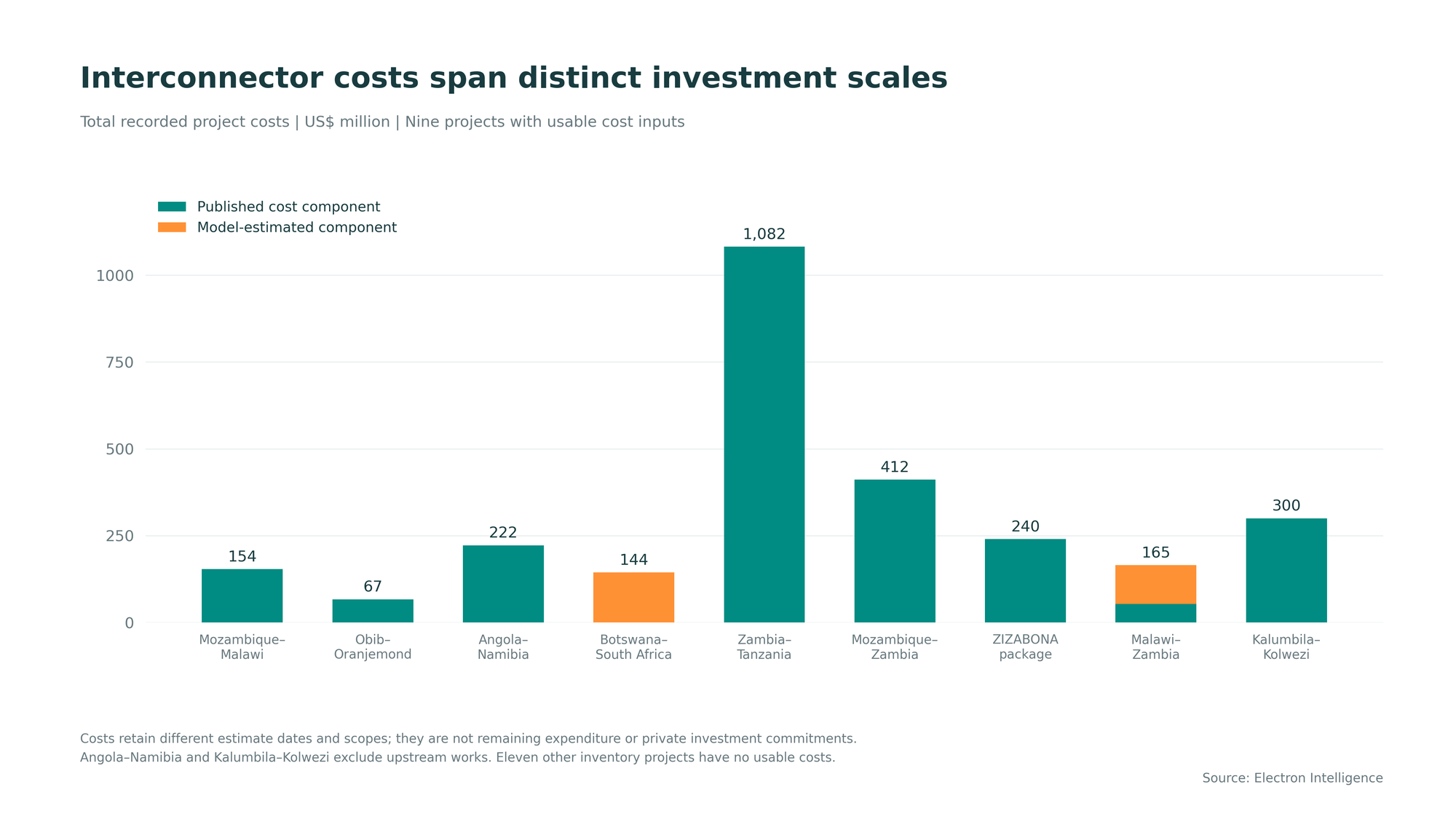
This week’s analysis examines how these opportunities translate into infrastructure investment, coordinated delivery and routes for private participation. Project costs cover different scopes, from individual links to programmes incorporating domestic reinforcement. Delivery scenarios illustrate how construction schedules and supporting works affect when those investments could become operational. Kalumbila-Kolwezi’s proposed ownership and financing arrangements show how developers, equity investors and financing partners can participate, while transmission payment agreements determine how expenditure is recovered. Developments to watch include committed financing, disclosed payment terms and further development mandates that could extend private participation across the regional pipeline.
ONE THING THAT STOOD OUT THIS WEEK
Burundi has signed a landmark 25-year partnership for private investment in electricity distribution, unlocking an unprecedented $1.4 billion in private capital.
Burundi signed a public-private partnership with Weza Power, an Anzana Electric Group company, on 15 October. The agreement is intended to mobilise US$1.4 billion and deliver more than 1.2 million new household and business connections. Weza Power will invest in, expand and operate distribution infrastructure across roughly half the country, while REGIDESO retains distribution responsibility elsewhere and continues supplying electricity through the national transmission network.
The significance lies in making distribution expansion a defined investment opportunity. The concession combines private capital and concessional financing with tariff and service-performance obligations, linking investment in the network to responsibility for delivering electricity to customers. The US$1.4 billion represents intended mobilisation under the partnership, rather than capital already deployed. Its commercial importance will depend on how connection funding, customer revenues and operating costs support sustained network expansion.
RESEARCH RADAR
Côte d’Ivoire: Kong Solaire secures long-term financing as construction advances
On October 16, Kong Solaire secured a 20-year long-term financing agreement from FMO to fund its 50 MWp solar plant in northern Côte d’Ivoire, where construction is already underway ahead of a planned 2028 commissioning. The project is backed by a 25-year power purchase agreement with CI-ENERGIES, creating a contracted revenue window that extends past the debt maturity to ensure full repayment. FMO is providing the entire loan package, highlighting how development finance institutions remain essential in advancing private solar projects from development to construction.
Nigeria: EBRD finances smart metering through Beacon Power Services
The European Bank for Reconstruction and Development (EBRD) is backing Beacon Power Services’ expansion of smart metering and digital grid-management solutions in Nigeria with a senior corporate loan of up to $10 million. Supporting deployment across six of the country’s 11 electricity distribution companies (DisCos), the transaction offers a centralised route to finance utility improvements via a single technology partner. By integrating smart meters with network data, the platform helps DisCos pinpoint revenue leakages and improve collection efficiency, enabling utilities to recover more income from the power they already deliver.
Africa: Africa50 and NTPC partner on generation and electricity trading
Africa50 and India’s NTPC have signed a strategic cooperation agreement to develop power-generation projects and cross-border electricity-trading opportunities across Africa. The partnership pairs Africa50’s capabilities in project selection, government engagement, and financial structuring with NTPC’s expertise in engineering, feasibility assessment, and operations; combining essential development and financial capabilities while evaluating generation capacity against broader regional demand. While the agreement establishes a framework for collaboration, specific projects, investment commitments, and timelines have not yet been disclosed.