EI Research Desk: 876 assets classified by electricity end use, South Africa's residential battery market, e-mobility financing, and Egypt's industrial solar investment.
EI Research Desk: 876 assets classified by electricity end use, South Africa's residential battery market, e-mobility financing, and Egypt's industrial solar investment.
EXPANDING ASSET COVERAGE BY ELECTRICITY END USE
This week, Electron Intelligence added 13 transactions, four assets and two power purchase agreements to the platform. We also introduced 11 electricity end-use categories, allowing users to identify projects by the customers and economic activities they serve, including mining, industry, agriculture, healthcare and public services.

The classification now covers 876 of the 917 tracked assets, representing 95.5% of the platform's asset inventory. Industry and commerce account for 99 classified assets, followed by mining with 46 and agriculture with 24. A new public services filter also makes it easier to identify electricity projects serving government facilities and essential services.
For platform users, the update adds another way to assess energy investment activity. Projects can now be examined by their intended electricity use, helping users identify where generation and infrastructure development are linked to specific sectors of the economy.
CHART OF THE WEEK: MORE FINANCING EVENTS DO NOT NECESSARILY MEAN MORE FINANCING OPTIONS
The number of banks appearing in power-sector transactions can overstate the breadth of regular financing activity. EI’s review identifies 17 banking groups, but repeated participation is concentrated among a much smaller group. For developers, this distinction matters: a bank with one disclosed transaction represents a different financing relationship from an institution repeatedly arranging or lending to projects.
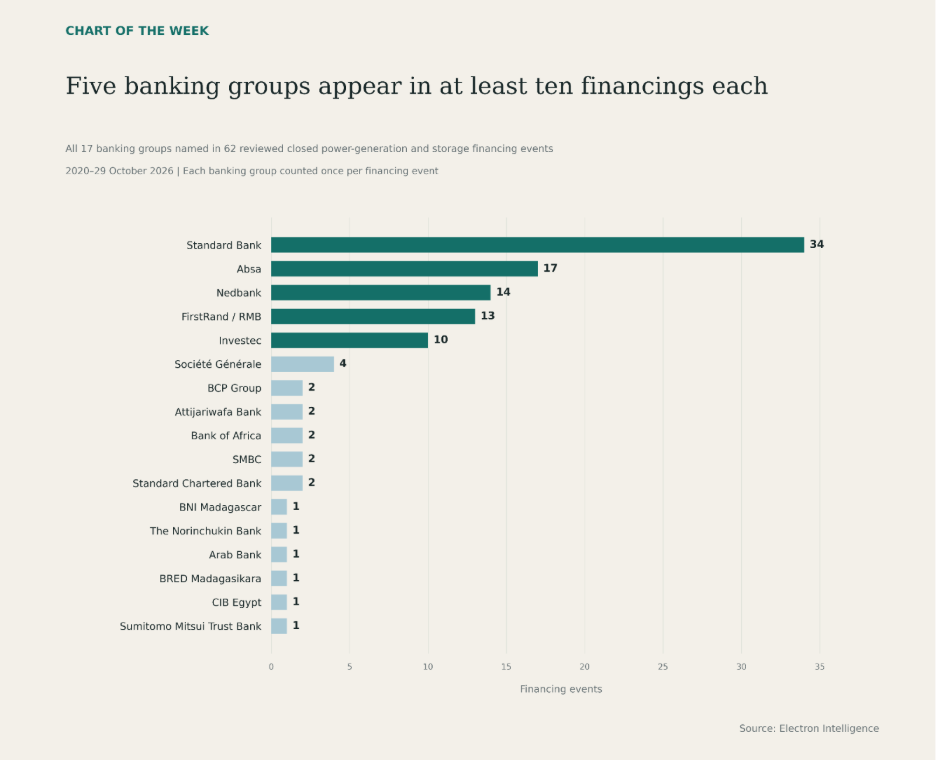
The pattern suggests that established banking relationships remain important to project delivery. Experience with power contracts, construction risks and repayment structures can be reused across successive financings, helping explain why the same institutions recur. South Africa accounts for 48 of the 62 reviewed events, so its established project-finance market strongly shapes the result. The useful measure of broader participation is therefore whether occasional lenders return for further transactions, extending the group of institutions with repeated project-financing experience.
THIS WEEK’S DEEP DIVE
Customer savings and dependable delivery shape the commercial opportunity in South Africa’s residential battery aggregation market
South Africa’s household batteries provide a foundation for virtual power plants built around equipment customers already own. Investment centres on connecting those systems, securing permission to manage them and coordinating their response. Equipment partnerships such as Plentify–Deye offer routes to existing installations, while electricity savings provide a basis for paid household optimisation. The commercial opportunity extends from these customer services to contracts that compensate aggregated portfolios for supporting the grid.
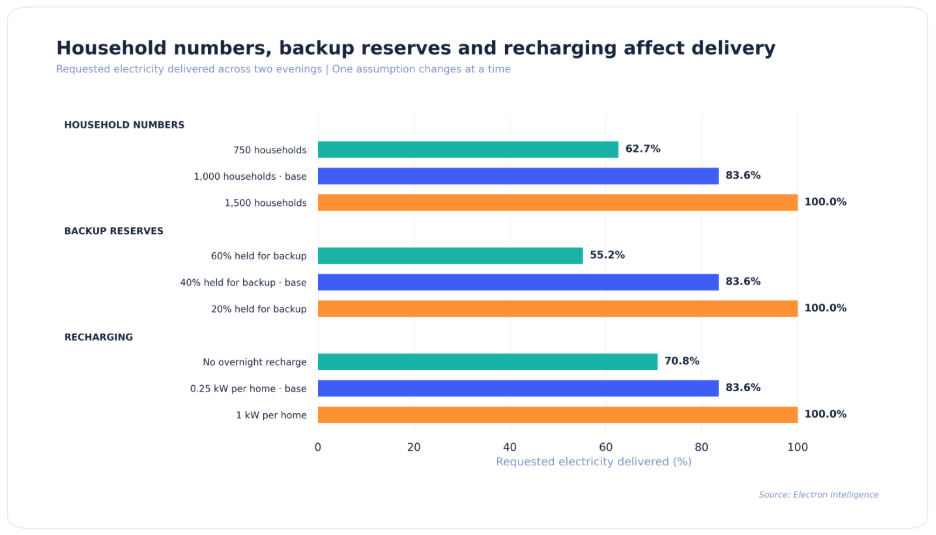
This week’s analysis examines how those activities translate into revenue and operating obligations. Illustrative calculations show how seasonal tariffs affect customer savings after service fees, and how backup reserves and recharging shape delivery across successive events. Greater enrolment expands the resource, but improved coordination also increases the service available from connected batteries. Standby and dispatch payments offer different revenue structures, with customer compensation and operating costs determining what remains to support growth. EI will track customer enrolment, grid-service contracts and market-rule developments that establish how residential portfolios can participate and earn income.
ONE THING THAT STOOD OUT THIS WEEK
Egypt’s industrial solar financing combines a long-term buyer with government backing
Scatec has signed $217 million of non-recourse financing for the first phase of its Dandara project, which will supply Egypt Aluminium. The development combines 569 MW of solar with 100 MWh of battery storage under a 25-year power purchase agreement backed by a sovereign guarantee. EBRD, AfDB and EIB are providing the debt, covering approximately 80% of the phase’s $271 million estimated construction cost. National Bank of Egypt will take a 20% ownership stake.
The financing shows how industrial demand and public financial support can work together to fund dedicated renewable supply. Egypt Aluminium provides the long-term electricity demand, while the sovereign guarantee supports the payment commitment on which lenders depend. Lower-carbon power also serves an industrial objective: helping Egyptian aluminium meet evolving environmental requirements in export markets. With construction beginning and first-phase operation targeted for the first half of 2028, the project connects electricity investment directly to manufacturing competitiveness.
RESEARCH RADAR
Nigeria: BII’s $7 million Okra facility finances equipment ahead of project orders
British International Investment has announced a $7 million debt facility for Okra Solar to support equipment procurement for approximately 150,000 new electricity connections, primarily in Nigeria. Okra supplies mesh-grid technology, which allows neighbouring households and businesses to share solar generation and battery storage.
The financing addresses the cash needed before equipment reaches a project. Previously, Okra ordered components after individual transactions closed. The facility allows earlier purchasing and larger orders, helping reduce costs and delivery times. For developers, having equipment available sooner can reduce procurement delays between securing a project and connecting customers. The 150,000 connections represent the facility’s intended reach, rather than connections already delivered.
Uganda–Tanzania: Procurement notice sets out the next interconnector contracts
UETCL has published a general procurement notice for Uganda’s portion of the 400 kV Uganda–Tanzania Interconnector Project. The scope covers approximately 258 kilometres of transmission lines from Wobulenzi through Masaka to Mutukula, a new Masaka substation and an extension to Wobulenzi substation. Contractor prequalification is planned for three main construction packages.
The development gives contractors a defined procurement pipeline and advances the infrastructure required for greater electricity trade between the two countries. A stronger connection would widen the market available to generators and give utilities more options for sourcing electricity. Those benefits require coordinated delivery of the transmission infrastructure on both sides of the border.
Togo: Nuclear cooperation agreement includes floating power plants as an option
Rosatom and Togo’s energy ministry signed a memorandum on peaceful nuclear cooperation on 28 October. The agreement establishes working groups to assess potential projects, workforce requirements and nuclear applications beyond electricity generation. Rosatom identified floating nuclear power units as one possible area of cooperation.
The significance is the prospect of adding nuclear generation through offshore units, expanding the technology options available to coastal electricity markets. However, the agreement establishes an assessment process rather than a committed power project. Any commercial proposition would need to define the electricity buyer, tariff, financing and allocation of responsibilities for operation, fuel and decommissioning. Those arrangements will determine what the technology would cost the host country and which obligations it would retain.
Chad: Humanitarian agencies buy solar electricity through a service contract
The UK-backed ZERO initiative is piloting solar and battery supply for UN agencies in Chad. Its first installation is operating in N’Djamena, with a second under development. Agencies pay an agreed electricity tariff, while the Access to Energy Institute finances, builds and operates the systems through local partners. ZE-Gen reports energy-cost reductions of at least 25%.
The model shifts equipment financing and maintenance responsibilities from humanitarian agencies to the electricity provider. It creates a route for spending previously committed to diesel to support renewable supply without a large upfront equipment purchase. Expansion funding is being sought to extend the model to additional humanitarian facilities.