EI Research Desk: Africa’s private transmission pipeline, Nigeria’s $550 million power-sector bond, Kamoa-Kakula’s solar-and-storage project
CHART OF THE WEEK: BATTERY STORAGE IS SCALING IN ONE MARKET
Africa’s tracked standalone battery-storage pipeline is moving beyond announcements, but construction remains concentrated in South Africa. Electron Intelligence tracks 412 MW and 1,645 MWh across three projects under construction, almost six times the 71 MW of disclosed operational capacity. Oasis 1 and Red Sands alone account for 410 MW of the construction-stage total.
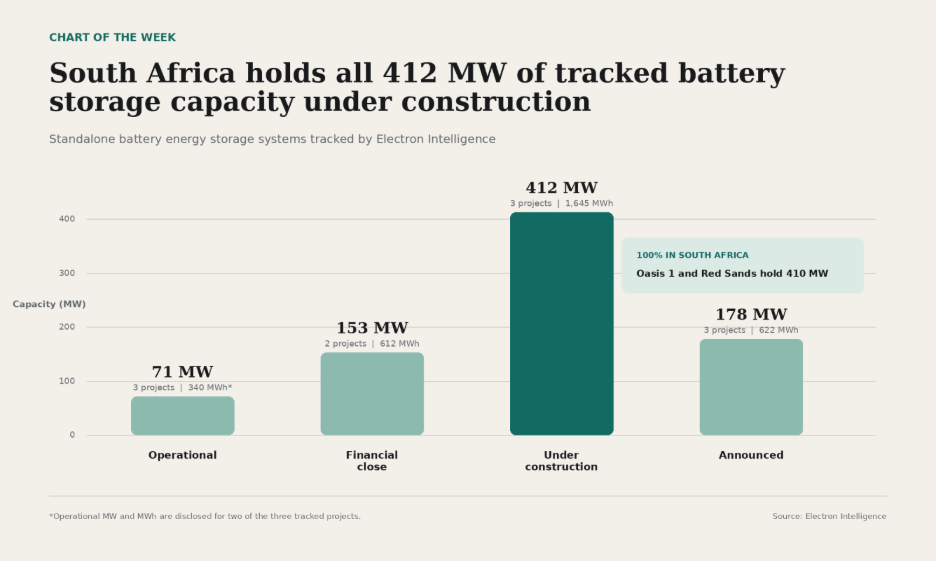
A further 153 MW has reached financial close, while 178 MW remains at the announced stage. The buildout is advancing, but South Africa currently carries the construction pipeline. Broader deployment across Africa will depend on other markets putting in place procurement programmes, bankable revenue structures and clear grid arrangements that can support projects through financing and construction. That is the market development EI is committed to making legible.
THIS WEEK’S DEEP DIVE
Africa’s private transmission pipeline is growing faster than its financing evidence
African governments are turning to privately developed transmission projects to expand constrained electricity networks without relying entirely on public balance sheets. The projects reviewed represent approximately $3.56 billion of reported investment across Uganda, Kenya, South Africa and Angola. However, only Uganda’s $50 million Amari project can be matched to publicly confirmed financial close. Kenya has signed a $311 million availability-based concession, while the larger South African and Angolan opportunities remain at procurement or development stages.
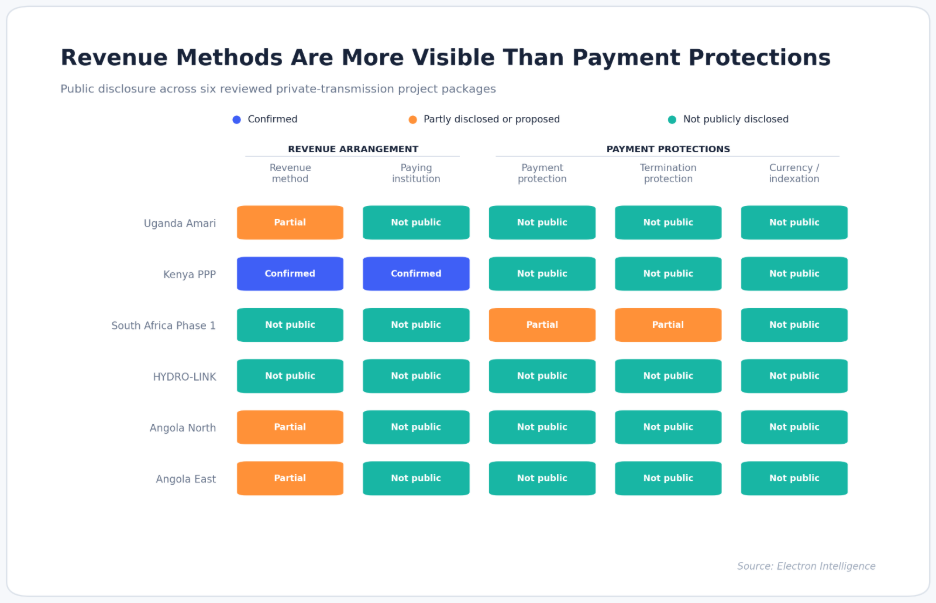
The pipeline therefore contains several distinct financing opportunities rather than one pool of construction-ready assets. Private participation can mobilise capital and delivery expertise, but recoverability will depend on who pays for network availability, how payment obligations are secured, and how construction, currency and political risks are allocated. EI will track whether the first projects reach financial close, establish reliable payment records and create structures that can be replicated across Africa’s transmission market.
ONE THING THAT STOOD OUT THIS WEEK
Nigeria completed an approximately $550 million bond issuance to settle verified legacy obligations in its electricity market. The Series 2 transaction comprises about $303 million in cash bonds and $247 million in non-cash bonds allocated to participating generation companies. It covers 11 companies representing 21 power plants and brings total issuance under the programme to approximately $928 million.
The bond converts part of the sector’s accumulated debt into a structured government-backed obligation. This should provide liquidity and greater certainty around outstanding claims. Its impact on the market will also depend on whether collections, revenue assurance, loss reduction and payment discipline improve sufficiently to limit the accumulation of new arrears.
RESEARCH RADAR
DRC: Solar and storage begin supplying round-the-clock power to Kamoa-Kakula
CrossBoundary Energy has started commercial operations at a 233 MWp solar and 526 MWh battery-storage facility supplying the Kamoa-Kakula copper complex in the Democratic Republic of Congo. The system is contracted to deliver a 30 MW continuous power block with 95% availability.
The project shows how solar and storage are moving beyond supplementary daytime generation towards firm industrial power. It reached commercial operation 16 months after the power purchase agreement was signed. Its performance will help determine whether the structure can be replicated across African mining markets where grid constraints and diesel costs support demand for private generation.
Zambia: ZESCO signs a 25-year PPA for ENERSYNK’s 500 MW solar project
ZESCO has signed a 25-year power purchase agreement with Hungary-based ENERSYNK Group for a proposed 500 MW solar project in Zambia. The agreement follows regulatory approval from the Energy Regulation Board and legal clearance from Zambia’s Attorney General.
The PPA provides a long-term revenue framework, but it does not mean financing or construction has been completed. The next milestones are the disclosure of the tariff and payment-security structure, completion of technical and environmental studies, financial close and the start of construction. These will determine whether the full 500 MW progresses from Zambia’s announced pipeline into operating capacity.
Kenya: Record electricity demand lifts KenGen’s revenue
KenGen reported a 6.4% increase in annual revenue to approximately $463 million, supported by higher electricity sales as Kenya’s peak demand reached a record 2,549 MW. The company supplied 8,975 GWh during the year, representing 57.2% of the electricity delivered to the national grid.
Demand growth is strengthening KenGen’s operating position, but it is also increasing the need for dependable new capacity. KenGen plans to advance geothermal, hydropower, solar and battery projects, with an ambition to add approximately 5.5 GW of renewable capacity by 2034. The important measure will be how quickly this pipeline is converted into commissioned capacity as demand continues to rise.