EI Research Desk: Coverage grows from 1,421 deals worth $65.63 billion to 2,179 worth $93.06 billion, commercial banks financing South African solar, industrial demand for private transmission, and the Global Grids Accelerator.
A BROADER VIEW OF AFRICA’S POWER MARKET
Since 21 September, Electron Intelligence’s coverage has grown from 1,421 deals worth $65.63 billion to 2,179 deals worth $93.06 billion. We now also track 941 assets. The expansion adds 758 deals and $27.43 billion in tracked deal value.

This deeper coverage helps us place current developments within the market’s longer history. Connecting projects with their financing, counterparties and development milestones gives us more evidence to identify recurring relationships and analyse how Africa’s power market is evolving.
CHART OF THE WEEK: COMMERCIAL BANKS SUPPORT SOUTH AFRICA’S SOLAR BUILDOUT
Commercial banks are participating in the financing of new solar generation in South Africa. Across six selected projects reporting financial close in 2026 and tracked by Electron Intelligence: Standard Bank participates in five, Absa in four and Nedbank in three. Standard Bank, Absa and Nedbank appear together in Notsi, Middlepunt and Beaufort West. The counts capture disclosed lending or arranging roles, rather than the amounts provided.
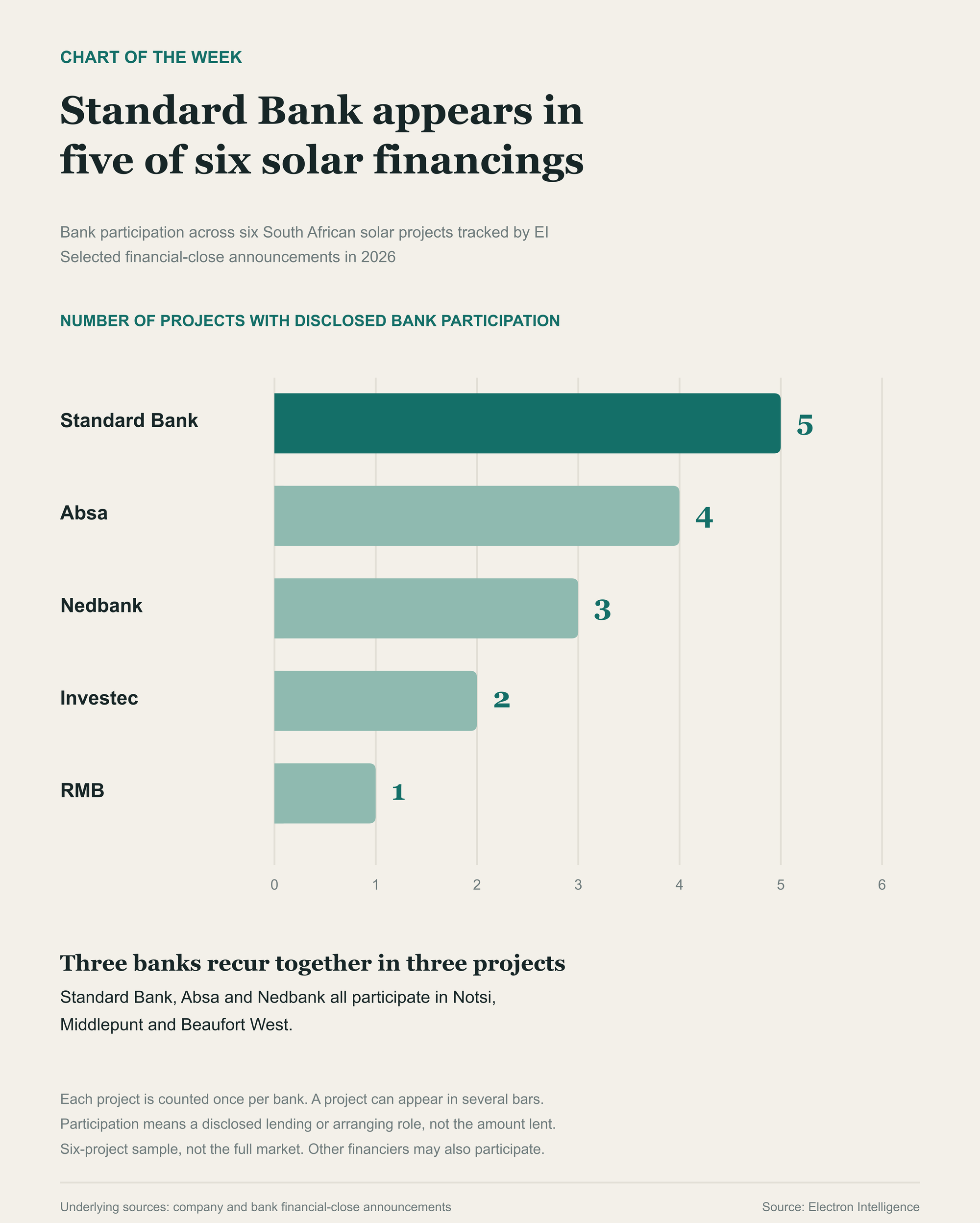
Their participation show that these projects are securing commercial bank support alongside their generation and power-sale arrangements. The recurring relationships also reveal how that support is organised: different projects draw on some of the same banks, rather than a separate financing group for every development. Commercial banks’ appetite for additional power-sector exposure therefore matters to the continued expansion of this project base. The six-project sample demonstrates their role in completed financings; it does not measure their share of financing across the wider market.
THIS WEEK’S DEEP DIVE
Industrial demand could help shape Africa’s next private transmission projects
South Africa’s and Kenya’s planned transmission corridors pass through mining regions, ports, industrial centres, and processing economies. These activities could provide a demand foundation for network investment, but nearby businesses are not yet publicly identified as contractual anchors for the reviewed projects. A clear precedent for this strategy can be seen in MOTRACO (the Mozambique Transmission Company). There, Mozal’s initial 425 MW electricity requirement shaped a $93 million transmission investment, which was later reinforced to provide 850 MW. Transmission tolls were intended to cover financing and operating costs.
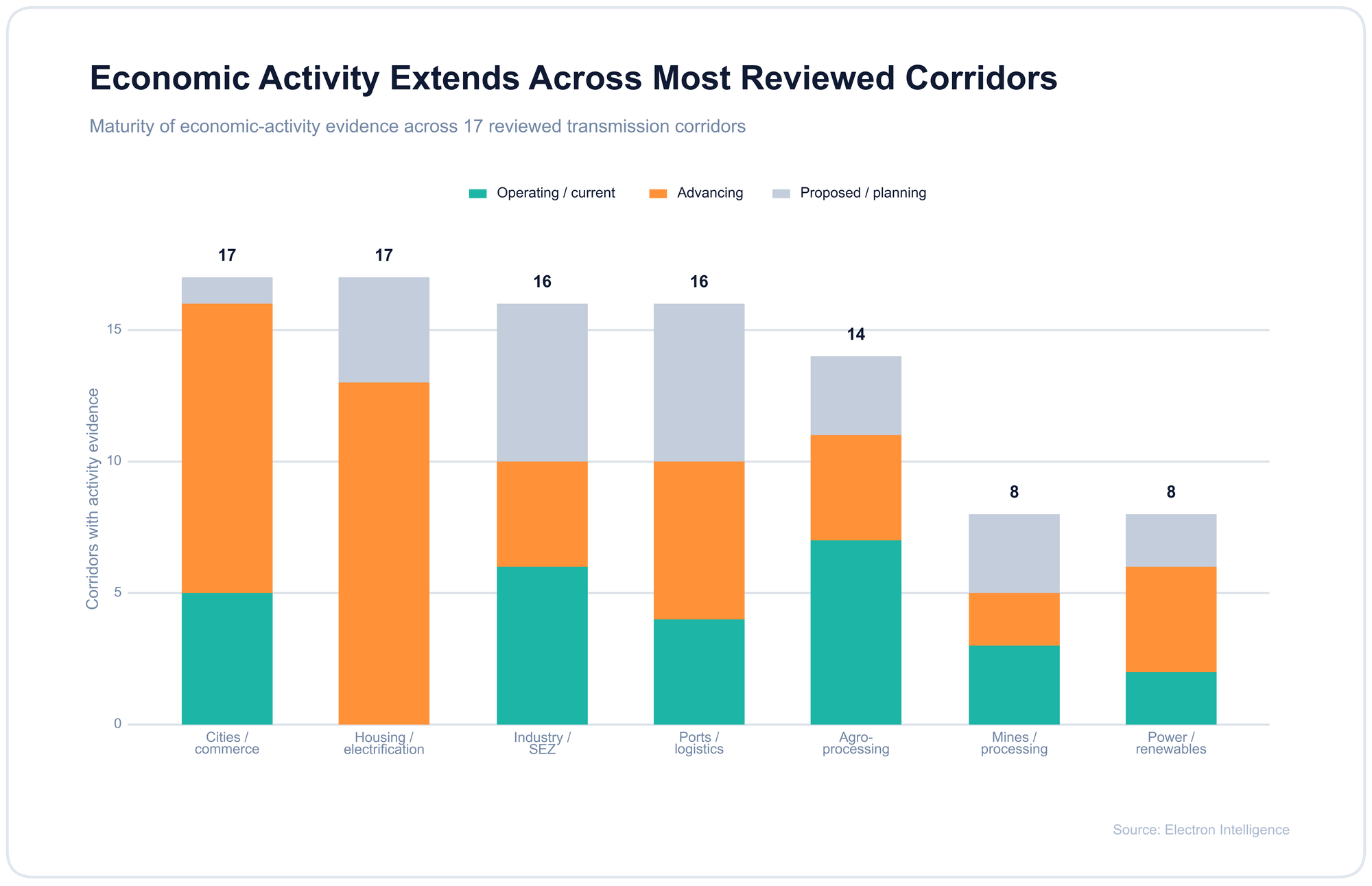
This week’s analysis examines how identifiable demand could help determine transmission capacity and support capital recovery. Kenya’s planned but unassigned Voi–Taveta and Sotik–Kilgoris corridors offer two different starting points: a dispersed logistics and commercial economy, and a more defined group of industrial processors. Neither is yet a proven industry-backed project. Their potential depends on establishing actual electricity requirements, dependence on additional network capacity and willingness to make long-term commitments. EI will track whether capacity reservations, user contributions and development agreements bring these economic users into the project structure. Read the deepdive here
ONE THING THAT STOOD OUT THIS WEEK
New co-ordination for Africa’s grid investment
The United Nations has launched the Global Grids Accelerator to help advance electricity-network investments in Africa and South-East Asia. Announced on 23 September, the initiative brings policy, technical, financing and implementation partners together around grid priorities identified by governments. In Africa, it will support existing programmes, including Mission 300 and regional interconnections.
The significance lies in how projects move towards financing and delivery. A transmission priority needs more than recognition in a national plan: it needs preparation, workable commercial arrangements and institutions capable of executing it. The Accelerator is intended to coordinate that support rather than establish another financing institution. For Africa’s power market, its practical contribution will become visible through the specific projects supported and the preparation and financing milestones they reach. Read more here
RESEARCH RADAR
Nigeria: UK-backed programme advances three small hydropower projects towards financing
The UK-funded Partnering for Accelerated Climate Transitions (UK PACT) programme has developed a pipeline of 79 small hydropower sites across Nigeria. According to UK in Nigeria, three priority projects have advanced to investment readiness: Ikere Gorge in Oyo State, Ghari Dam in Kano State and NESCO Cascade on the Jos Plateau. Discussions also covered a proposed $1 billion Small Hydropower Project Preparation Facility.
The development gives prospective financing partners specific projects to assess within a much larger pipeline. Project preparation can clarify technical requirements, costs and commercial arrangements, making individual sites easier to evaluate. Investment readiness remains distinct from financial close, and the proposed facility does not represent committed funding. The immediate significance is the preparation of identifiable projects around which financing discussions can proceed. Read more about it here
Zambia: Maamba’s 100 MW solar project begins supplying the grid
The 100 MWac Maamba Solar PV project injected its first electricity into Zambia’s national grid on 24 September, entering commissioning, according to ZCCM Investments Holdings. The announcement marks first power, and is nor a confirmation of full commercial operation.
The development adds evidence of delivery to Zambia’s expanding solar pipeline. Solar generation can diversify electricity supply and reduce reliance on rainfall-dependent output during daylight hours. Its contribution to reliable supply will become clearer as commissioning progresses and sustained generation is established. Read more about it here
Mozambique: Government proposes a financing coalition for off-grid electrification
Mozambique announced plans on 23 September to establish a Strategic Funding Coalition for Off-Grid Electrification. Its national electrification pathway identifies 2.5 million off-grid connections requiring an estimated $1.1 billion. The proposed coalition would coordinate concessional resources, guarantees, results-based financing and commercial capital.
The implication is a more coordinated approach to financing rural electricity access. Different instruments can support different needs, from early development expenditure to customer connections and expansion. The coalition’s initial work will identify financing gaps and develop a national roadmap; the announcement does not represent $1.1 billion of secured funding. Read more about it here
Botswana: New national plans link renewable power with local manufacturing
Botswana launched a Renewable Energy Power Sector Plan and a Clean Technology Manufacturing Policy and Investment Guide on 24 September. The instruments combine generation planning with opportunities in solar manufacturing and related industries, including access to regional markets.
The approach broadens the economic proposition around renewable deployment. Domestic generation demand could support equipment production, while regional sales could provide a larger customer base. Manufacturing viability will depend on procurement volumes, production costs and export access. The launch establishes a policy framework rather than announcing committed factories or manufacturing investment. Read more about it here
Access the full platform
Coverage of African power and renewables markets. Live deal tracking, asset profiles, electricity pricing index, PPA tracker and contracted energy pricing, and the import tariff & VAT data for African markets. Request access here