EI Research Desk: New solar landed cost model across six markets, Small-ticket energy financing trends, Zimbabwe's private power trading agreement, and Zambia's hydropower financing plans.
EXPANDING INVESTMENT DATA AND INTRODUCING THE LANDED COST MODEL
This week, Electron Intelligence introduced a new Landed Cost Model covering six African markets: Nigeria, Kenya, Egypt, South Africa, Morocco and Algeria. The dashboard allows users to compare estimated solar equipment import costs in US$/W DC, examine VAT treatment and test different cost scenarios. The model provides a more consistent basis for assessing how import costs vary across markets.
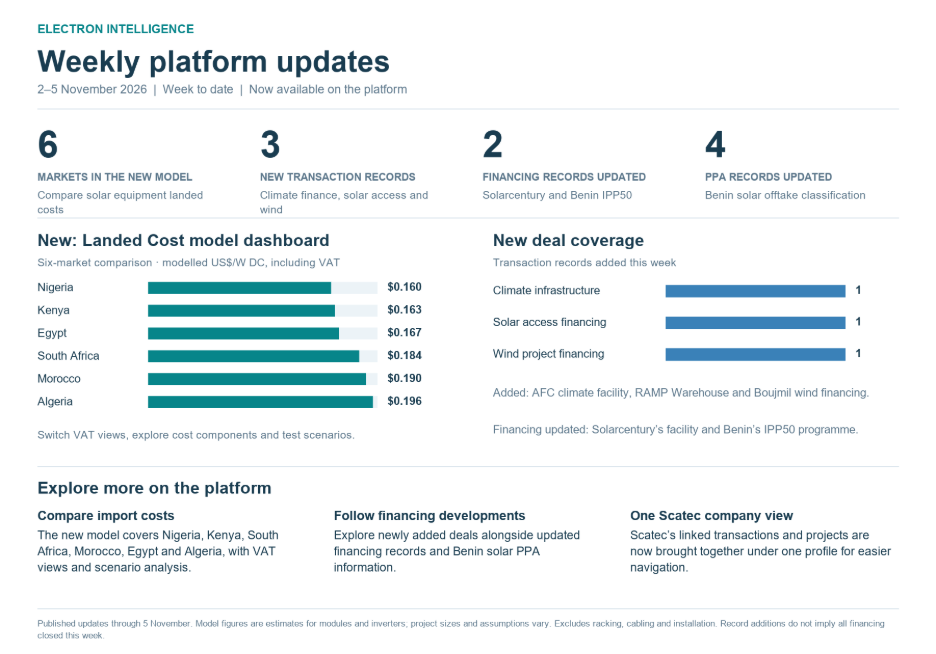
The platform also added three transaction records covering climate infrastructure, solar access financing and wind project financing. Two existing financing records were updated, alongside four PPA records relating to Benin's solar programme. We also consolidated Scatec's linked transactions and projects under one company profile to improve navigation.
These updates expand the platform's investment coverage and analytical capabilities. The Landed Cost Model provides a new resource for comparing solar equipment costs across countries, while the transaction, financing and PPA updates improve the information available for tracking investment activity and commercial arrangements across African energy markets.
CHART OF THE WEEK: WHERE SMALL-TICKET ENERGY FINANCING GOES
Small-ticket financing supports both energy businesses and the development of infrastructure. EI’s review identifies approximately $1.15 billion in disclosed commitments below $10 million between 2020 and 5 November 2026. Power generation accounts for 46% of that value. Clean cooking, energy technology and e-mobility together account for another 34%, showing that smaller commitments serve several parts of the energy market.
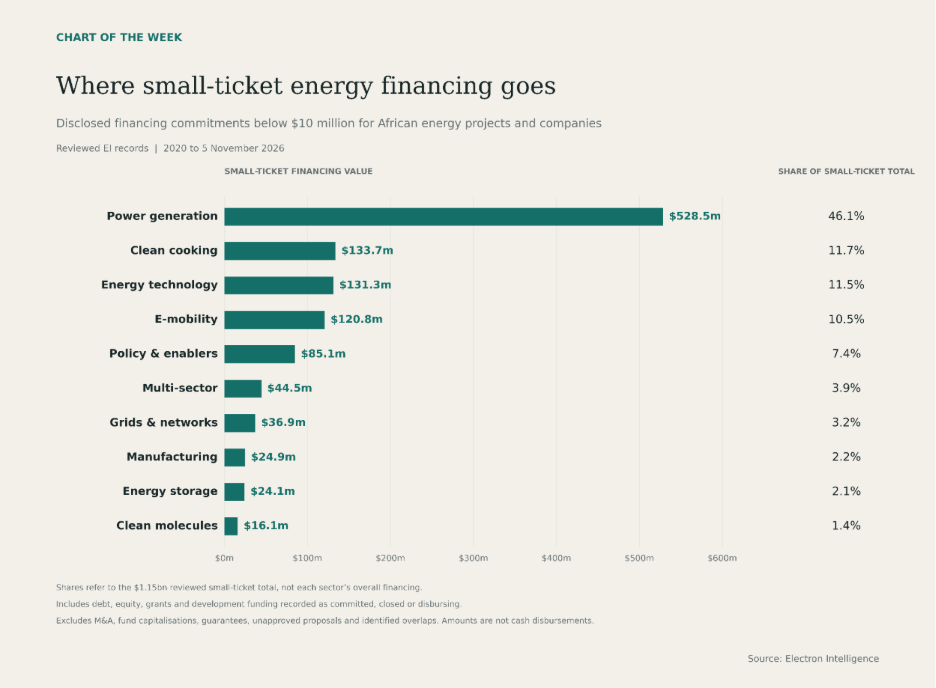
The distinction is what those commitments finance. Development funding can pay for studies and preparation before a large project secures construction finance. Company loans and equity can support equipment purchases, distribution and expansion. A small financing commitment therefore does not necessarily mean a small project or an early-stage company. The concentration in power generation shows why small-ticket capital deserves attention within infrastructure financing: some of its value lies in funding the work that precedes a much larger investment. Assessing its contribution requires following those commitments through to the projects and businesses they support.
EI RESEARCH DESK: ONE THING THAT STOOD OUT THIS WEEK
Zimbabwe’s Guruve-Mazowe project brings together utility and private-trader demand
ZimGreenCo has signed preliminary terms to purchase part of the electricity from the Guruve-Mazowe project, which Modaso Energy and Tatanga Energy are developing in Zimbabwe. ZESA is expected to be the principal buyer. The planned development combines 128 MW of wind and 100 MW of solar with battery storage, while Standard Bank is arranging the debt. Financial close is targeted for mid-2027.
The commercial significance is the addition of a buyer that can sell electricity to customers in Zimbabwe and across the Southern African Power Pool. That gives the developers access to demand alongside the national utility, potentially reducing dependence on a single purchasing relationship. How much this strengthens the financing will depend on the allocation of output and the payment obligations agreed with each buyer. The preliminary terms establish the intended structure; the final electricity contracts and committed debt will establish how the project’s revenues and risks are shared.
RESEARCH RADAR
Benin: Four solar plants secure financing agreements
AXIAN, Caisse des Dépôts et Consignations du Bénin, IFC and Proparco announced financing agreements on 29 October for four solar plants totalling 62 MWp. Located in Natitingou, Djougou, Parakou and Bohicon, the plants are expected to produce approximately 110 GWh annually once operational.
For Benin, the significance extends beyond additional solar capacity. The transaction combines government concessions, domestic investment and development-finance lending to fund privately developed generation. That structure provides a practical example of how the country can expand domestic supply and reduce dependence on imported electricity.
South Africa: PNE sells a 250 MW solar development
PNE announced on 2 November that it had sold a 250 MW solar project in the Free State to a South African independent power producer. PNE will continue supporting development through financial close. The sale therefore transfers ownership before construction financing has been completed
The arrangement illustrates how developers can earn a return from preparing projects without owning them through construction and operation. Continued development support also gives the buyer access to the original developer’s project knowledge. For investors, the distinction matters: acquiring a development-stage asset provides access to future capacity, while leaving financing and delivery obligations ahead.
Zambia: Ngonye Falls appoints banks to arrange construction financing
Western Power Company has appointed Standard Bank South Africa, Stanbic Bank Zambia and DBSA to structure and arrange financing for its $800 million, 180 MW Ngonye Falls hydropower project. The developer is targeting approximately $600 million in debt, with the balance funded through sponsor equity. The mandate advances fundraising but does not constitute financial close.
The significance is the combination of commercial and development-finance institutions in arranging a large construction loan. With debt expected to cover roughly three-quarters of project cost, financing terms and lenders’ assessment of construction risk, electricity payments and river flows will materially shape the investment. The run-of-river design adds generation capacity, but its output will still depend on water availability.
Egypt: UK Export Finance considers support for Scatec’s Energy Valley project
UK Export Finance published a notice identifying Scatec’s Energy Valley project as under consideration for support. The development includes 1.95 GW of solar generation, battery storage at three locations and associated grid infrastructure. The notice is an environmental disclosure, rather than confirmation of financing approval.
The project’s design extends storage beyond the solar plant to separate sites at Abu Qir and Nagaa Hammadi. This makes the investment relevant to how Egypt manages electricity across its network, as well as how much renewable power it generates. Export-credit support, if approved, could also broaden the financing sources available for this combination of generation, storage and grid investment.