EI Research Desk: Zambia’s offtake market beyond ZESCO, ESKOM’s earnings release, Masaiti wind acquisition
You asked. We’re happy to respond.
Many of you have asked for a simpler way to explore Electron Intelligence’s research and data directly. Today, we’re opening access to EI through our new self-service subscription.
This means the insight you receive here can now be the starting point for deeper research: tracking the companies, projects, transactions and market developments shaping investment across the continent.
Subscribe to Electron Intelligence today. A seven-day free trial is available, so you can explore the platform and share your feedback with us.
See pricing and request a 7-day free trial
CHART OF THE WEEK: AFRICA’S ANNOUNCED WIND PIPELINE IS CONCENTRATED IN A FEW LARGE PROJECTS
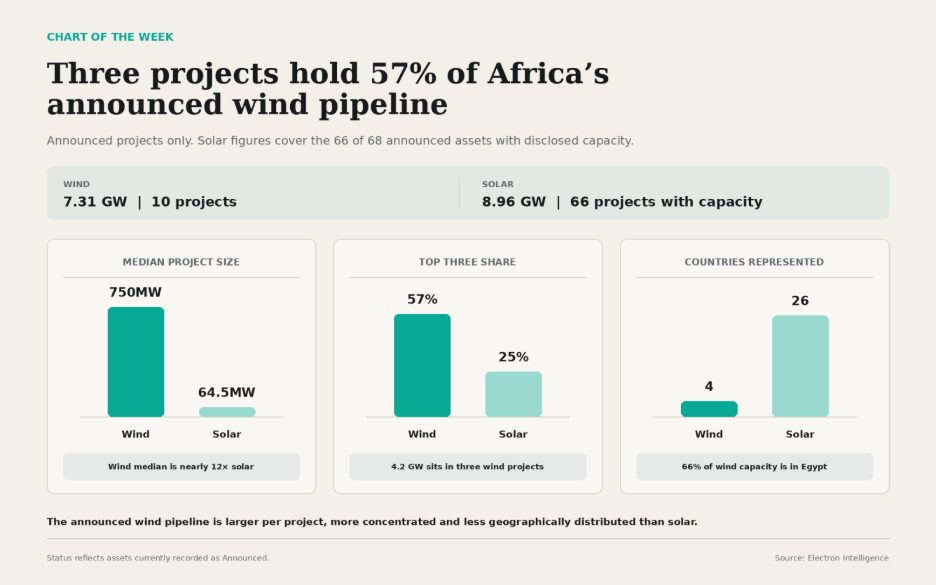
Electron Intelligence tracks 7.31 GW across ten announced wind projects, compared with 8.96 GW across 66 announced solar projects with disclosed capacity. The difference is sharper at the project level. The median announced wind project is 750 MW, nearly twelve times the 64.5 MW median for solar. This comparison covers only projects at the announced stage. It excludes assets in financing, construction or operation.
Three projects account for 4.2 GW, or 57% of the announced wind pipeline. Egypt alone holds 4.8 GW, equivalent to 66% of the total. Solar is more distributed: its announced capacity spans 26 countries, and its three largest projects represent 25% of capacity. The question is therefore not only how much capacity has been announced, but how much of the wind pipeline depends on a small number of projects progressing to financing and construction. That is the concentration EI is committed to making legible.
THIS WEEK’S DEEP DIVE
Zambia has created more alternative demand than deliverable supply
Zambia’s open-access reforms allow generators to sell electricity to traders and large customers outside ZESCO’s conventional purchasing role. The market now has about 1,164 MW of approved non-ZESCO PPA capacity, but only 225 MW can be matched to operating projects. Private traders support 200 MW of that operating capacity, making them the clearest route to executable alternative offtake.

The gap shows that securing an approved buyer is only one part of bringing new generation online. Projects still need financing, construction, network capacity, metering, balancing, and payment security. GreenCo’s 100 MW Chisamba project and 25 MW Ilute project show that trader-backed contracts can reach operation and financial close. EI will track whether this model can expand beyond a small number of projects and concentrated mining and export demand.
EI RESEARCH DESK
South Africa has moved its transmission separation into execution.
The Development Bank of Southern Africa has issued a tender for advisers to support the creation of a fully independent, State-owned Transmission System Operator by 31 December 2027. The new entity will own and control the transmission network separately from Eskom, allocate grid capacity and operate the electricity market.
The advisers will structure the transfer of assets, address tax and financing requirements, and develop a plan for securing consent from Eskom’s lenders. They are not being asked to reconsider the separation itself. That decision has already been made. The key question is now whether government can complete the financial and institutional work within the 2027 timetable. EI will track the transaction structure and what it means for grid investment, market access and Eskom’s financial position. Read the official DBSA tender
RESEARCH RADAR
Projects and market shifts that will shape the next phase of growth.
South Africa: Eskom has restored supply, but electricity sales are still falling. Eskom sold 178 TWh in the year to March 2026, down 6.2% from the previous year and around 2% annually over the past decade. Industrial sales fell 22.5%, while embedded generation, energy efficiency and wheeling also reduced demand. This creates a different challenge: Eskom has ended load-shedding and produced a $1.89 billion (R30.3 billion) profit, but its customers increasingly have alternatives. The next test is whether it can earn more from transmission, wheeling and new demand without relying on tariff increases to compensate for falling volumes. Read Eskom’s report
Zambia: Masaiti is being designed around several routes to market. Sturdee Energy is entering Zambia through the acquisition of the 200 MW Masaiti wind project from Upepo Energy. The late-stage project will connect to a nearby 330 kV ZESCO transmission line, with ZESCO expected to anchor an offtake structure that could also include regional trading, bilateral contracts and local electricity traders. Sturdee is considering solar and battery storage alongside the wind project. Masaiti is therefore testing whether one project can serve domestic industrial demand and the Southern African Power Pool rather than depend on a single buyer. Read here
Africa: Hyundai and the AfDB are linking clean energy with industrial development. Hyundai Motor Group and the African Development Bank have signed a letter of intent covering clean energy, green hydrogen, transport infrastructure, electric-vehicle value chains and local manufacturing. The agreement does not yet identify projects or committed capital, but the proposed model combines Hyundai’s technology and operating capacity with AfDB financing and risk reduction. The next signal will be whether the partnership produces specific investments that connect Africa’s critical minerals to local manufacturing rather than extraction alone. Read here
ACCESS THE FULL PLATFORM
Coverage of Africa power and renewables markets. Live deal tracking, asset profiles, electricity pricing index, PPA tracker and contracted energy pricing, and the import tariff & VAT data for African markets.
See pricing and request a 7-day free trial