How Customer Electricity Savings and Grid-Service Payments Shape South Africa’s Battery Aggregation Market
South Africa’s residential battery aggregation market links household savings and dependable grid services to the revenues and costs shaping a developing investment opportunity.
South Africa’s residential battery aggregation market presents an opportunity to develop service income from equipment households already own. Private capital funds the connections, customer agreements and controls needed to coordinate these systems. The commercial proposition remains at a development stage: access to batteries provides a route to scale, while customer retention, reliable delivery and the cost of providing the service determine whether that scale produces a profitable business.
This deep dive examines how customer savings, operating requirements and buyer payments shape the economics of aggregation. Establishing investable returns requires evidence of savings that sustain subscriptions, contracts that secure grid-service payments and delivery records that support those receipts. The income remaining after customer compensation and operating costs must also recover recruitment and integration expenditure. These relationships distinguish a growing battery portfolio from a business capable of financing its expansion.
Executive Summary
- Seasonal savings do not fully cover year-round service fees. Under the selected tariff-shifting assumptions, high-season gains are outweighed by low-season shortfalls, leaving an annual gap of approximately US$26 per household.
- Insufficient recharging limits repeated grid support. When asked to provide two hours of support on consecutive days, the illustrative 1,000-household portfolio delivers 83.6% of the electricity requested because it cannot replenish enough energy between requests.
- Improving delivery does not always require more households. Increasing recharge power or releasing more energy from backup reserves independently closes the modelled shortfall, offering alternatives to expanding enrolment but changing charging requirements or household backup protection.
- Dispatch payments provide a limited budget for operating the portfolio. At the historical pilot rate, 100-
–500 paid hours generate approximately US$16-–80 annually per enrolled household in the 1,414-household portfolio, before customer compensation and operating costs. Standby income is excluded..
Developing a residential battery portfolio requires system integration and agreements governing battery use
Residential battery aggregation separates ownership of the equipment from the rights to manage it. Households get to retain their batteries, while customer agreements establish who provides the service and when the aggregator can control charging and discharge. Manufacturers and installers can provide access to customers without holding those contracts or dispatch rights. This allocation of responsibilities also determines which costs the aggregator bears, including integration, recruitment, metering, verification and ongoing operations.
The Plentify–Deye partnership, announced on 27 August 2026, illustrates the scale available through an equipment partnership. Its announcement identifies more than 160,000 installed residential batteries in South Africa, representing approximately 2.7 GWh of storage, as the base for aggregation. It does not disclose how customer contracts, dispatch rights or costs are divided between the parties. The figures therefore describe a recruitment opportunity; the portfolio available for grid services will depend on enrolment and the energy customers commit after household consumption and backup needs are accommodated.
Customer agreements define that availability through charging permissions, backup reserves and override rights. Permission to optimise a household’s electricity bill does not automatically include a commitment to respond during a grid-service event. The terms of enrollment therefore determine the service available from each installation, while the additional benefit offered to households shapes their willingness to participate.
Customer electricity savings support recruitment and recurring service income
Electricity savings give developers a basis for recruiting battery owners into a paid optimisation service. The customer retains part of the value through lower overall expenditure, while the provider receives subscription income for managing the system. This creates a commercial relationship around existing equipment, with the strength of the offer shaped by the customer’s tariff and the improvements available over their current battery operation.
Plentify’s published SolarBot charges provide a reference. The activation fee and subscription, including a two-month free trial, average US$10.34 per month over an assumed two-year participation period. Under the selected Homeflex tariffs, shifting an additional 88 kWh each month generates high-season savings of US$19.22 after charging losses and a battery-wear allowance. After service fees, the household retains US$8.88. This shows how additional electricity savings can support both customer benefit and service-provider revenue.
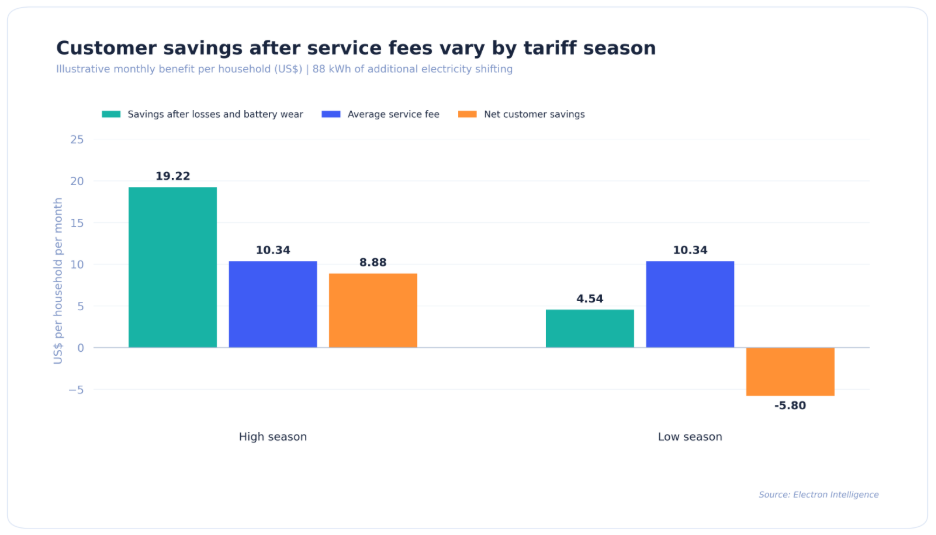
Figure 1: Monthly tariff-shifting savings and average service costs under the selected Homeflex assumptions.
The seasonal comparison shows that tariff shifting alone does not cover the service cost across a full year under the selected assumptions. Shifting an additional 88 kWh each month produces savings of US$19.22 per month during the three high-season months and US$4.54 during the nine low-season months, after charging losses and an allowance for battery wear. Annual savings total approximately US$98.54, against an average annual service cost of US$124.09, leaving a US$25.55 shortfall. Higher winter savings therefore do not fully offset the shortfall during the rest of the year. The annual service cost averages the activation fee and subscription over an assumed two-year participation period, including a two-month free trial; it is not the amount billed in each individual year.
The calculation isolates the additional savings from shifting grid electricity purchases from peak to off-peak periods under the selected Homeflex tariffs, assuming sufficient daily recharging. It excludes benefits from increased use of household solar generation, backup power and payments for grid services. The shortfall consequently identifies the additional annual benefit needed to cover the service cost under these assumptions, rather than measuring the full value of the optimisation service or battery ownership.
For developers, these differences make customer selection commercially significant. Compatible equipment provides technical access, but tariff exposure, consumption patterns and existing inverter settings determine the additional value available. Households can already schedule charging during cheaper periods and discharge during peak hours without a subscription. Where those controls achieve the same savings, tariff shifting alone does not justify the service fee. Recruitment and retention therefore depend on measurable improvements over what customers can achieve independently.
Subscription income nevertheless buys an optimisation service, not automatically a commitment to provide grid support. Extending the relationship into aggregation introduces a further exchange: customers make operating flexibility available under agreed terms. The extent of that flexibility determines how much service the developer can deliver from the recruited portfolio.
Backup reserves and recharging determine the service available from a battery portfolio
Turning customer participation into a grid service requires dependable delivery at the hours a buyer needs it. Subscription income pays for household optimisation, while a grid-service agreement introduces an obligation to coordinate batteries against a defined request. The capacity available for that commitment depends on the energy households retain for backup and how effectively batteries recharge between events.
This makes the composition of the portfolio as important as its size. Inverter capacity determines discharge power, but available stored energy determines how long that power can be sustained. Two portfolios with the same installed capacity can therefore support different commitments if their backup reserves, starting charge or availability differ. Contracting against the equipment’s rated capacity alone overlooks these operating limits.
Repeated dispatch makes the distinction clearer. In the illustrative portfolio, 1,000 enrolled households meet a 1.5 MW request for two hours on the first evening. Limited overnight recharging leaves insufficient energy to repeat the response in full the following evening. Delivery across both events reaches 5.01 MWh against 6 MWh requested, or 83.6%. The result identifies an energy-replenishment limitation: the fleet can supply the required power, but cannot sustain the same service across successive days under the selected charging assumptions.
The example assumes 1,000 enrolled households, with the same 900 available for both events. Each has 10.24 kWh of storage at 90% initial charge and a 40% backup reserve. Between events, recharging is limited to 0.25 kW per household for four hours, at 85% round-trip efficiency. These illustrative assumptions exclude solar recharging and competing household battery use.
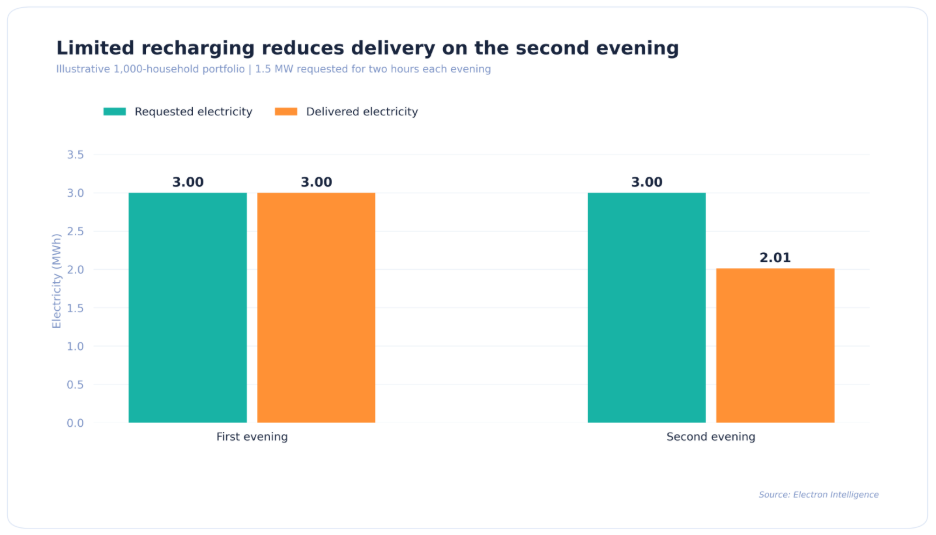
Figure 2: Modelled delivery against a 1.5 MW request lasting two hours on each of two consecutive days, with limited recharging between events.
Expanding enrolment is one response, although it brings additional recruitment, integration and servicing costs. Restoring more charge between events increases delivery from systems already connected, with charging expenditure and customer operating permissions shaping the value of that improvement. A shorter service commitment may improve delivery reliability, but it could also reduce the payments available if the buyer values longer-duration responses. These alternatives create different costs for delivering the same dependable response, making fleet expansion only one part of the investment decision.
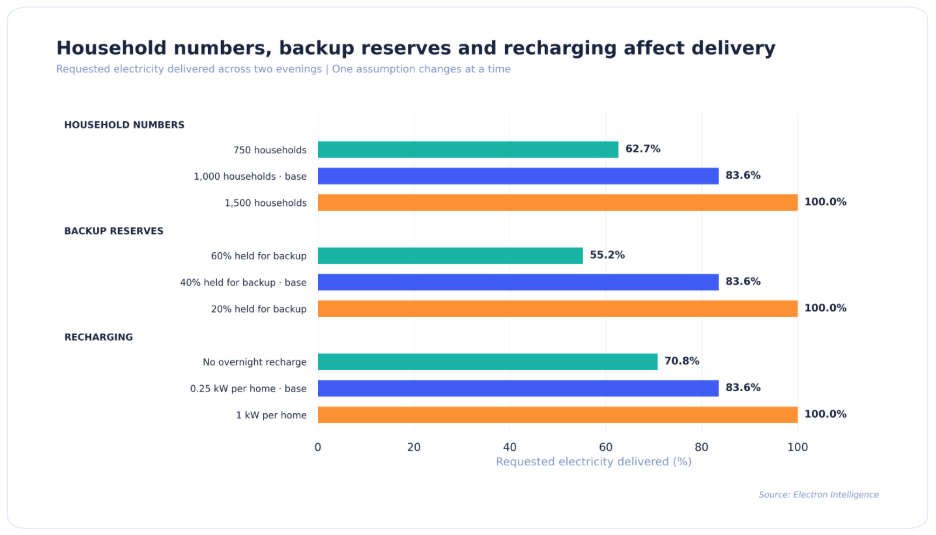
Figure 3: Effects of changing enrolment, backup reserves or recharge power individually on the share of requested electricity delivered.
The resulting commercial unit is a portfolio capable of meeting a specified obligation over time. Its value rests on matching customer permissions, charging schedules and available energy to that obligation. Payment terms then determine how dependable delivery translates into revenue and how much income remains to support the cost of assembling and operating the fleet.
Availability and dispatch payments shape the revenue supporting battery aggregation
A dependable battery portfolio provides two services: maintaining a response ready for use and delivering that response when requested. How the buyer pays for each determines the revenue available to sustain the fleet. Availability payments support the cost of maintaining readiness, while payments for verified electricity reductions link income to actual dispatch. This distinction matters because customer servicing, communications and system monitoring continue even when batteries are not called upon.
The National Transmission Company South Africa’s published demand-response programmes purchase different forms of flexibility. Supplemental response combines standby and energy payments, with a minimum reduction of 500 kW or 15% of average plant demand, whichever is greater. It requires half-hourly remote metering and at least two hours of delivery following a 30-minute dispatch notice. Instantaneous response pays for standby without an energy payment and requires at least 10 MW capable of responding within seconds and sustaining delivery for ten minutes. These obligations distinguish portfolios built for sustained energy delivery from those offering rapid response. Published payment rates and acceptance of residential battery aggregators remain unconfirmed.
Eskom’s 2023 small commercial and residential pilot provides an explicit aggregation precedent, specifying submissions of 1–5 MW, contracts with aggregators, half-hourly metering and independent verification. Events required at least 30 minutes’ notice and a minimum one-hour response. At its historical payment benchmark of approximately US$150/MWh, a portfolio delivering 1.5 MW generates approximately US$22,551 over 100 paid hours annually and US$112,754 over 500 hours. The same delivery capability therefore supports substantially different revenue depending on purchased hours. These illustrative gross receipts exclude standby income and operating costs. Current procurement terms and contracted purchases remain necessary to establish the revenue available to a residential portfolio today.
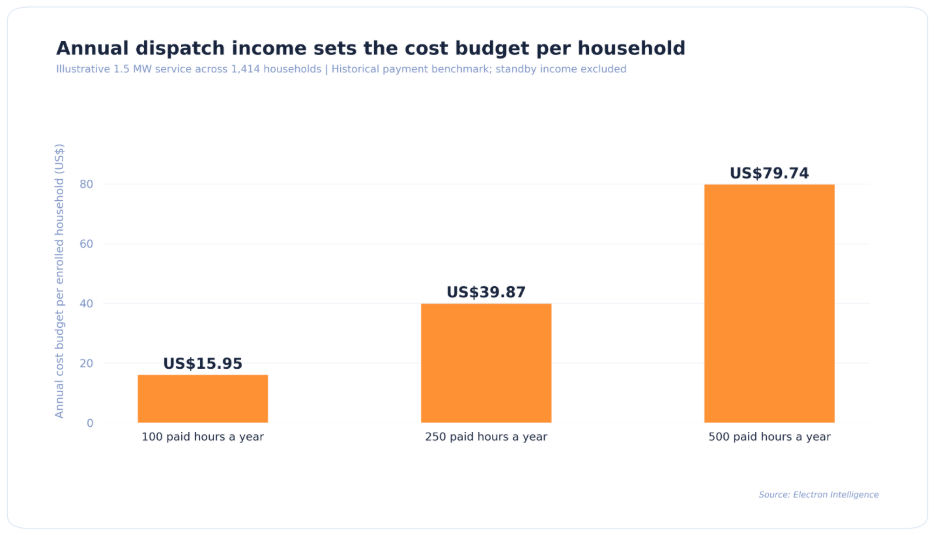
Figure 4: Annual dispatch-income budget for customer compensation and portfolio costs per enrolled household, assuming full delivery over 100, 250 or 500 paid hours. Standby income is excluded.
The payment calculation uses 1,414 enrolled households at 90% availability, sufficient to supply both events without recharging. This differs from the earlier 1,000-household delivery example. At 100–500 paid hours, dispatch income provides US$16–80 per household annually for customer compensation and incremental operating costs combined, excluding standby income. Spending the full amount leaves nothing for capital recovery or returns. Undisclosed compensation, charging, battery-wear, metering, verification and platform costs prevent a margin assessment.
Customer compensation and the additional costs of providing the grid service must fit within that budget for dispatch to generate a surplus. Where those costs exceed it, the portfolio would need additional income, such as a contracted standby payment. Establishing these costs and payment terms is therefore necessary before the revenue illustration can support an investment case.
Household subscriptions provide a separate source of income, but combining services requires attention to how battery use affects the customer. A grid event can alter a charging schedule, increase battery wear or use energy otherwise reserved for household savings. The additional service strengthens the business when its receipts cover those incremental costs and preserve the benefit supporting customer retention. Subscription and grid-service revenues can support the same operating platform, but their full amounts do not translate into an equivalent increase in profit.
Battery aggregation’s financing options depend on contracts and operating evidence
The evidence reviewed points first to a platform-development proposition. Platform equity is suited to funding integration, customer recruitment and controls, with returns tied to growth in paying customers and service revenue. That investment bears the risk that access to installed batteries does not translate into sustained participation or profitable operations. Equipment partnerships and published subscription fees establish a route to market, but the disclosures reviewed do not demonstrate recurring collections, retention or operating margins.
Infrastructure equity and private credit require a clearer connection between investment and portfolio receipts. Infrastructure equity accommodates greater variation in utilisation and operating performance, while private credit requires sufficient cash flow for scheduled repayments. Both depend on enforceable dispatch rights, buyer commitments and the income remaining after customer compensation and delivery costs. This analysis has not identified executed residential portfolio contracts or settlement histories demonstrating repeatable net receipts. The modelled dispatch budget therefore indicates the expenditure that revenue supports, rather than cash available for debt service.
The role for development finance lies in funding the work needed to establish that commercial record. Metering, independent verification and customer-protection arrangements are potential uses of grants or technical assistance; initial deployment presents a case for risk-bearing equity. These are financing options, not commitments established by the evidence reviewed. Development-finance lending still requires an identifiable repayment source. The distinction is between funding the demonstration of a viable service and financing expansion against proven contractual cash flow.
What we are watching
The expansion of residential aggregation will become clearer as equipment partnerships translate into enrolled customers and contracted services. Initiatives such as Plentify–Deye’s planned onboarding through Deye Cloud and installer networks provide routes to existing battery owners. Disclosed participation, customer compensation and repeated delivery results will show how effectively those channels support a commercial portfolio.
NERSA’s decision on the submitted SAWEM Market Code is the regulatory milestone to watch. The final qualifying criteria will show whether a route for aggregated household batteries is explicitly recognised. The accompanying metering, balancing and settlement provisions will determine how delivery is recorded and deviations are charged. For demand-response procurement, buyer acceptance of residential portfolios, approved measurement methods and contract terms allocating shortfall costs remain separate milestones.
Bottom line
South Africa’s residential batteries create an opportunity to build an electricity-service business around equipment households already own. Investment goes into connecting systems, securing participation and coordinating delivery. Household optimisation provides a customer relationship and subscription income, while grid services introduce payments for dependable flexibility.
The evidence identifies a platform-development opportunity, with its investment value resting on customer retention, contracted revenue and operating margins. Verified savings after fees and sustained subscription renewals would demonstrate a durable customer base. Buyer contracts specifying payment commitments, duration and shortfall liability, backed by delivery and settlement records, would establish dependable receipts. Recurring margins sufficient to recover recruitment and integration expenditure would strengthen the case for financing expansion against demonstrated cash flow.