More Nuclear Power for South Africa as Government looks to add 5,000 MW Capacity
South Africa 5000MW nuclear capacity; plus Algeria's solar goals; Kenya's first independent transmission project; Djibouti, Nigeria and Mozambique Oil and gas updates.
Hey, David Oni here. If you’re new here: tap Subscribe to get Africa Energy Weekly in your inbox every week. If you find this useful, please share it with a colleague and let me know your thoughts.
South Africa plans to launch a 5,000 MW nuclear expansion to stabilize its electricity grid and reduce chronic power shortages, Energy Minister Kgosientsho Ramokgopa announced at the G20 Ministerial Conference on Nuclear Energy in Durban. The programme, to be implemented with the South African Nuclear Energy Corporation (NECSA), forms part of the government’s long-term strategy to strengthen energy security and diversify the generation mix.
South Africa’s Nuclear Energy Landscape and Legacy Ambitions
South Africa is currently Africa’s only nuclear power generating country with 2 pressurized water reactors generating approximately 4% of its electricity. The 1,800 MWe Koeberg nuclear plant near Cape Town is operated by Eskom.
South Africa’s nuclear journey has been marked by ambition and setbacks. Eskom’s 2007 plan to double capacity to 80 GW, including 20 GW of nuclear power, collapsed in 2008 due to financing constraints. The Integrated resource plan (IRP) 2010 revived hopes with a $50 billion 9.6 GWe target involving multiple international partners, but cost, governance, and legal setbacks halted progress by 2017. A smaller 2.5 GWe plan approved in 2021 identified Duynefontein and Thyspunt as potential sites, though procurement was paused in 2024 for further consultation.
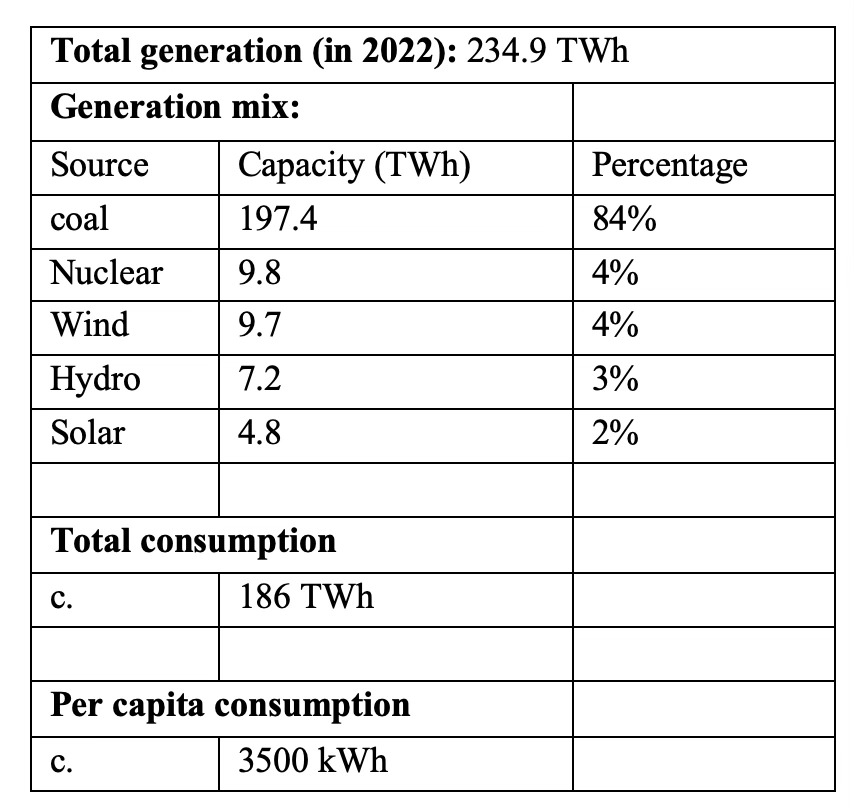
South Africa’s Energy Snapshot. Source: International Energy Agency. Data for year 2022.
Hurdles on the Road to 5,000 MW
1. High Capital Costs and Financing Constraints
South Africa’s nuclear ambitions have repeatedly stalled because of financing barriers. Each failed episode highlights the same challenge: the inability to secure affordable, transparent funding for capital-intensive nuclear projects.2. Timelines and Political Will
Nuclear projects are long-term undertakings that span multiple political cycles. Shifting government priorities, policy reversals, or public spending pressures could stall momentum. Without sustained political commitment and clear energy governance, even approved projects may never break ground.3. Technical and Logistical Challenges
Building a new generation of reactors requires specialized expertise, grid integration, and supply-chain readiness. South Africa has limited recent experience with large-scale nuclear construction, as Koeberg was completed nearly 40 years ago. Site preparation, safety certification, and waste management infrastructure would take years, and any delays could inflate costs dramatically.
Turning Challenges into Opportunity
Pursue Public-Private partnerships and multilateral financing to overcome financing barriers. By employing blended financing models, the government could reduce state exposure. Exploring Build-Own-Transfer (BOT) or Build-Own-Operate (BOO) structures with transparent repayment frameworks can improve bankability.
Institutionalise political continuity. To sustain momentum beyond political cycles, South Africa should anchor its nuclear programme within a legally protected, bipartisan energy framework linked to the Integrated Resource Plan (IRP). Long-term stakeholder consultation and public communication would build societal trust, while clear milestones and accountability mechanisms would prevent drift or politicization.
Build Technical Capacity. Reviving South Africa’s nuclear capabilities requires capacity building and international partnerships. Collaboration with experienced vendors (e.g., Rosatom, EDF, KEPCO) should include technology transfer, training, and local supply-chain integration. Investing early in skills development through NECSA and universities, modernizing waste management systems, and establishing project management offices (PMOs) for oversight can minimize construction delays.
Bottom Line
South Africa’s proposed 5,000 MWe nuclear expansion represents both ambition and resolve. If pursued transparently and aligned with the IRP, it could stabilize the grid, cut coal dependence, and secure long-term energy reliability. But financing, governance, and technical execution will determine whether this marks a nuclear renaissance or another unrealized ambition.
Deals & Investment
- Algeria: Algeria prepares to commission 400 MW of solar by end of 2025 via two 200 MW plants in Biskra and El M’ghair provinces. These projects are part of a broader 3,200 MW solar rollout under its National Renewable Energy Programme, with contracts signed in 2023. Renewables Now.
- Nigeria: NUPRC halts TotalEnergies’ $860 million exit from SPDC consortium. The NUPRC’s decision reflects Nigeria’s tougher stance on asset transfers. Regulators have grown increasingly cautious to ensure incoming operators have both the financial and technical ability to meet obligations. Punch.
- Kenya: Kenya Advances Africa’s First Independent Transmission Project, Opening Doors for Power Investors. The project, developed under a 30-year public-private partnership (PPP) framework, will oversee the construction and operation of the 400 kV Lessos–Loosuk and 220 kV Kisumu–Musaga transmission lines. These two key lines will significantly strengthen grid reliability, unlock new power flows across western Kenya, and create the structural backbone for future renewable energy integration. Quidah.
- Mozambique: Oil Major Eni Nears Final Investment Decision for $7 Billion Mozambique LNG Plan. The $7.2 billion Coral Norte project is a continuation of the Coral South development, which has been in production since 2022. It involves drilling six subsea wells that will be tied back to a floating liquefied natural gas (FLNG) unit. Its estimated annual capacity is 3.55 million metric tons of LNG, equating to approximately 5.2 billion cubic meters of gas over thirty years. Bloomberg.
- Djibouti: Djibouti Secures $90 Million ITFC Loan to Boost Energy Security. The loan will enable the Société Internationale des Hydrocarbures de Djibouti (SIHD) to guarantee refined petroleum supplies essential for electricity generation. Ecofin Agency.
Regulation and Policy Updates
- Sudan: UAE blocks Sudan oil shipments amid diplomatic fallout, global trader caught in crossfire. The United Arab Emirates has reportedly blocked several Sudanese crude oil shipments amid escalating diplomatic tensions between the two countries, disrupting a key revenue lifeline for Khartoum’s military-led government. Business Insider Africa
- Nigeria: At the Cape Town Energy Summit, NLNG urged African nations to adopt a unified LNG strategy, calling on them to move beyond being mere raw material suppliers and position themselves as key global players in the liquefied natural gas market. Vanguard
Executive Takeaways:
- Energy Sovereignty Is Replacing Energy Dependency: Governments are doubling down on domestic energy production to shield their economies from external shocks. South Africa’s nuclear expansion, Algeria’s upstream reinvestment, and Mozambique’s LNG progress reflect a push for self-reliance and value retention, rather than serving as raw commodity exporters.
- Grid and Infrastructure Modernization Is the New Frontier: The emphasis is shifting from generation to transmission, storage, and integration. Kenya’s PPP transmission model and Algeria’s renewable rollout highlight how infrastructure gaps, not resource scarcity, are the biggest constraint.
- Balanced Energy Mixes Are Emerging as the Pragmatic Path: Across the continent, policymakers are avoiding hard transitions. Instead of replacing hydrocarbons abruptly, they’re layering renewables, LNG, and nuclear to create balanced portfolios.
- Financing and Regulation Are Now Central to Market Access: Nigeria’s NUPRC move shows that capital access will increasingly hinge on regulatory credibility. Governments are becoming more assertive in policing transactions and vetting investor capability.
- State-Led Transitions Are Becoming Investment Anchors: Most large-scale projects are being driven by state-backed frameworks; nuclear in South Africa, LNG in Mozambique, renewables in Algeria, and transmission PPPs in Kenya. This underscores that Africa’s energy transition will remain public–private in nature, where governments provide policy cover while investors and developers supply capital and technology.
What to Watch This Week
- Egypt Energy (Cairo, Oct 4-16): The show brings together energy manufacturers and suppliers from all over the world to showcase new technologies and innovative solutions covering the entire energy value chain from power generators, energy storage and energy management systems, high and low voltage cables, energy transmission and distribution, solar panels, solar power and green energy. Egypt energy
- Renewable Energy Innovation Forum 2025 (Abuja, Oct 14-15): The Rural Electrification Agency (REA) of Nigeria will organise the inaugural Nigeria Renewable Energy Innovation Forum at the Abuja Continental Hotel. rea
- Solar & Storage Live Cape Town 2025 (Cape Town, Oct 15-16): The event is engineered to capture the essence of South Africa’s energy evolution, focusing on the transformative power of solar energy, cutting-edge battery storage solutions, the forefront of clean energy advancements and disruptive market forces that are propelling South Africa’s energy transition. terrapinn
- Africa Energy Efficiency Policy Training Week 2025 (Accra, Oct 23-25): The event represents a unique opportunity for policy makers to learn from international best practice and foster a truly international global community of energy efficiency practitioners, helping them to advance the goal of doubling energy efficiency by 2030 while improving people’s lives. iea
- Monitoring global & local interest in SA’s $500 million foreign-currency funding initiative, as the Treasury reviews over 100 proposals from international institutions. Reuters
- South Africa is likely to announce or firm up details of its new 5,000 MW nuclear expansion plan (sites, suppliers, timeline) in the coming days.
- Keep an eye on developments from the IAEA / G20 nuclear energy outcomes, especially new frameworks or commitments released during South Africa’s presidency. iaea
- EU’s €1.16 Billion renewables package. The EU pledges additional €618 Million for African Clean Energy, an addition to the €545 million pledged in September. Funds target electrification, grids, and renewable storage in 17 countries. Disbursement pending; pledges part of Africa-EU Green Energy Initiative. European Commission