Power Investment and Electricity Procurement in Morocco’s Desalination Expansion
Morocco’s desalination expansion creates substantial electricity demand, while supply commitments and cost-recovery terms shape the opportunities and financial exposure for power investment.
Morocco’s desalination expansion is creating a market for power supply alongside investment in water infrastructure. The opportunity takes shape through the electricity purchases needed to sustain water production. Casablanca’s dedicated renewable supply arrangement and OCP’s (Morocco’s phosphate and fertiliser producer) combination of cogeneration and external electricity illustrate different ways of meeting that requirement.
Existing supply commitments determine how much demand is already covered and where additional procurement is needed. Delivery obligations and electricity-price arrangements then determine who must secure any supplementary supply, who bears cost increases and how these responsibilities affect project cash flow. This deep dive examines how those relationships connect desalination to power investment, providing a basis for assessing the supply opportunities emerging as water production expands.
Executive Summary
- Casablanca's expansion increases electricity requirements by half under unchanged operating assumptions. Annual demand rises from 630 GWh in the initial phase to 945 GWh at full development, assuming 90% utilisation and 3.5 kWh/m³. Existing supply commitments determine whether this requires additional procurement.
- Operating conditions materially change demand at full development. At the same 300 million m³ annual capacity, the sensitivities produce requirements of 630–1,200 GWh. This variation creates exposure to unused purchase commitments or supplementary supply, depending on contractual flexibility.
- Contractual cost recovery determines the operator’s exposure. A US$10/MWh increase across 945 GWh of annual purchases adds US$9.45 million to electricity costs. Recovering half from the water buyer leaves US$4.725 million with the operator; actual recovery provisions remain undisclosed.
- Further power investment must be linked to identifiable purchasing commitments. Desalination provides concentrated demand, but the evidence does not establish an uncovered requirement at Casablanca. Additional supply awards and associated generation financing will distinguish new investment from demand already served under existing agreements.
Desalination creates electricity customers with different procurement needs
Desalination creates an identifiable customer for electricity, but the customer’s operations determine what it needs to purchase. Municipal plants procure power to meet water-delivery commitments, while industrial facilities secure water for their own production. These uses shape the volume of external electricity required and the business supporting payment.
Casablanca’s expansion illustrates how municipal water requirements translate into a larger electricity purchase. Under the selected assumptions of 90% utilisation and 3.5 kWh/m³, annual electricity requirements rise from 630 GWh for the initial 200 million m³ phase to 945 GWh at full development of 300 million m³. For a supplier, that progression makes the timing of demand as relevant as its eventual scale: generation and delivery commitments must accommodate the plant’s operating needs as water production expands.
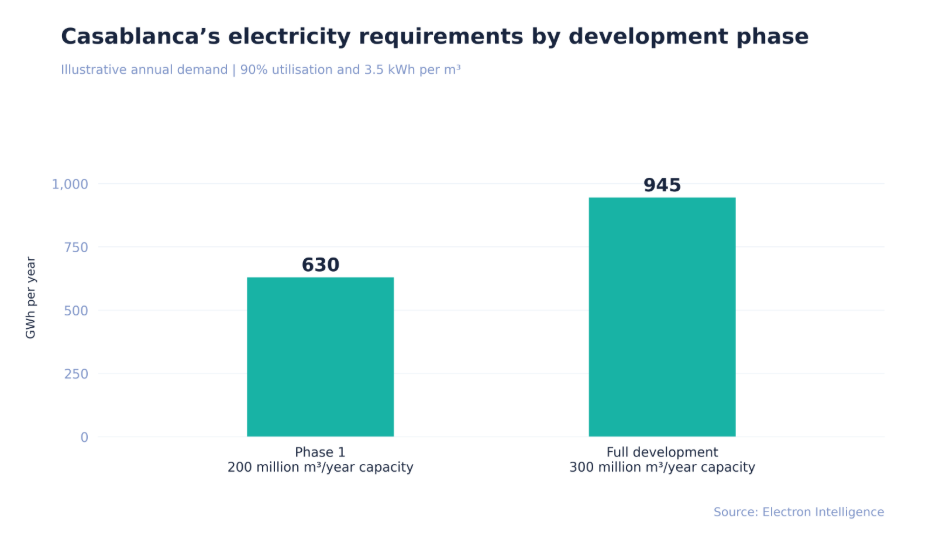
Figure 1. Illustrative annual electricity requirements for Casablanca’s initial and full-development phases, holding utilisation at 90% and electricity intensity at 3.5 kWh/m³
OCP’s industrial desalination project at Jorf Lasfar and Safi incorporates electricity generated from recovered heat from sulphuric acid production. The European Bank for Reconstruction and Development’s (EBRD) project assessment envisages this cogeneration meeting 30–50% of desalination electricity requirements, without specifying a separate share for each plant. The report identifies on-site renewable generation for the balance, so the range does not establish an external procurement requirement. External suppliers therefore serve a smaller share of the total load, with purchases depending on both water output and the contribution from internal generation. Electricity procurement supports the continuity and cost of industrial production, linking the purchasing decision to the wider business.
The resulting demand takes different commercial forms. Casablanca brings a dedicated water-supply customer, while OCP places desalination within an industrial electricity requirement. Understanding those customers establishes the demand available to suppliers; examining their existing procurement arrangements reveals how that demand is already supporting power development.
Dedicated supply agreements connect desalination projects to power investment
Electricity supply agreements translate desalination requirements into a commercial relationship with a power developer. They establish the purchases a supplier is expected to serve and provide a basis for planning generation around the customer’s expansion. Their investment significance rests on the commitments attached to those purchases.
Casablanca provides a concrete example. ACCIONA describes a renewable power purchase agreement covering the plant’s entire electricity consumption, with 47% of output from the 360 MW Bir Anzarane wind farm allocated to the facility. The arrangement links desalination demand to an identified renewable generation asset, although the disclosure does not establish the desalination contract’s role in financing or enabling the wind farm’s development. As the plant expands, the supply schedule and delivery obligations determine how this arrangement accommodates the electricity requirements of each phase.
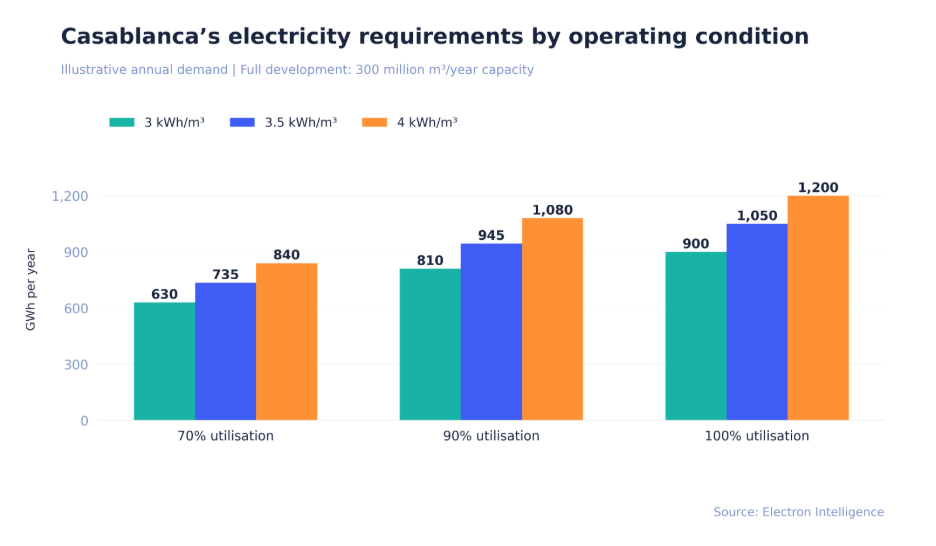
Figure 2. Illustrative annual electricity requirements at Casablanca’s full-development capacity of 300 million m³, varying utilisation and electricity intensity.
At Casablanca’s full-development capacity of 300 million m³/year, varying utilisation from 70% to 100% and electricity intensity from 3 to 4 kWh/m³ produces annual requirements of 630–1,200 GWh. The central estimate remains 945 GWh. A fixed purchase commitment at that level would leave 315 GWh above requirements in the lower-demand case or require 255 GWh of supplementary supply in the higher-demand case. Minimum-purchase obligations give the generator greater revenue certainty to support financing, but expose the buyer to payments for unused electricity. Flexible volumes reduce that exposure while leaving the generator with less certain sales. Casablanca’s disclosed terms do not establish which participant carries these risks.
Procurement across an industrial group allows lower consumption at one facility to offset higher consumption elsewhere, where supply arrangements permit. For OCP’s selected facilities, the reviewed disclosures do not establish how their requirements are allocated within group procurement or how much revenue they support for an individual generation asset.
Matching annual purchases to consumption does not ensure supply when water production requires it. Differences between renewable output and demand create a balancing requirement, with the agreement determining who secures supplementary electricity and bears its cost.
Delivery obligations and electricity-cost allocation shape the commercial relationship
An agreement covering annual electricity consumption does not, by itself, establish how supply will meet the desalination plant’s needs throughout the year. Renewable output varies, while water-delivery commitments place requirements on production. The commercial issue is who must cover the difference when generation and consumption do not coincide.
Water storage and operating flexibility can help accommodate variations, while supplementary electricity can maintain production when renewable output falls. Each approach carries a cost. A supplier responsible for dependable delivery must account for covering generation shortfalls; an operator purchasing variable output retains more responsibility for securing the balance. Casablanca’s disclosed whole-plant supply commitment does not reveal the detailed allocation of these obligations. Its annual renewable supply coverage therefore cannot establish the cost of providing dependable electricity.
Electricity-price protection and recovery through water sales are also separate arrangements. A fixed electricity price limits the operator’s exposure to the price movements covered by that agreement. A water-price adjustment instead allows an electricity-cost increase to reach the buyer. The recovery arrangement determines how much of an electricity-cost increase the operator absorbs. At the illustrative annual purchase volume of 945 GWh, a US$10/MWh increase adds US$9.45 million to expenditure in every scenario. With no recovery from the water buyer, the operator bears the full increase; at 50% recovery, its exposure falls to US$4.725 million; full recovery transfers the increase to the buyer.
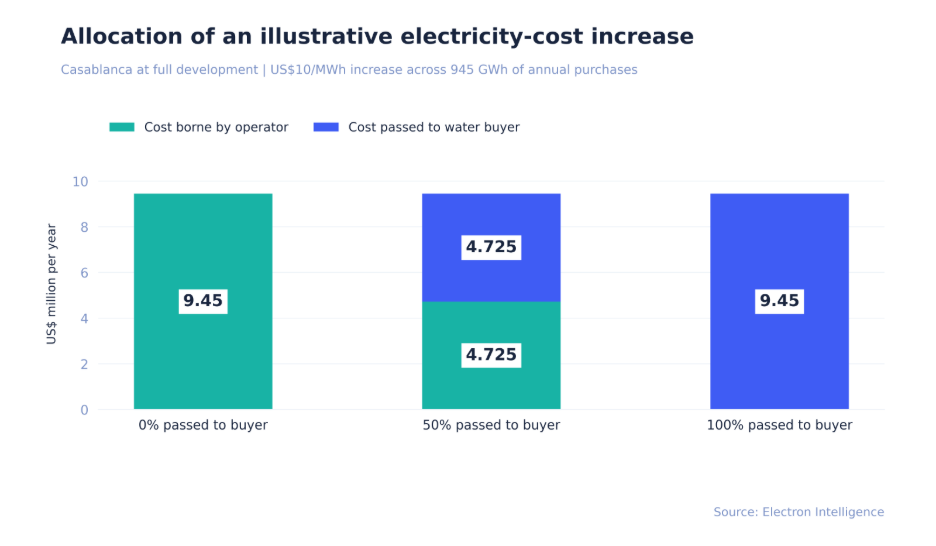
Figure 3. Allocation of an illustrative electricity-cost increase between the operator and water buyer under alternative recovery assumptions.
For OCP’s industrial facilities, external electricity costs enter the wider economics of production. Their recovery depends on product pricing and margins unless a specific agreement provides otherwise. Across both settings, cost allocation determines which participant’s cash flow absorbs changes in electricity prices and delivery costs. That exposure matters to financing because a purchase commitment supports debt repayment only to the extent that the revenue remaining after fulfilment costs is sufficient and dependable.
Existing procurement shapes the remaining opportunity for power investment
Generation serving an established desalination customer, additional supply accompanying expansion, and services required to fulfil electricity agreements offer distinct routes for investment. The allocation of supply obligations determines who finances generation assets, secures supplementary electricity and manages delivery, while payment terms establish how those costs are recovered.
Dedicated generation provides the clearest connection. Casablanca’s disclosed renewable supply arrangement links a power development to the desalination facility’s electricity purchases. That gives capital providers an identifiable asset and customer relationship to assess. The financing case then rests on the supplier’s contracted receipts after delivery costs, alongside construction expenditure and operating performance. The arrangement demonstrates a route for investment, although it does not establish that a new financing round or ownership stake is currently available.
Expansion introduces a different decision: whether the existing supplier must commit additional capital to serve higher consumption. If expansion falls within its agreement, the supplier’s investment programme becomes the relevant place to examine that requirement. If the customer procures additional electricity separately, a new route opens for competing developers. The distinction changes who originates the investment and who controls access to the customer. Casablanca’s rising electricity requirement makes this commercially relevant, but its disclosed whole-plant commitment prevents the modelled increase from being treated automatically as open procurement.
Delivery obligations can also create demand for supplementary electricity or flexibility. Their financing characteristics depend on how the service is purchased. Committed payments for readiness provide a different revenue basis from payments earned only when electricity is delivered. Capital assessment therefore needs to follow the specific service agreement, including utilisation risk and the cost of maintaining availability. Neither Casablanca nor OCP’s reviewed disclosures establish a separately investable service contract.
What we are watching
Casablanca’s first phase, with annual capacity of 200 million m³, is scheduled for commissioning on 1 February 2027. Operating disclosures will show how actual water production and electricity consumption compare with planned requirements, alongside the delivery of contracted power.
ACCIONA targets August 2028 for completion of the second phase, taking annual capacity to 300 million m³. We will track how electricity deliveries scale with production and whether supplementary procurement is announced alongside existing supply commitments.
Electricity-price adjustments and recovery through water payments remain important disclosures, although no publication timetable has been established. The relevant terms are who bears cost increases, how frequently charges adjust and whether payment timing leaves the operator funding the difference.
Bottom line
Morocco’s desalination expansion creates identifiable electricity customers, and Casablanca’s renewable supply agreement demonstrates how that demand connects to a generation asset. The commercial significance lies in the commitments attached to those purchases: volume flexibility affects the certainty of sales, while cost recovery determines the operator’s financial exposure.
Existing supply arrangements provide a foundation for power businesses serving desalination. Further investment becomes identifiable when expansion or delivery obligations require additional assets or services. The available disclosures establish the purchasing relationship, but leave the allocation of these obligations and the returns on additional capital unresolved.