Private Investment in Morocco’s Transmission and Egypt’s Industrial Grid Connections
Morocco’s transmission plans and Egypt’s industrial grid connections show how private capital could finance electricity networks, with different arrangements for recovering investment.
Private participation in North Africa’s electricity network is taking shape through dedicated transmission proposals and connections supporting industrial supply. These arrangements give private capital a role in infrastructure serving public networks without necessarily transferring network operations. They also introduce different investment responsibilities and routes to capital recovery.
Morocco’s proposed TAQA Morocco–Nareva partnership would develop a dedicated transmission link for ONEE, while Egypt’s private supply framework assigns certain connection responsibilities to producers serving industrial customers. The analysis examines where private investment can support dedicated transmission infrastructure and where grid investment is tied to electricity sales to industrial customers.
Executive Summary
- North Africa’s emerging private grid opportunities take different commercial forms. Morocco’s proposed partnership creates a dedicated transmission development role, while Egypt’s framework links connection investment to industrial electricity supply.
- Morocco provides an identified transmission proposition. The proposed 3,000 MW high-voltage direct current link gives private development a defined infrastructure focus. The terms agreed with ONEE will determine how the developers recover their investment
.. - Egypt’s industrial supply projects create connection opportunities. Approved projects serving customers including Suez Steel and Ezz Steel provide a basis for investment in grid connections that enable electricity sales, with potential savings where the connection arrangements qualify for lower network charges
.. - Commercial arrangements shape investment recovery. Financing terms affect the recurring payment requirement for transmission development, electricity volumes and applicable network charges influence whether connection investment can recover its costs.
Morocco separates transmission development, while Egypt links connection investment to private supply
Private capital can finance grid infrastructure while established transmission operators retain responsibility for the wider network. The investment opportunity depends on the activities assigned to private participants and how those activities connect to income.
In Morocco, the proposed TAQA Morocco–Nareva venture would design, finance, construct and commission a 3,000 MW high-voltage direct current link, then make it available to the National Office of Electricity and Drinking Water (ONEE). This creates a defined development role around infrastructure serving the national network. The agreement with ONEE would establish how that role translates into payment rights and a continuing investment interest in the asset.
Egypt’s private electricity supply framework also creates a role for private capital in grid infrastructure. Eligible producers can serve industrial customers through the Egyptian Electricity Transmission Company’s (EETC) network, with certain connection works and costs assigned to them. This expenditure enables electricity sales, placing its recovery within the supply arrangement. Network-use charges are paid to EETC; the disclosed framework does not establish a separate transmission-income entitlement for producers funding connections.
These arrangements point to different investment opportunities. Morocco’s proposal gives sponsors a dedicated transmission development role, while Egypt’s connection obligations place infrastructure spending within private electricity supply. This distinction determines the infrastructure private participants finance, their responsibilities towards the network operator and the payment rights needed to recover their investment.
Morocco’s proposed partnership creates a distinct role for transmission developers
Morocco’s proposed TAQA Morocco-–Nareva partnership gives private sponsors a defined role in financing and delivering transmission infrastructure for ONEE. The venture would develop a 3,000 MW high-voltage direct current (HVDC) link between the country’s south and centre, then make it available to the network institution. This creates a development opportunity around providing infrastructure without making network operation the venture’s stated responsibility.
TAQA Morocco disclosed planned transmission programme investment equivalent to $4.71 billion, establishing the scale of expenditure envisaged within the partnership. The signed development agreement and completed technical studies give this role a concrete project basis, with procurement planned for the fourth quarter of 2026. The investment proposition therefore combines an identified asset, assigned development responsibilities and documented preparation for delivery.
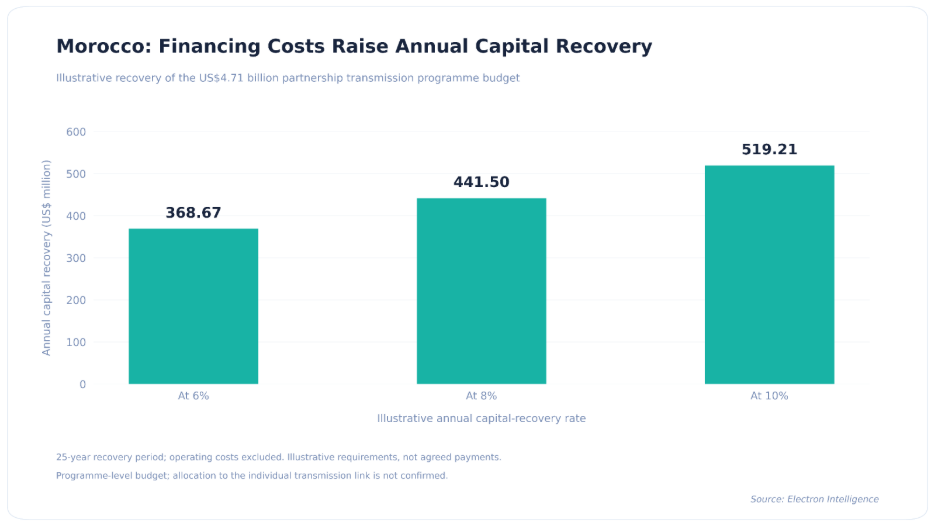
Figure 1: Higher financing costs increase Morocco’s illustrative annual transmission capital-recovery requirement.
The commercial significance lies in how the agreement with ONEE connects those responsibilities to payments. Infrastructure delivery requires upfront funding, while investment recovery takes place over time. The illustrative scenarios show how financing costs and repayment periods affect required annual payments, highlighting the importance of payment terms alongside the construction budget.
Morocco thus provides evidence of a dedicated transmission development proposition. The expenditure attributable to the link and the agreement’s ownership, payment and risk provisions remain central to assessing it as a separate investment business.
Egypt’s private supply framework makes connections part of the electricity investment
Egypt presents a different route for private capital: connection investment that enables electricity sales to industrial customers. Producers can use the Egyptian Electricity Transmission Company’s (EETC) network to supply these customers, with certain connection works and costs assigned through the producer connection agreement. The infrastructure enables electricity sales without necessarily creating a separate entitlement to network revenue.
The approved private-to-private projects give this arrangement identifiable commercial users. KarmSolar’s project would supply Suez Steel, while TAQA PV’s would serve Ezz Steel. AMEA Power’s customers include BEFAR Group and the Suez Canal Container Terminal. These approvals establish supply relationships around which connection requirements can be assessed, although they do not establish the expenditure or delivery status of individual connection assets.
Connection expenditure must therefore be assessed alongside the electricity supply contract it supports. While the infrastructure may be necessary to secure electricity sales, it may not generate separate revenue, and its cost can affect the profitability of the supply arrangement. Commercial agreements will determine if the producer bears these costs, shares them with the customer or recovers them through the electricity price. These arrangements remain unconfirmed for the named projects.
The applicable network charges also affect the investment case. Additional connection spending may reduce electricity delivery costs where the resulting voltage configuration qualifies for a lower charge. That assessment must account for both the producer’s connection and the customer’s endpoint. Upgrading the producer’s connection alone does not establish that the supply arrangement qualifies for the saving.
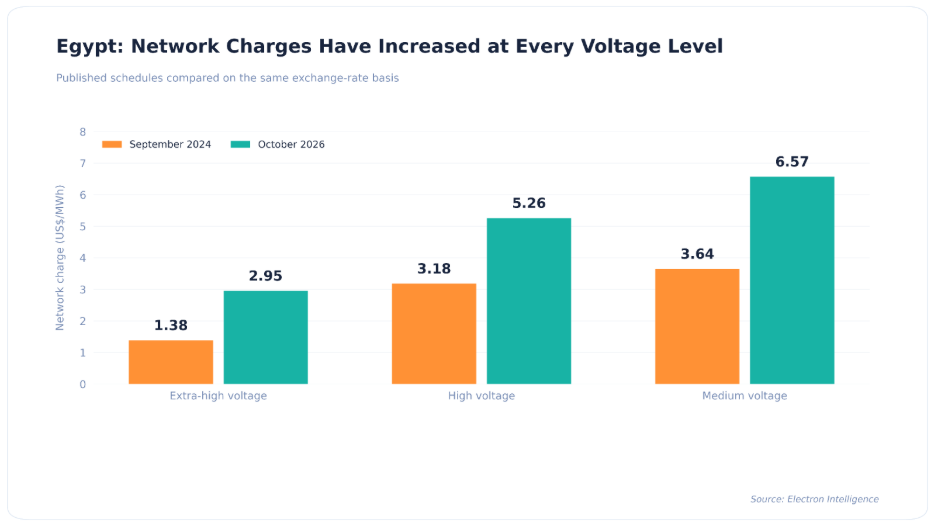
Figure 2: Egypt’s network charges have risen across all voltage levels, with lower charges applying at higher voltages.
Egypt consequently offers a route for private capital into grid equipment through industrial electricity supply. Investment recovery depends on the sales enabled and any delivery savings available under the actual connection arrangement. Establishing a separately investable network asset would require evidence of ownership and payment rights beyond the connection obligations themselves.
The source of recoverable value determines the opportunity for private capital
Morocco and Egypt place investment recovery within different commercial relationships. Morocco’s proposed transmission partnership depends on the agreement with ONEE linking infrastructure delivery to payments. In Egypt, connection expenditure supports electricity sales to industrial customers, with recovery forming part of the supply business. The distinction determines who pays and what obligations the private participant must fulfil to earn that income.
For Morocco, the investment case depends on the payment entitlement attached to the transmission asset. If payments are linked to infrastructure availability, the agreement would need to define the required performance and the consequences of outages or delayed completion. The illustrative recovery calculations indicate the recurring amount needed to recover a given investment under different financing costs and repayment periods. They do not establish what ONEE has agreed to pay or confirm that the proposed arrangement uses availability-based payments.
For Egypt, the relevant value arises from the electricity contract enabled by the connection and any eligible reduction in network charges. Additional equipment may improve the cost of supplying a customer, but the resulting saving does not automatically accrue to the participant funding it. The supply and connection agreements determine whether the producer retains that benefit, passes it to the customer through a lower electricity price or shares it through another arrangement.
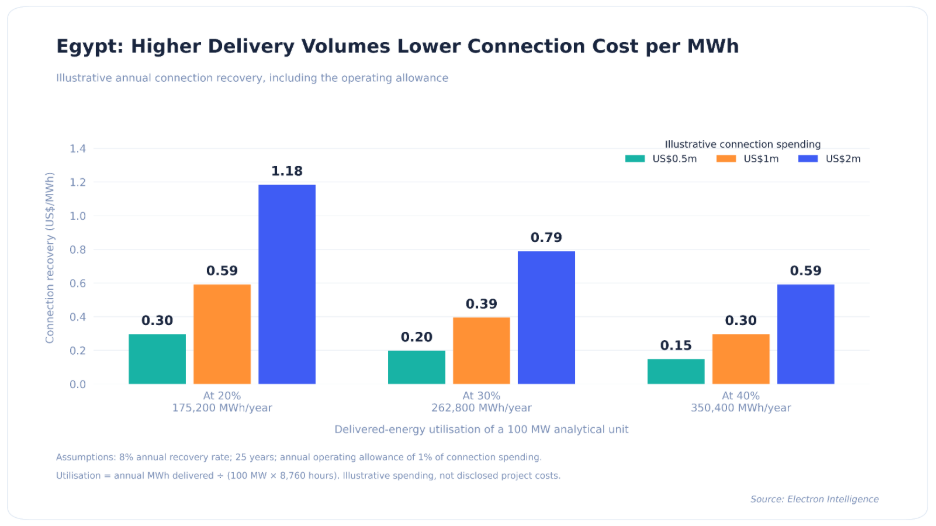
Figure 3: Higher electricity delivery volumes reduce the connection-cost recovery required per megawatt-hour.
The supporting calculations therefore answer different questions. Morocco’s scenarios estimate the payment requirement associated with infrastructure expenditure. Egypt’s scenarios estimate potential delivery savings against which additional connection costs can be assessed. Neither calculation establishes an investment return without the corresponding expenditure, contractual allocation and payment terms.
The opportunity for private capital consequently rests on both the source of value and the right to receive it. A dedicated transmission developer needs evidence of payments supporting its infrastructure obligations. A producer funding connection needs evidence that the electricity supply arrangement allows it to recover that expenditure. These are distinct commercial propositions, even where both finance equipment serving the grid.
Asset-specific agreements determine how far the disclosed opportunities can advance
Morocco and Egypt’s disclosed arrangements give private capital identifiable roles in grid development. They connect infrastructure expenditure to a commercial activity: delivering transmission capacity in Morocco and supplying industrial electricity in Egypt. The agreements governing those activities shape the investment interests that emerge.
In Morocco, separating transmission development from network operation creates scope for developers to finance and deliver infrastructure serving the wider system. Private participation can therefore extend beyond connections for individual generators or customers. Ownership and payment arrangements would determine whether that role ends with delivery or continues through a longer-term financial interest in the asset.
Egypt’s connection framework places grid investment alongside identifiable industrial demand. A producer funding connection equipment gains access to electricity sales that the infrastructure enables. Where the connection configuration qualifies for lower network charges, additional spending could also improve the economics of supplying the customer. The commercial benefit can therefore arise within the supply business even without a separate network payment.
The duration and allocation of these benefits influence how much expenditure each arrangement can support. Longer payment or supply periods spread recovery across more years, while the allocation of delivery savings affects the value retained by the funding participant. Ownership and transfer terms also shape its position after the initial agreement ends.
The disclosed evidence points to different ways of financing grid infrastructure through commercial relationships. Morocco offers a potential development business serving the network institution. Egypt links connection investment to industrial electricity purchases. Asset-specific agreements would make the scale and duration of these opportunities clearer as the arrangements advance.
What We’re Watching
Egypt’s next phase of electricity-market liberalisation could clarify how private supply develops beyond the initial projects. The government is reviewing the regulatory framework and market-management rules. Their publication would show whether participation expands and how the arrangements for using the network evolve, with implications for the connection investment supporting industrial supply.
In Morocco, the payment structure agreed with ONEE will be a central signal. Disclosure of the payment basis, duration and security would clarify how developers recover their investment and whether income depends on infrastructure availability, electricity transported or another contractual arrangement. The planned tender for the south–centre transmission link could also provide greater detail on delivery responsibilities and asset scope.
The delivery of Egypt’s approved private supply projects will provide a further signal. Executed connection agreements, construction milestones and confirmed voltage arrangements could show how industrial electricity purchases translate into grid expenditure, and where lower network charges create additional value within the supply business.
Bottom Line
Morocco and Egypt show how private capital can participate in electricity networks through different commercial arrangements. Morocco’s proposed development model creates a role in financing and delivering dedicated transmission infrastructure alongside public network operation. Egypt’s framework instead embeds connection investment within private supply contracts: producers fund the grid works needed to serve industrial customers, with recovery coming through electricity sales and any qualifying reduction in delivery charges.
The distinction lies in how that expenditure earns a return. Morocco’s opportunity depends on the payment arrangements agreed for financing and delivering the transmission infrastructure.. Egypt’s sits within the value of the electricity supply contract. Together, they illustrate a wider scope for private grid investment, with dedicated transmission development and customer connections offering different routes to capital recovery.