The Real Cost of Cheap Grid Across Selected African Power Markets
African electricity markets do not only differ in the prices consumers pay, but also in the reliability of the electricity supply they receive. These differences shape the overall cost of electricity, influence investment decisions and affect the competitiveness of businesses operating across the continent. Comparing electricity markets therefore requires looking beyond published tariffs alone.
This deep dive compares electricity pricing, affordability and supply reliability across selected African electricity markets to examine how the cost of unreliable supply changes the relative cost of electricity. By evaluating electricity costs beyond published tariffs, the analysis assesses how supply reliability influences the relative affordability and competitiveness of different electricity markets.
Executive Summary
Incorporating the cost of unreliable supply materially changed the relative ranking of electricity markets. Several countries that appeared relatively affordable based on published tariffs moved significantly lower once supply reliability was taken into account.
Supply reliability played a decisive role in determining the effective cost of electricity. Markets delivering more dependable grid supply often provided lower overall electricity costs than markets where consumers experienced frequent supply interruptions.
Differences in tariff design, investment and power system performance produced materially different electricity outcomes across African markets. Similar electricity prices did not necessarily translate into similar levels of affordability or competitiveness.
Incorporating supply reliability materially changed electricity affordability across several markets, demonstrating that published tariffs alone did not fully capture the cost consumers ultimately incurred to maintain access to electricity.
Supply Reliability Changes How Electricity Affordability Is Measured Across African Markets
Published electricity tariffs remain an important measure of electricity costs, but they no longer provide a complete basis for comparing affordability across African electricity markets. Markets with similar tariffs often deliver very different electricity outcomes because consumers do not experience the same quality of electricity supply. As reliability diverges across markets, the cost of electricity increasingly depends on more than the tariff charged by the utility.
The comparison across the markets analysed reveals that this assumption does not consistently hold. Nigeria, for example, records the lowest residential electricity cost relative to household income but also falls well below the 95% reliability threshold, indicating that consumers frequently rely on costly alternatives when grid electricity is unavailable. In Ethiopia, despite similarly low electricity costs, it achieves much stronger supply reliability, allowing consumers to realise far more of the affordability implied by its published tariff. In Egypt, although electricity prices are higher than in Nigeria and Ethiopia, dependable electricity supply places the country among the strongest performers for reliability, illustrating that higher tariffs do not necessarily coincide with weaker consumer outcomes.
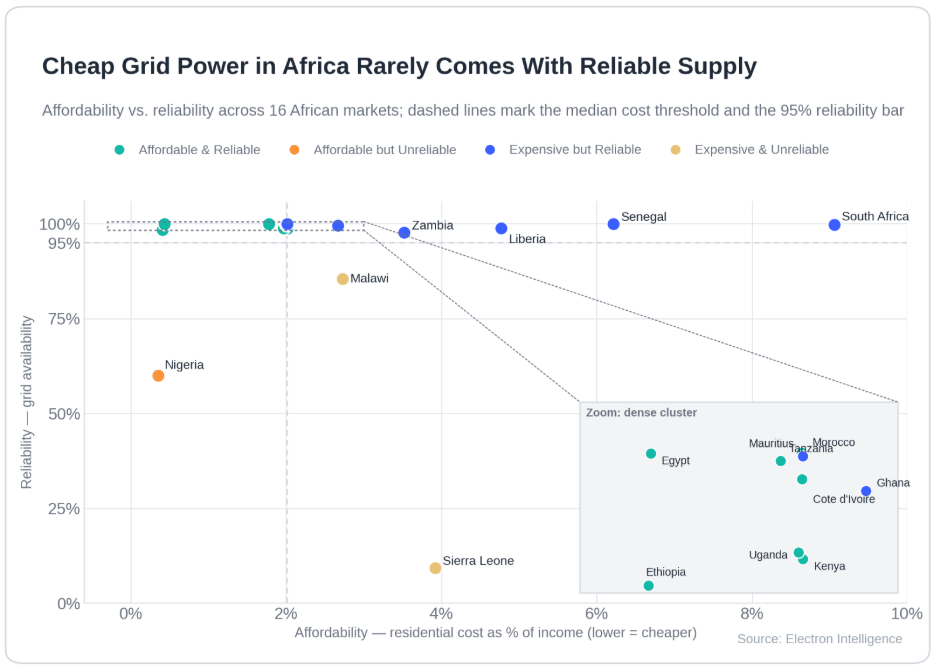
Figure1: Published electricity tariffs and supply reliability do not consistently move together across African power markets.
This divergence changes how electricity markets compare with one another. Some lower-tariff markets continue to offer relatively affordable electricity, while others become considerably more expensive once the cost of unreliable supply is considered. At the same time, several higher-tariff markets remain competitive because more dependable electricity reduces the additional costs consumers incur outside the grid.
Incorporating supply reliability thus produces a different picture of electricity affordability from one based on published tariffs alone. The relative position of several markets changes materially once reliability forms part of the comparison, indicating that electricity prices and electricity affordability no longer move together as closely as published tariffs alone might suggest.
How Unreliable Electricity Is Changing the Cost of Doing Business Across African Markets
Reliable electricity is a fundamental input for commercial and industrial (C&I) activity. Unlike residential consumers, businesses cannot easily absorb prolonged electricity interruptions without disrupting production, reducing output, or increasing operating costs. As a result, electricity reliability has become an increasingly important determinant of business competitiveness across African power markets.
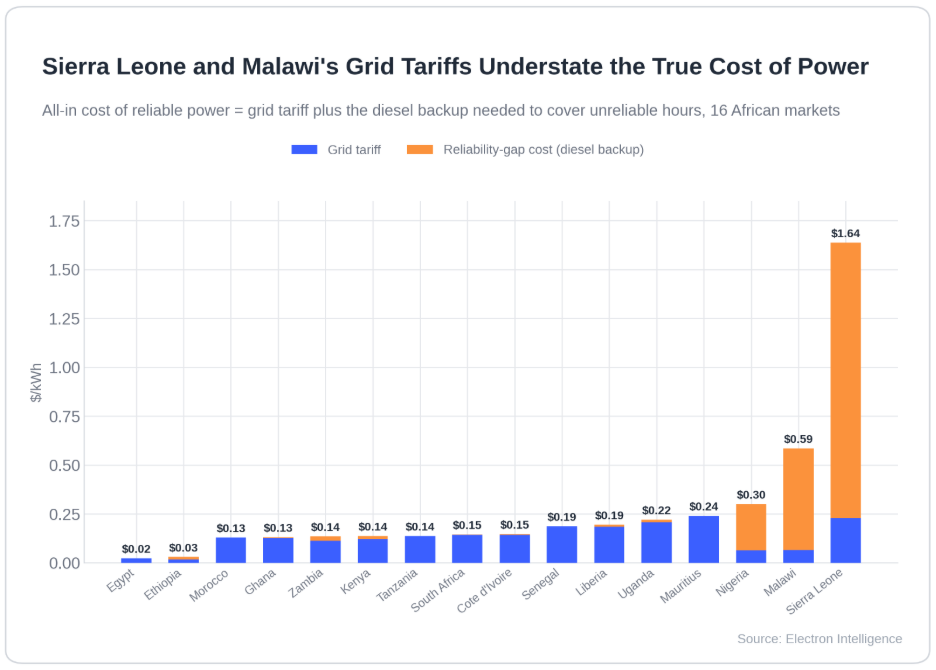
Figure 2: Including the cost of diesel backup substantially changes electricity affordability across several African markets.
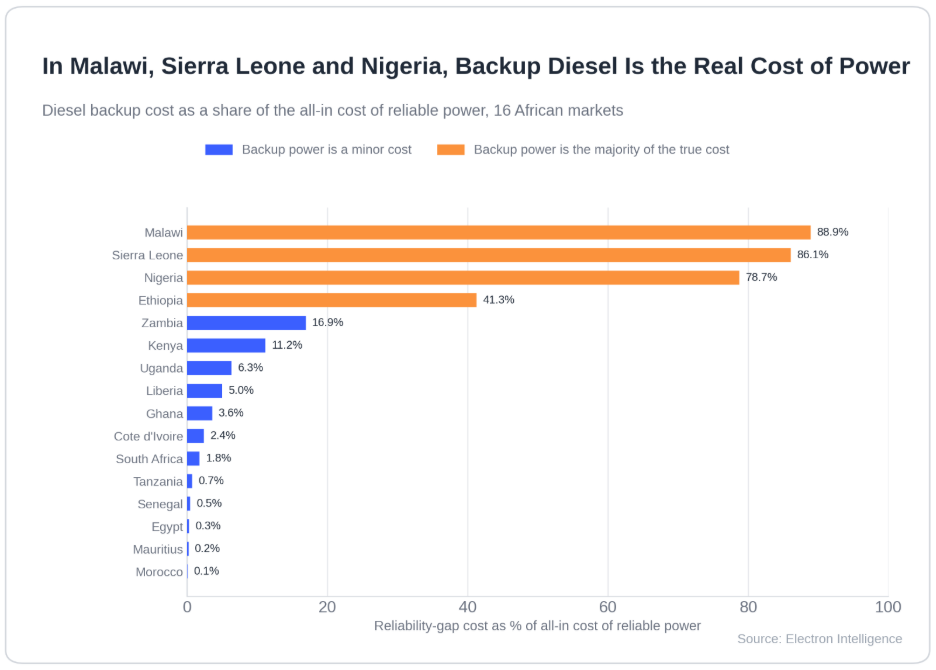
Figure 3: Backup generation accounts for most of the total cost of dependable electricity in Malawi, Sierra Leone and Nigeria, indicating that unreliable grid supply is the primary driver of electricity costs in these markets.
Across much of the continent, unreliable electricity supply has become an unavoidable cost of doing business. Ageing transmission and distribution infrastructure, delayed investment in new generation capacity, financially constrained utilities and fuel supply constraints continue to weaken system performance in several markets. While these challenges differ across countries, they produce a common outcome: businesses increasingly assume responsibility for maintaining dependable electricity themselves.
Nigeria, Malawi and Sierra Leone illustrate the consequences most clearly. Prolonged electricity interruptions have normalised the use of diesel generators across commercial and industrial users, transforming backup generation from an emergency solution into an essential part of day-to-day operations. Published electricity tariffs suggest these markets offer relatively affordable electricity, yet once the cost of maintaining dependable electricity is considered, affordability deteriorates substantially. The gap between tariff-based affordability and the total cost of electricity is considerably wider than in markets where grid supply remains more reliable.
The commercial response has become increasingly consistent across markets experiencing unreliable electricity supply. Backup generation is now planned alongside core production assets rather than treated as contingency infrastructure, while diesel procurement has become a recurring operating expense. For many businesses, the cost of electricity therefore reflects the cost of maintaining continuous operations rather than the tariff charged by the utility alone.
This shift also creates broader economic pressures. Greater reliance on diesel exposes businesses to fuel price volatility, foreign exchange movements and supply chain disruptions, increasing the cost and uncertainty of productive activity. Electricity affordability therefore becomes closely linked to the resilience of the power system itself, rather than the published tariff alone.
Reliable Electricity Supports More Competitive Business Environments
The effect of electricity reliability extends well beyond electricity expenditure. For C&I users, dependable electricity determines how efficiently businesses can operate, expand production and compete. Markets providing continuous electricity supply allow firms to focus investment on productive assets, while businesses operating in unreliable electricity systems must devote a growing share of capital towards maintaining operational continuity.
The contrast between Egypt and Nigeria illustrates these different operating environments. In Egypt, dependable grid electricity enables manufacturers and other industrial users to rely primarily on the public electricity system, allowing investment to support production capacity and business expansion. Nigerian businesses operate under very different conditions. Frequent electricity interruptions require many firms to maintain diesel generators as a permanent part of their operations, increasing capital requirements and diverting resources away from productive investment.
In Ghana, although businesses pay higher electricity tariffs than in several neighboring markets, dependable electricity supply reduces the need for continuous self-generation, allowing firms to operate with greater certainty and lower operational disruption. The result is that electricity supports productive activity more effectively despite the higher published tariff. This reinforces that business competitiveness depends as much on the quality of electricity supply as on its price.
These differences become increasingly important for power-intensive industries such as manufacturing, mining, agro-processing and commercial real estate, where production depends on uninterrupted electricity supply. Businesses located in markets with dependable electricity are better positioned to improve productivity, meet delivery schedules and attract long-term investment. On the other hand, firms operating in unreliable electricity markets must continuously absorb costs that do not increase output but are necessary simply to maintain normal business operations.
Stronger Electricity Systems Deliver More Affordable Electricity
The differences in electricity affordability across African markets reflect more than pricing policies. They also reflect the ability of power systems to deliver electricity consistently. Markets that maintain dependable generation capacity, strengthen transmission networks and improve system performance limit the additional costs consumers incur outside the grid, allowing published tariffs to translate more directly into affordable electricity.
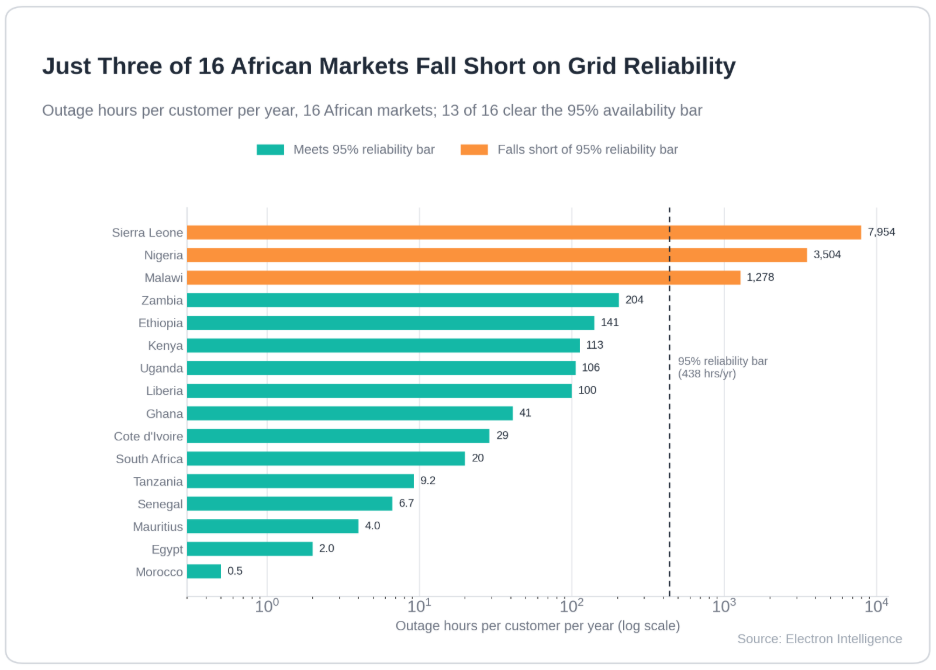
Figure 4: Electricity outages are highly concentrated across three countries in the markets
Egypt and Morocco provide a useful contrast to markets where unreliable electricity has become a business cost. Rather than improving affordability through lower electricity prices, both countries have strengthened system performance through continued investment in generation and network infrastructure. Dependable electricity supply has reduced the need for C&I users to invest heavily in alternative power sources, allowing published tariffs to remain broadly representative of the total cost of electricity.
Improving electricity affordability therefore does not necessarily depend on reducing published tariffs. Investments that expand generation capacity, strengthen transmission infrastructure and improve system operations reduce the need for businesses to rely on costly alternative sources of electricity, allowing a greater proportion of electricity expenditure to remain within the grid. Over time, these improvements enhance the value consumers derive from every unit of electricity purchased, even where tariff structures remain broadly unchanged.
As African power systems continue to expand generation capacity and improve network performance, electricity affordability is likely to become increasingly shaped by system reliability rather than tariff policy alone. For policymakers, this suggests that strengthening electricity infrastructure can deliver affordability gains that extend beyond lower prices, improving the competitiveness of productive sectors while reducing the economic costs associated with unreliable electricity supply.
What We're Watching
Several policy developments could reshape the relationship between electricity prices and affordability across African power markets. Nigeria's planned expansion of cost-reflective electricity tariffs beyond Band A will test whether higher tariffs can be matched by meaningful improvements in electricity reliability.
How countries navigate this trade-off will shape the competitiveness of their electricity markets over the coming decade. The pace of infrastructure investment, improvements in utility performance and the growing role of private sector participation will determine whether electricity systems can become more dependable while keeping the cost of electricity manageable for commercial and industrial users.
Bottom Line
Published electricity tariffs explain only part of the operating environment faced by commercial and industrial users across African power markets. By incorporating the cost of maintaining dependable electricity, this analysis provides a broader measure of electricity affordability that captures the commercial consequences of unreliable supply alongside electricity pricing.
For investors and developers, this does not determine whether one market is more attractive than another. Rather, it provides additional context for understanding the cost structures businesses are likely to face in different markets. In markets where unreliable electricity increases operating costs, those same conditions may also create opportunities for investment in generation, transmission, storage and other solutions that improve electricity reliability.